


Africa CDC Director General, Dr Jean Kaseya, is asking questions with no comfortable answers: why is Kenya being eyed to house America’s Ebola patients, and why has the world waited 19 years to find a cure?
Africa CDC Director General Dr Jean Kaseya is demanding answers from donor nations and Western governments over their handling of the Ebola outbreak in central and east Africa, warning that shrinking funding, punishing travel bans, and decades of neglect on vaccines are costing the continent both lives and economic stability as Kenya finds itself at the centre of a heated row over whether it should house American Ebola patients.
The absence of a vaccine after nearly two decades cuts deepest. During a visit to Bunia in eastern DRC, residents confronted Dr Kaseya directly. “The question they are asking me is, after 19 years of this outbreak, why do we still not have a vaccine? Why do we still not have medicine?” he said.
A local leader told him plainly that had this outbreak struck Europe or the United States, a vaccine would already exist. Dr Kaseya did not disagree. Africa CDC has acknowledged that the Bundibugyo virus was identified nearly two decades ago, and that wealthy nations have historically taken pathogen samples from Africa without ensuring that treatments developed from them were shared back. “We don’t want to beg every time we have an outbreak. We are no longer begging. We are taking action,” he said.
Travel bans have sharpened the frustration further. At least 15 countries, including the United States, Canada, the Bahamas, Jordan, and Bahrain, have imposed restrictions tied to the outbreak, some against countries with no confirmed cases at all.
Dr Kaseya pointed to South Sudan, which has recorded zero cases and zero deaths, as a particularly striking example. “It’s even a shame to see a country like South Sudan with zero cases, zero suspected cases, zero deaths, under travel restrictions,” he said. “The treatment that Western countries are applying to Africa, I will continue to talk about it. It’s not acceptable.”
The 2014- 2016 West Africa outbreak cost an estimated Ksh6.9 trillion in economic damage
The economic stakes are just as stark. Dr Kaseya has been blunt: fighting Ebola fast is cheaper than letting it spread. He pointed to the 2014 to 2016 West Africa outbreak, which cost the region an estimated $53 billion (Ksh6.9 trillion) in total economic damage, roughly the same as losing 12 per cent of the entire region’s annual income in one blow. His case for acting now rests on one striking figure: for every $1 (Ksh129) spent on outbreak response, $7 (Ksh903) comes back in economic value. Waiting, he argues, is the more expensive choice.

Yet funding is disappearing almost as fast as it is pledged. The outbreak was declared a public health emergency of international concern by the World Health Organization (WHO) on May 17, 2026. On Monday, May 25, global commitments stood at $498.8 million (Ksh64.3 billion). By Thursday, May 28, they had dropped to around $290 million (Ksh37.4 billion). The full cost of the response is estimated at $467 million (Ksh60.2 billion), of which $319 million (Ksh41.1 billion) is needed directly in affected countries and $149 million (Ksh19.2 billion) for wider operational support.
“People are dying. How can you keep quiet?” Dr Kaseya asked, directing his frustration at donors who pledged funds and then quietly reversed their commitments. He has given those organisations one week to make good on their promises before he names them publicly. The World Bank and the African Development Bank were singled out for praise for moving money from development budgets to support the response.
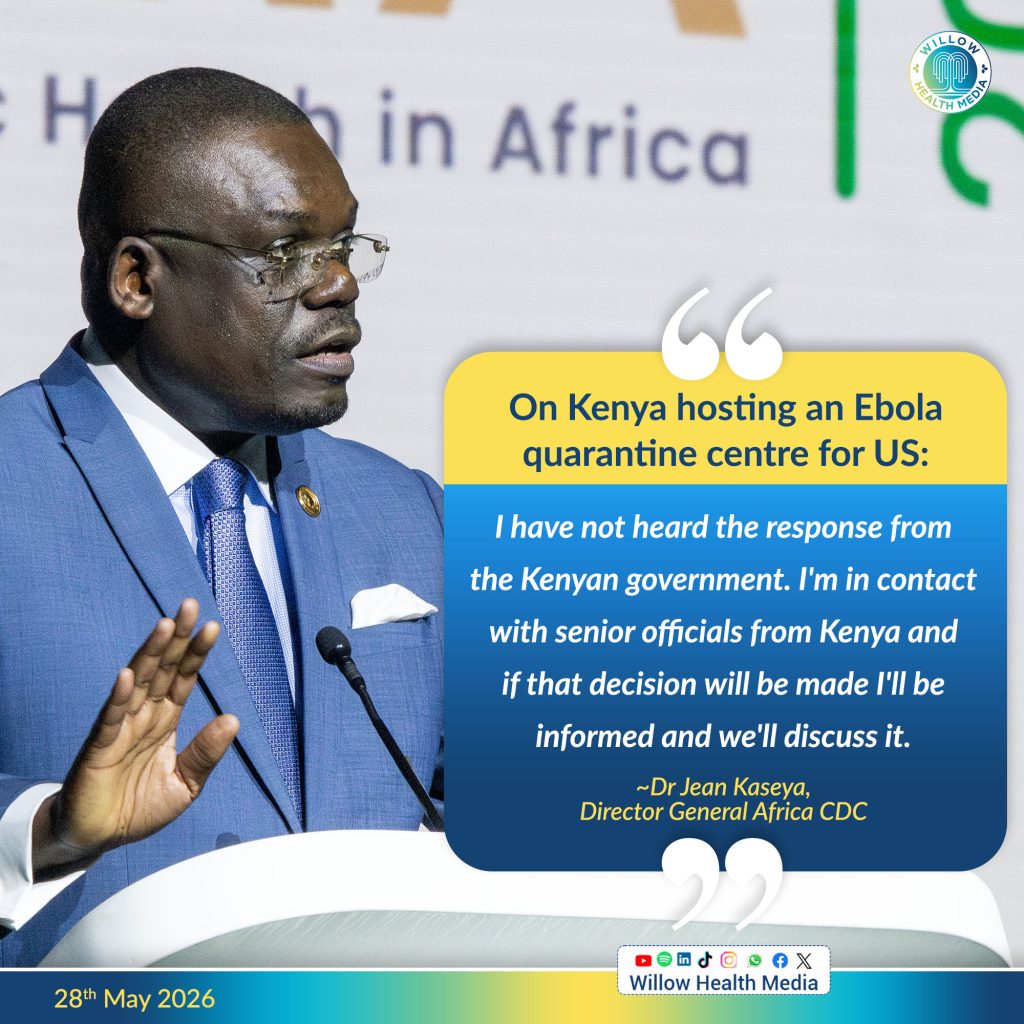
Kenya sits at the heart of another controversy. Reports that the United States wants to send Americans exposed to Ebola to Kenya for quarantine and treatment have divided opinion sharply.
Dr Kaseya has not received formal word from Nairobi on whether it will agree, but he has raised clear concerns about what it could mean for a country already listed as high risk due to its role as a regional travel and medical hub.
He warned that without significant extra resources, adding an international quarantine responsibility on top of Kenya’s existing pressures could stretch the health system dangerously thin.
Kenya’s health system was significantly strengthened during Covid-19- Dr Oluga
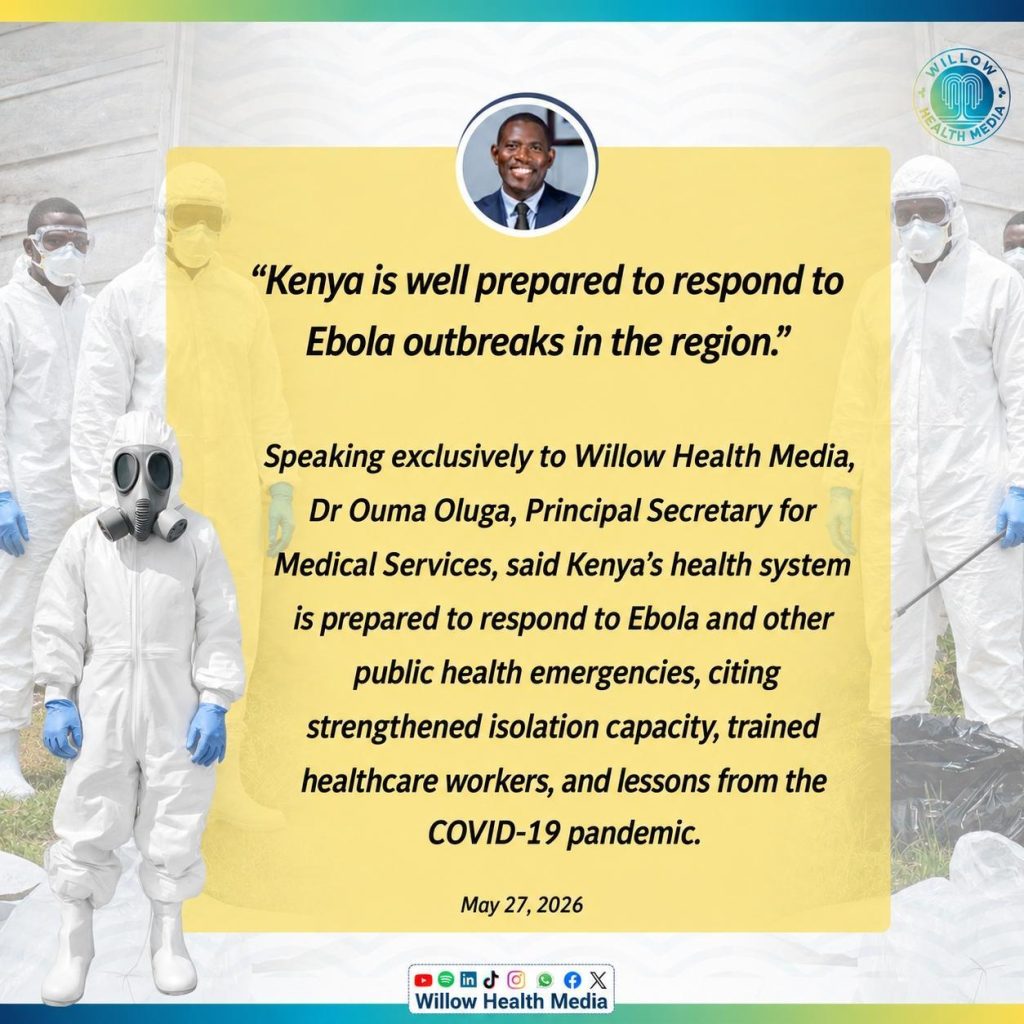
Kenya’s Medical Services Principal Secretary, Dr Ouma Oluga, has pushed back, saying the country is ready, pointing out that Kenya already treats more than 20,000 patients from 13 East African countries every year and that its health system was significantly strengthened during Covid-19. A Kenyan civil society group, Katiba Institute, has filed a court petition seeking to stop the arrangement.
Dr Kaseya has described the outbreak as the second largest in Ebola’s history. A vaccine candidate developed by Russia’s Gamaleya Research Institute is now under technical review by the Africa CDC, built on technology from the 2014 to 2016 West Africa epidemic. Dr Kaseya said Africa CDC aims to have an approved vaccine and treatment for Bundibugyo by the end of 2026.
Dr Ngashi Ngongo of Africa CDC warned that the conditions driving repeated outbreaks have not changed. Mining activity, environmental disruption, and human encroachment on wildlife habitats continue to bring people into contact with animals carrying dangerous viruses. “Once there is human-animal-environment interaction, we will continue to have these outbreaks,” he said.
Dr Kaseya ended with a direct message to communities across the region. “Our commitment will not stop until this outbreak is no longer a threat,” he said.
Graphics by Arthur Mbuguah.
We believe in the free flow of information
Republish our articles for free, online or in print, under Creative Commons licence.