
Kenya’s cataract surgery backlog has reached 360,000 cases, leaving thousands at risk of preventable blindness. Children can be born with cataracts due to infections during pregnancy or genetic factors, while diabetes accelerates the process.
At 75, Ocharo Abdillahi can read again. Six weeks after cataract surgery on his right eye, he no longer needs to close it to make sense of the world. “Before the surgery, when I closed my left eye and tried to read with the right eye, everything was blurry,” he says. “Now when I use the same eye, it is very clear.”
His journey to that moment took more than a decade.
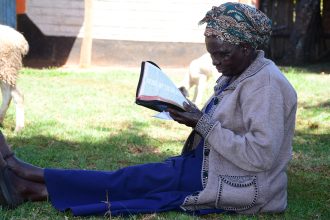
Around 2009 or 2010, Ocharo first noticed what he describes as “a shade” in his right eye. Subtle at first, it did not alarm him. “It was like something was coming into the lens,” he recalls. “Like a shadow.” He visited a doctor, who confirmed a cataract developing deep inside the eye but said surgery was unnecessary until the cataract matured.
Ocharo was given reading glasses and told to return for periodic reviews. “The doctor told me I was lucky because some cataracts grow very fast,” he says. “Mine was not growing, so they said let us wait.”
From 2010 through 2014 and beyond, he attended check-ups. Each visit brought the same news. Eventually, he stopped going regularly, managing instead with his one healthy eye. Then, during Ramadan in 2026, in Mombasa for a medical check-up, he was told the cataract had matured. Surgery was now necessary. “They removed it nicely,” he said.
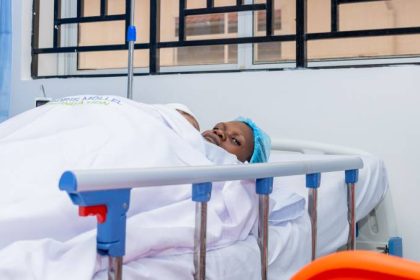
The operation took about an hour. Surgeons removed the cloudy natural lens and replaced it with an artificial intraocular lens. He has started reading slowly without glasses. “Now the vision is becoming clear.”
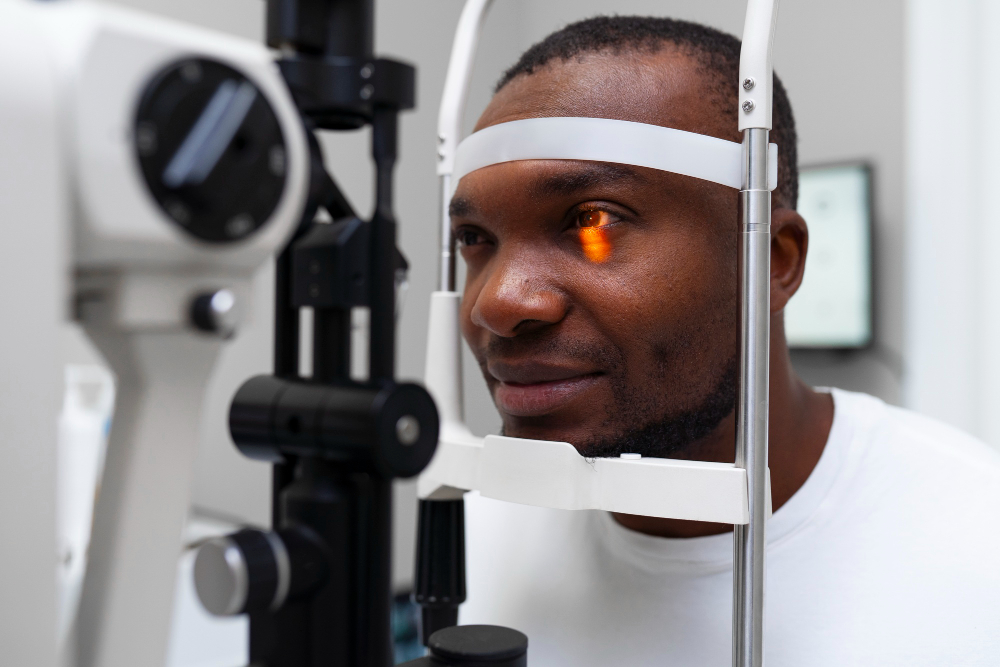
A cataract occurs when the natural lens inside the eye becomes cloudy, preventing light from reaching the retina clearly
His story is far from unusual. Cataracts are among the leading causes of blindness globally and, critically, among the most treatable conditions in medicine.
A cataract occurs when the natural lens inside the eye becomes cloudy, preventing light from reaching the retina clearly. The condition often develops slowly, which is why many people, like Ocharo, live with it for years before seeking treatment.
According to Dr Alain M’bongo, a consultant ophthalmologist and vitreoretinal surgeon at Aga Khan University Hospital, the eye functions much like a camera, relying on a clear lens to focus images. “There is a natural lens in our eye that allows us to see,” he explains. “When that lens turns grey, we call it cataract.”
Early symptoms are often subtle: blurred or dim vision, faded colours and sensitivity to bright light. Night driving frequently becomes difficult because of glare from headlights. “Suddenly they realise the glare at night is very much worse than before when they were driving without too much trouble,” Dr M’bongo says. “That is an early sign that can trigger attention.”
As the condition progresses, everyday activities such as reading, recognising faces, cooking or walking independently can become increasingly difficult. Many patients describe the sensation as looking through a fogged or frosted window.
Ageing is the leading cause globally, as proteins within the lens gradually break down and clump together
There are several types of cataracts, categorised by where the clouding develops. Nuclear cataracts, the most common in older adults, affect the centre of the lens and can initially create a temporary shift towards short-sightedness, making some patients momentarily less reliant on reading glasses. Cortical cataracts affect the outer edges of the lens. Posterior subcapsular cataracts develop at the back of the lens capsule and can progress more quickly. Congenital cataracts affect children and are sometimes visible to the naked eye.
“In congenital cataracts, you can sometimes see the eye appearing white,” Dr M’bongo says. “But in some types, especially subcapsular cataracts, you cannot see them unless you use a microscope.”
Ageing is the leading cause globally, as proteins within the lens gradually break down and clump together. But cataracts are not exclusively a condition of old age. Children can be born with cataracts due to infections during pregnancy or genetic factors. Risk factors also include prolonged sun exposure, smoking, obesity, previous eye injuries and long-term use of corticosteroid medications. Diabetes significantly accelerates the process. “Although cataract is a natural process for adults, when you have diabetes you can have cataract anytime,” Dr M’bongo explains. “It is no longer a matter of ageing.”
Beyond the physical effects, untreated cataracts carry deep social and economic consequences. Vision loss erodes independence, reduces the ability to work and increases dependence on caregivers. In low and middle-income countries, it remains a driver of poverty for individuals and families alike. “If people have their sight, they can continue being economically active,” Dr M’bongo says.
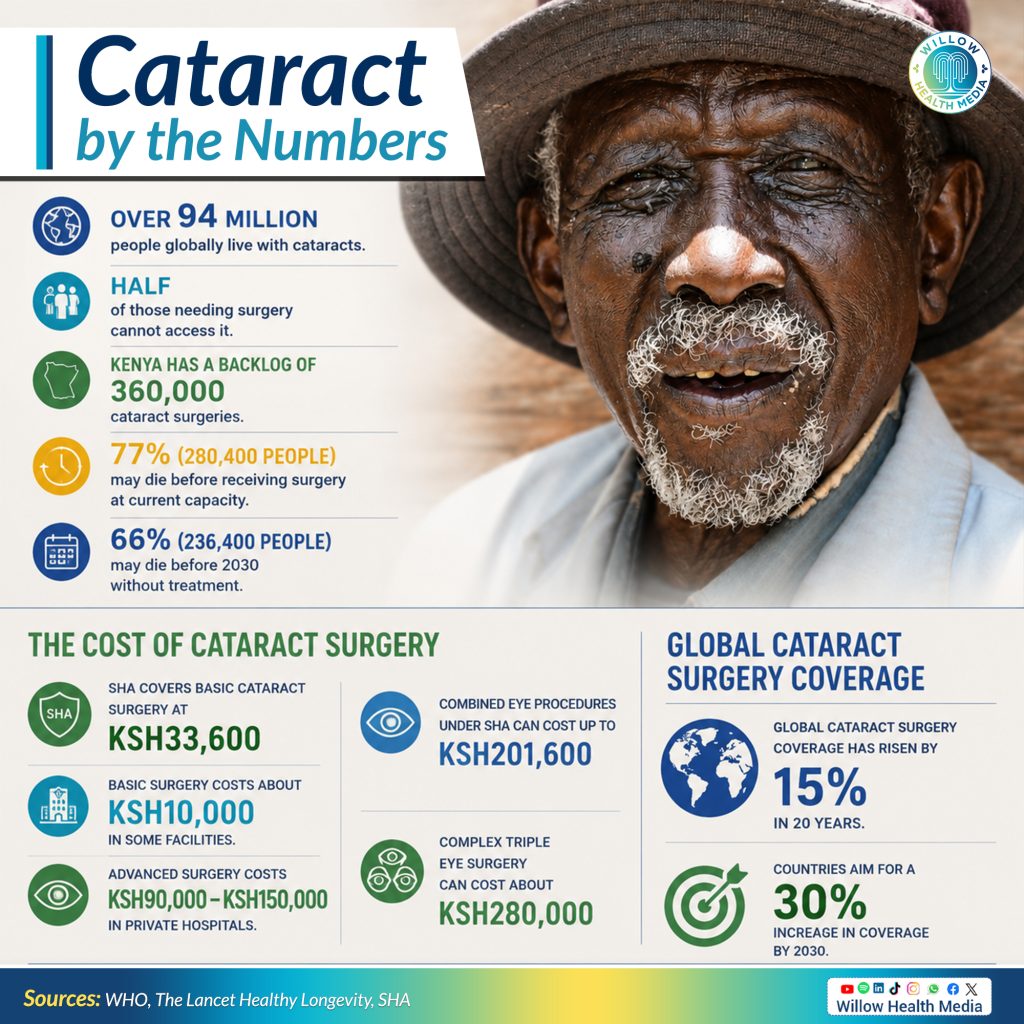
In Kenya, the burden is acute. At current surgical capacity, an estimated 280,400, representing 77 per cent of the 360,000 people on Kenya’s cataract surgery backlog in 2025, will die before receiving surgery, with 236,400 expected to die before 2030. The research, published in The Lancet Healthy Longevity and led by the International Centre for Eye Health at the London School of Hygiene and Tropical Medicine in partnership with Kenya’s Ministry of Health (MoH), also found that for every cataract surgery performed in Kenya between 2025 and 2029, four individuals are expected to die without having received treatment.
Basic cataract can cost Ksh10,000, while using premium technology can reach between Ksh90,000 – Ksh150,000
Globally, the World Health Organization (WHO) estimates that more than 94 million people are affected by cataracts, making it one of the leading causes of preventable blindness in the world. One in every two people requiring cataract surgery still lacks access to the procedure.

The barriers vary. In some areas, there are too few specialists or surgical centres. In others, cost is the primary obstacle. In Kenya, basic cataract procedures can cost as little as Ksh10,000, while modern surgical techniques using premium technology can reach between Ksh90,000 and Ksh150,000 in private facilities.
Under the Social Health Authority (SHA), basic cataract surgery is covered at Ksh33,600, with more complex procedures such as vitrectomy combined with cataract surgery reaching over Ksh200,000, and triple procedures involving corneal transplant and lens implantation potentially exceeding Ksh280,000.
Ocharo paid about Ksh20,000 in cash because his chosen private hospital did not accept SHA coverage. “Not everybody is capable of having good insurance and taking care of the cost of cataract operation,” Dr M’bongo notes.
The PCEA Kikuyu Eye Unit became one of Africa’s foremost referral centres for ophthalmology
Despite the gaps, Kenya has made meaningful progress. Devolution has helped bring specialist eye care closer to more communities, moving it beyond the major urban centres where it was once concentrated. The country also holds a significant place in African ophthalmology history: PCEA Kikuyu Eye Unit, established in 1975, became one of Africa’s foremost referral centres for ophthalmology and has long been recognised for its pioneering work in eye care across East and Central Africa.

Globally, countries have committed to increasing cataract surgical coverage by 30 per cent by 2030. The WHO estimates that surgery coverage has improved by about 15 per cent over the past two decades, but progress remains too slow to close the gap between supply and need.
For Dr M’bongo, cataracts occupy a unique place in medicine precisely because the blindness they cause is reversible at almost any stage. “Nobody should remain blind because of cataract,” he says. “Despite the stage of blindness, it is reversible.”
For Ocharo, that reversal has already begun to reshape daily life. The science to restore sight exists. The remaining question is whether health systems can ensure it reaches everyone who needs it before vision loss and time, run out.
We believe in the free flow of information
Republish our articles for free, online or in print, under Creative Commons licence.