

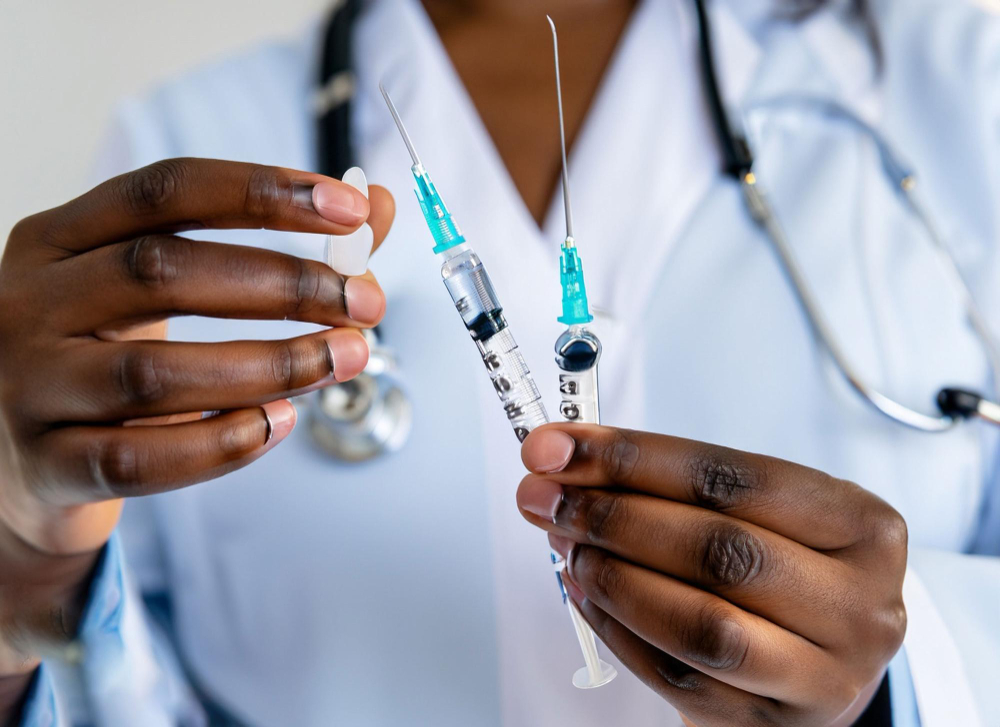

Community health promoters are winning over sceptical families one conversation at a time, even as culture keeps shifting the goalposts.
When her five-month-old son developed a fever and became weak at night, Noreen Chemko knew she needed urgent medical attention for him. Together with her husband, Brian Korir, she took their son, Elian, to Ndhiwa Sub-County Hospital in Homa Bay, where he was diagnosed with severe malaria. “We stayed in the hospital for three days for him to be treated before he was discharged. It wasn’t a nice experience,” she recounted at a malaria awareness event in Homa Bay.
A month later, in September 2019, Chemko heard that the government was rolling out a malaria vaccine for infants at the same hospital, and urged her husband to have their son vaccinated so that he would not have to battle malaria again. The couple agreed, and Elian, who turned seven this year, became the first Kenyan child to receive a malaria vaccine. He has never caught malaria since. His parents also ensured Elian’s younger sibling, now four, received all four vaccine doses, and he too has never had malaria.
Nolyne Boit, Coordinator of Vaccines and Immunisation at the sub-county, said the vaccine had reduced severe malaria cases significantly: “We used to have up to 100 severe malaria admissions in a month; currently we only have at most 20 admissions in a month.” Christine Ong’ete, the County Expanded Immunisation Programme Coordinator in Homa Bay, described the vaccine as a timely intervention, especially in malaria-endemic areas.
In neighbouring Migori County, Sarah Zadock, a mother, told Willow Health Media she does not regret vaccinating her daughter. “Here in Migori, the vaccine is being given freely. My daughter was vaccinated, and I did not see anything wrong. I don’t see any cause for alarm, and I urge parents to take their children for the vaccine, as it is for their good. It is better to prevent or reduce the severity of a disease rather than stay in hospital and spend more,” she said.
Kisumu, Siaya, Homa Bay, Migori, Bungoma, Busia, Kakamega and Vihiga counties were prioritised for the rollout of the RTS,S/AS01 vaccine, with a supplementary rollout later extended to Turkana, targeting high-risk children and refugee settlement zones. Kenya has since transitioned from RTS,S/AS01 to the newer R21 vaccine.
Diseases affecting large numbers of people justify vaccines with lower efficacy
Both vaccines were approved and recommended by the World Health Organization (WHO) after completing phase three clinical trials in 2023. RTS,S showed 55 per cent efficacy in the first year of vaccination, falling to between 36 and 39 per cent over several years without booster doses, while R21 showed efficacy of between 75 and 79 per cent, particularly when administered seasonally, according to WHO.

Dr Moses Masika, a microbiology and immunology expert at the University of Nairobi, explained why a vaccine with comparatively modest efficacy was still approved: diseases affecting very large numbers of people justify vaccines with lower efficacy levels, because even a modest percentage still protects huge numbers of people. “The malaria vaccine’s efficacy level, though lower, was approved because the disease affects millions of children. For example, if the vaccine’s efficacy level is 30 per cent, it means it can protect 300,000 out of one million people from getting or dying from the disease. This is a significant number that must be considered in decision-making during clinical trials,” he explained.
According to the Severe Malaria Observatory (SMO), a global online resource for complicated malaria data, Kenya accounted for an estimated 1.5 per cent of global malaria cases and 1.9 per cent of global malaria deaths in 2024, recording at least 4.2 million cases and 11,656 deaths. The estimated under-five mortality rate stood at about 39 deaths per 1,000 live births that year. Globally, WHO reported an estimated 282 million malaria cases and 610,000 deaths in 2024 across 80 endemic countries, with the African region accounting for 95 per cent of both cases (265 million) and deaths (579,000). Children under five accounted for roughly 75 to 76 per cent of all malaria deaths in Africa.

Despite these figures, vaccines combined with vector control measures, such as insecticide-treated nets, fumigation and chemoprevention, are proving effective in Kenya. In Homa Bay, where over 100,000 children have been vaccinated, malaria infection rates fell from 27 per cent to 3.6 per cent within five years, and malaria hospitalisations dropped by 32,000 across the county, according to the National Vaccines and Immunisation Programme. WHO’s Africa Regional Office (WHO-AFRO) reported that vaccination reduced malaria deaths by 13 per cent in areas where it was administered during a four-year pilot period.
Uptake has not been uniform everywhere. In Vihiga County, the community showed hesitancy when the vaccine was first rolled out in three of five sub-counties, though uptake has since improved. “There was fear among the locals, as people were not sure what to expect, but after seeing good results, vaccine acceptance has improved. The queues in the paediatric clinics have reduced due to declining malaria incidences,” said Edith Anjere, County Expanded Programme on Immunisation coordinator.
My mother, due to cultural, religious beliefs and lack of awareness, did not take me for the BCG vaccine for TB
Florence Owiti, a mother in Homa Bay, said she was unaware of the vaccine because her children are past the eligible age, but her experience with other childhood vaccines has shaped her views on immunisation generally. “Personally, my mother, due to cultural and religious beliefs and lack of awareness, did not take me for the BCG vaccine for tuberculosis, and now I understand the risk the decision came with. That’s why I advocate for vaccines, especially those approved by the government,” she said.
Robert Chisaka, Kakamega County Head of Immunisation, acknowledged that religion and cultural practice are recurring hurdles across all vaccines, not just malaria’s. “We rolled out the malaria vaccine for children in 10 out of 12 sub-counties in Kakamega, and during the initial stages there was a little bit of resistance and hesitancy that slowed uptake,” he said, adding that religious groups opposed to modern medicine showed resistance, requiring the county to engage national government administrators and Community Health Promoters (CHPs) to build and sustain awareness.
“It was a new thing, and people were asking a lot of questions. In Malava sub-county, some groups were resistant, citing their cultural and religious beliefs, but targeted communication through CHPs changed perceptions,” he explained. Improved outcomes in those 10 sub-counties made the vaccine easier to introduce later in Lugari and Likuyani, once it was folded into the routine immunisation schedule administered at six, seven, nine and 24 months, which has reduced cases of incomplete dosing.
That said, dropout remains a challenge nationally. A study published in the National Library of Medicine found that fourth-dose uptake for RTS,S/AS01 dropped to between 24 and 69 per cent, down from 78 to 94 per cent for the first three doses. Ong’ete attributed a fall in uptake from 77 per cent to 32 per cent in Homa Bay to mothers assuming immunisation ended after the measles-rubella shot at nine months, calling for clearer communication.
Chisaka added that hesitancy often peaks during immunisation campaigns, when people question the motive behind them. “CHPs have greatly helped debunk cultural and religious myths that impede not only the uptake of malaria vaccines, but vaccination and treatment of malaria and other diseases in health facilities,” he said.
Leonida Akanda Sikolia, a CHP in Mukuyu village, Lugari sub-county, said convincing mothers to bring infants in for all vaccines, malaria included, still takes work. “There are some cultural and religious beliefs, like praying for the sick and seeking herbal interventions, that affect vaccine uptake. It takes one-on-one conversations between the mothers and us, and targeted follow-ups, to get these families to take their children for immunisation and treatment,” she said.
Other young mothers leave babies with grandparents, reducing probability of clinic-visits
While cultural and religious resistance has gradually eased, Akanda said newer social dynamics are now emerging as concerns. “Teenage mothers are leaving their babies with their grandparents, some of whom are not conversant with immunisation schedules or have not fully embraced modern medicine; hence, children miss out on vaccines,” she said. “Other young mothers leave their babies with their grandparents as they go back to urban areas to look for jobs or get into new relationships, reducing the probability of clinic-visit adherence.”
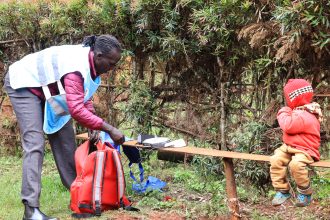
CHPs try to close this gap by flagging such families, conducting regular malaria tests where symptoms arise, and giving older guardians referral forms to the nearest health facility. “We then check the treatment referral forms during our visits to ensure they sought treatment for the babies in public health facilities, and reach out to the parents to ensure they remind guardians about clinic visits,” she explained.
Dr Rose Jalang’o, National Head of the Vaccines Programme, said CHPs remain vital to ensuring children access these vaccines. “Each CHP works an average of two hours a day, serving 100 households and doing about 33 visits every month as the first point of care. They, however, face risks like floods, and strengthening immunisation means investing in the people who make the systems work,” she said during a meeting with Gavi, the Vaccine Alliance, and other stakeholders.
We believe in the free flow of information
Republish our articles for free, online or in print, under Creative Commons licence.