
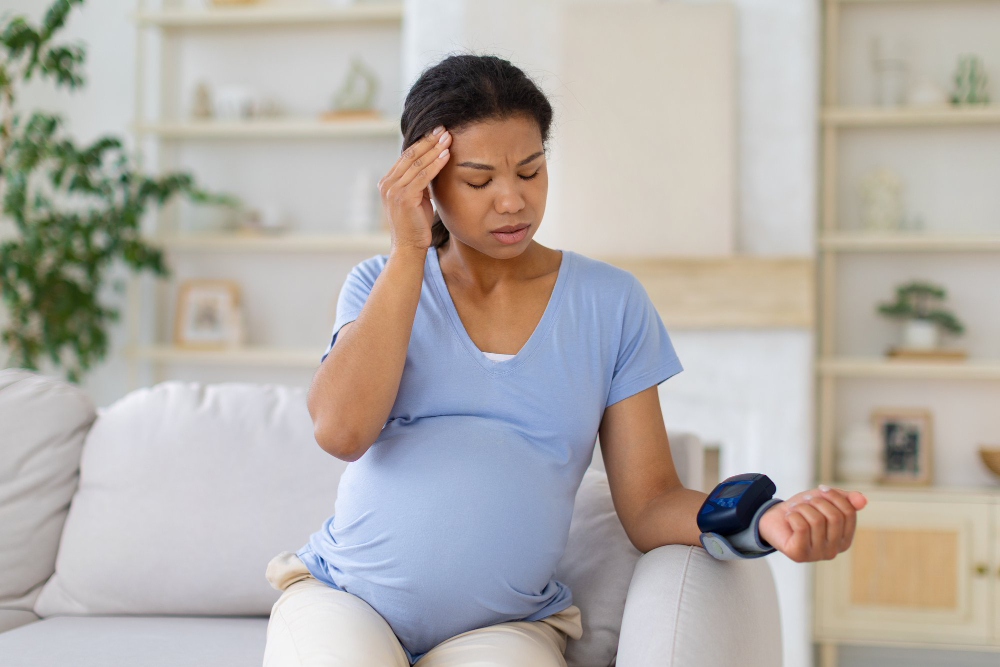

Warning signs of Pre-eclampsia include: severe headache, blurred vision, upper abdominal pain, yellow eyes, breathlessness, and sudden swelling or passing less urine.
In the wee hours of July 2022, Esther walked in, wrung out and heavily pregnant, the hubby supporting her by the left shoulder. Her other hand pressed tightly on the middle of her upper abdomen as she wailed and winced in pain. “Daktari, help! I am dying!” she cried, as her wailing intensified, a sign the pain was worsening.
Esther, 29 weeks pregnant, had been on treatment for peptic ulcer disease. Her pain was, in fact, a warning sign of severe pre-eclampsia, a dangerous rise in blood pressure during pregnancy that soon progressed to eclampsia.

Her case holds a lesson for every expectant mother. From 20 weeks of pregnancy until six weeks after birth, a severe, uncontrollable burning pain in the upper abdomen, between the ribs, should never be ignored. It may signal an impending obstetric catastrophe, placing the life of the mother, her unborn child, or both at risk. Immediate medical evaluation is recommended.
The stakes are high. According to the World Health Organization (WHO), pre-eclampsia affected three to eight per cent of women who gave birth worldwide. Hypertensive disorders, including pre-eclampsia, accounted for a whopping 16 per cent of maternal deaths globally, around 42,000 deaths in 2023. Early antenatal care, preventive treatment, and timely delivery save lives.
Because of the severe pain, Esther could not give a history, so her husband did. She was a mother of two. During her previous pregnancies, she had only been treated for urinary tract infections and peptic ulcer disease. Otherwise, those pregnancies were uneventful.
Esther rolled her eyes and developed uncontrolled body movements
At 10 weeks of this pregnancy, she had been started on omeprazole, a medicine that reduces stomach acidity, and advised to avoid foods that triggered hyperacidity. That worked then. This pain, however, was unlike anything she had experienced: severe and unresponsive to omeprazole.

The nurse attempted to measure her blood pressure twice. Both readings were unrecordable, meaning it was either dangerously low or dangerously high. Given her severe upper abdominal pain and advanced pregnancy, it was the latter. Severe pre-eclampsia rose to the top of our list of possible diagnoses.
Before blood tests and a urinalysis could confirm it, Esther rolled her eyes and developed uncontrolled body movements. The new diagnosis was eclampsia. This called for swift action: controlling the convulsions, lowering the blood pressure, and delivering the baby regardless of gestational age.
Everything went as planned. The baby was delivered by caesarean section and admitted to the newborn unit (NBU) until it could breathe regularly without stopping, breastfeed effectively, and gain weight consistently. The mother was closely monitored. After seven weeks, both were discharged with a clean bill of health.
Pre-eclampsia usually develops after 20 weeks of pregnancy
It is a dangerous condition marked by blood pressure readings of 140/90 mmHg or higher. It usually develops after 20 weeks of pregnancy but can occur up to six weeks after childbirth.
It exists in mild and severe forms. The mild form is silent and, if left untreated, may progress gradually or rapidly to the severe form. Attending all recommended antenatal care (ANC) visits is key to early detection.
Warning signs of severe pre-eclampsia
- A severe headache that does not improve with rest, painkillers or hydration.
- Blurred vision or other changes in vision.
- Persistent upper abdominal pain that is unrelated to hyperacidity and does not improve with heartburn treatment, as in Esther’s case.
- Yellowing of the eyes.
- Difficulty breathing.
- Nausea and vomiting, particularly after 20 weeks.
- Sudden swelling of the face, hands and feet.
- Passing less urine than usual.
The mild form may or may not come with protein in the urine. The severe form, however, presents with these warning signs, which may occur alongside kidney dysfunction, a low platelet count and abnormal liver enzymes.

If severe pre-eclampsia is not managed diligently and on time, it progresses to eclampsia, a life-threatening condition characterised by convulsions.
Not many are as lucky as Esther. Some suffer a stroke, leaving them unable to use parts of their body. Organs such as the kidneys may temporarily stop functioning, requiring dialysis. Worse still, left untreated, it ultimately kills the mother.
The unborn child is never spared either. Its growth is restricted in the womb, so it is born small for gestational age. Because delivery is part of management, babies are born regardless of gestation. A premature birth guarantees NBU admission, as in Esther’s case. In the worst case, they are born dead.
Women at risk include those with chronic hypertension, lupus, diabetes, multiple pregnancies
Low risk factors include pregnancy below 20 years or above 35 years, a first pregnancy, and obesity.

High risk factors include chronic hypertension, a previous history of pre-eclampsia, autoimmune diseases such as antiphospholipid syndrome and lupus, diabetes, multiple pregnancies such as twins or triplets, and molar pregnancies, in which pregnancy hormones are higher than normal for that stage. A family history, especially in a mother or sister, also raises the risk.
Having any of these is not a death sentence. It calls for vigilance, awareness of warning signs, and keeping clinic appointments.
While there is no sure way to prevent pre-eclampsia, certain strategies lower the risk. Early prenatal care includes switching blood pressure medicines to methyldopa, nifedipine, or both, as these are considered safer in pregnancy.
High-risk women are booked into high-risk clinics and have more visits than healthy women
Regular ANC visits allow early detection of high blood pressure and warning signs. High-risk women are booked into high-risk clinics and have more visits than healthy women, as WHO recommends.
Where calcium intake is low, calcium supplements started no later than 16 weeks have been shown to help prevent pre-eclampsia in low-risk mothers. High-risk mothers should also receive 75mg of low-dose aspirin, starting between 11 and 14 weeks and continued until 36 weeks.

Treatment depends on the form. The mild form, with blood pressure of 140/90 mmHg or higher but below 160/110 mmHg and no severe features, requires close monitoring at ANC, with methyldopa, with or without nifedipine, depending on how well the blood pressure responds.
With any severe feature, the goal is to save both mother and child through early delivery and close postpartum monitoring. Eclampsia is managed as in Esther’s case.
In either case, if high blood pressure persists beyond the postpartum period, the mother should be referred to the Medical Outpatient Clinic (MOPC) for long-term management and further investigation.
SHA members access doctors’ consultations, ANC visits, lab tests, obstetric ultrasounds, delivery services
Maternal and child health is more than crucial. A pregnant woman whose Social Health Authority (SHA) contributions are fully paid deserves access to doctors’ consultations, ANC visits, laboratory tests, obstetric ultrasounds, and delivery services, regardless of mode of delivery, at SHA-accredited hospitals.

Pregnant women, those planning to conceive, and their spouses should know these warning signs, as early detection and timely management save lives.
Esther’s case is not a made-up story but what befalls some mothers. The lucky ones survive, while others lose the battle.
Dr Rachel Kerubo is the Resident Medical Officer, Department of Internal Medicine, Nyamira County Referral Hospital.
We believe in the free flow of information
Republish our articles for free, online or in print, under Creative Commons licence.