



A new report says Africa is training more health workers than ever, but many people still cannot access care because too many workers are unemployed, unevenly distributed, or leaving the system.
Africa is producing more health workers than at any point in its history-almost a million-but it cannot employ them, even as millions of patients across the continent remain without basic care. That contradiction sits at the centre of a landmark WHO report launched in Accra on May 6, 2026, at the Second African Health Workforce Investment Forum. The report calls for a fundamental shift in how Africa plans, trains and retains its health workforce, and sets a target of three million additional workers educated, employed, and kept in service over the next decade.

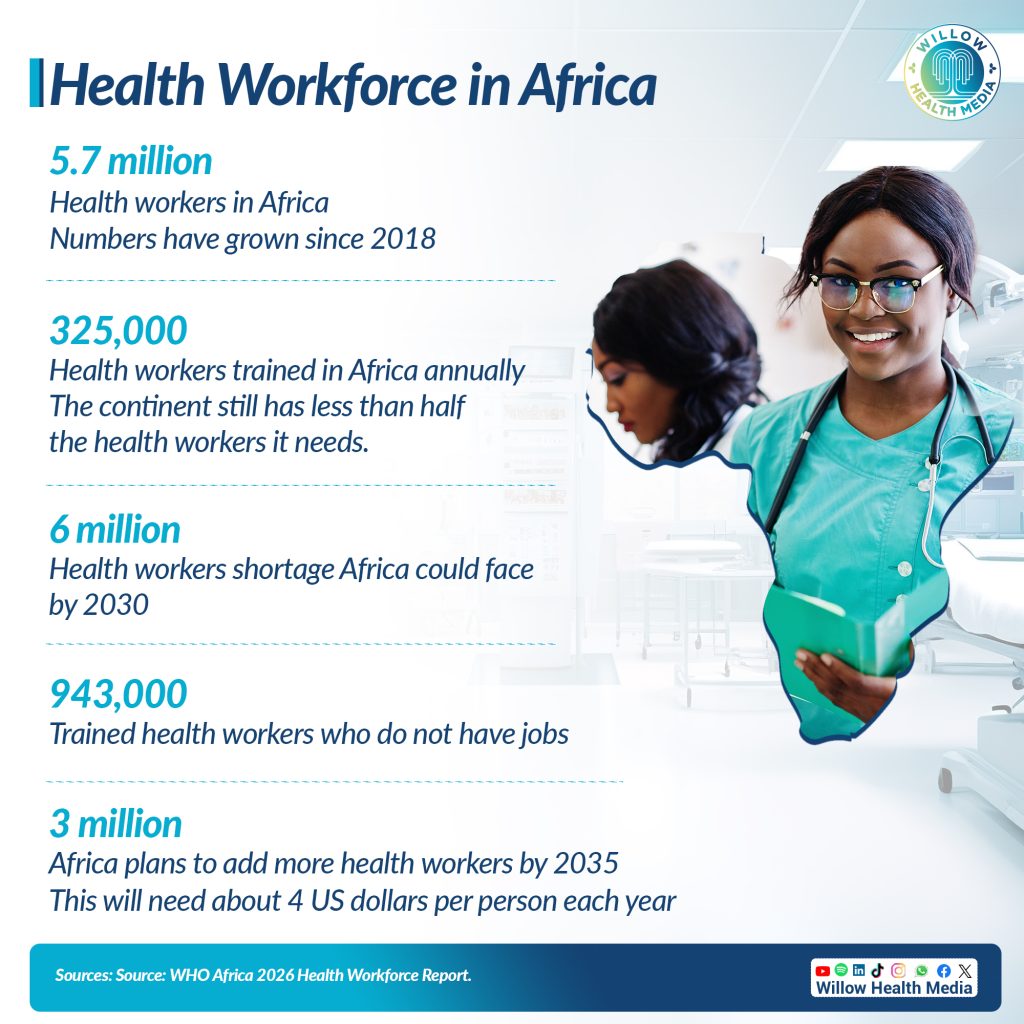
The State of the Health Workforce in Africa 2026: Plan. Train. Retain. found that Africa’s health workforce has grown to 5.72 million in 2024, up from 4.3 million in 2018. Training institutions now number over 4,000 and collectively produce more than 325,000 graduates each year, while health worker density has climbed to nearly 10 per 10,000 people, slightly above pre-Covid levels.
Yet Africa still has only 46 per cent of the health workforce it requires. An estimated 943,000 trained health workers were unemployed in 2024 alone, even as health systems across the continent remain critically understaffed. The projected shortage by 2030 stands at 5.85 million workers, revised down marginally from an earlier estimate of 6.1 million – progress that WHO cautions is fragile and could easily be reversed.
“Africa’s health workforce crisis is no longer defined by scarcity alone, but by systemic failure,” Prof Mohamed Janabi, WHO Regional Director for Africa, told the press briefing. “We are training more health workers than ever before, yet too many remain unemployed while millions go without care. Without bold investment and coordinated reform to plan, train and retain health workers, progress towards universal health coverage will remain out of reach.”
Investing in our health workforce is not just a health priority, but an economic and development imperative
Ghana’s Vice-President, Prof Jane Naana Opoku-Agyemang, who addressed the launch in Accra, said the challenge went beyond health. “Investing in our health workforce is not just a health priority; it is an economic and development imperative. This forum provides a critical platform to turn commitments into action and ensure that every African has access to quality care delivered by a skilled and motivated workforce,” she said.

Dr Janabi was direct about where the focus must shift. “The challenge is no longer just numbers,” he said. “It is about jobs, distribution, quality and retention. We must move from a fragmented approach to a fully integrated strategy to plan, to train, and to retain.”
To address the gap, WHO and its member states have launched the Africa Health Workforce Agenda 2026–2035, a ten-year framework with a clear goal: three million additional health workers educated, employed, and retained across the continent within the decade.
Achieving this will require what Dr Janabi described as a “modest but decisive shift” – an additional four US dollars per capita per year in health workforce investment, or an expansion of workforce budgets by roughly 15 per cent annually. The report argues the investment makes economic sense: every dollar invested in the health workforce can generate up to ten times that amount in direct financial returns, and more than thirty times in broader social and economic benefits.
Kenya, Uganda and Angola have made investments in cardiac care, kidney transplant, and cancer treatment
Dr Janabi drew on personal experience to make the case for targeted spending. He spent 19 years working abroad before returning home, drawn back by incentives that included tax relief on imported goods, free housing, and a decisive government decision in 2012 to invest in Tanzania’s first cardiac catheterisation laboratory.

“That investment, it was two million dollars at the time, saved the country six to ten million dollars every year,” he said. “Because now we were not sending patients outside. Today they are doing wonders.”
The lesson, he argued, is that investing in specialist equipment is also a retention tool. Angola, Kenya, and Uganda have made comparable investments in cardiac care, kidney transplant, and cancer treatment, respectively, each of which has helped anchor specialists who might otherwise have emigrated.
When pressed on how cash-constrained African governments could realistically increase health workforce investment, Dr Janabi’s answer was direct: the priority is to spend more wisely, not simply to spend more.
He outlined concrete measures: ring-fencing three to five per cent of national health budgets for training as a protected line item; shifting from expensive in-person workshops to digital and e-learning platforms; pooling resources regionally through the African Union, Africa CDC, and WHO Africa; and tying requests to external partners, including the Global Fund and Gavi, to workforce development outcomes.
Japan invested in universal health coverage and primary healthcare as far back as 1926
“Africa must rethink, not reduce, training,” he said. “We protect a small, dedicated share of health budgets and use it smarter.”
He also pointed to Japan as a long-term model. Japan invested in universal health coverage and primary healthcare as far back as 1926, achieved full national coverage by 1961, and today has one of the highest life expectancies in the world. “If you want to live longer,” Dr Janabi observed, “move to Japan.”
Dr Francesco Branca, Director of Nutrition and Food Safety at WHO Geneva, speaking on the role of development partners, said support must go beyond funding training to encompass job creation and retention. He pointed to Ghana’s national health workforce investment plan as a model of how clear objectives around training alignment, job creation, and retention can attract and coordinate partner support.
“Not all governments can fund the workforce that they need,” Dr Branca noted. “Partners have a need to support job creation based on standards set by the government, as well as the diversification of financing sources.” He also highlighted health taxes on tobacco and alcohol as a way to generate domestic revenue that can be recycled into disease prevention and workforce development.
The final portion of the briefing addressed an unrelated but pressing matter: a viral outbreak linked to a cruise ship originating in Argentina, which has since spread across more than 23 nationalities, leaving eight confirmed cases and three deaths.
WHO is coordinating a multi-country response under the International Health Regulations framework, rating global risk as low but medium on the vessel itself. One case has emerged in Switzerland, 69 contacts in South Africa are under close monitoring, and three patients have been evacuated from Cabo Verde to the Netherlands for care, with a WHO epidemiologist set to board the ship – still docked in Praia – within hours.
We believe in the free flow of information
Republish our articles for free, online or in print, under Creative Commons licence.