

AI could put critical clinical expertise in the hands of frontline health workers like nurses and CHPs, especially where doctors are scarce in Africa. Nairobi’s Penda Health shows which way the choice could go.
Artificial intelligence could help close some of the world’s deepest health inequalities, but it could also widen the gap between rich and poor if its development and deployment follow existing patterns of inequality, the Gates Foundation’s 2026 Goalkeepers Report warns.
The report, titled Make This Matter: AI, Equity, and the Choice We Can’t Delay, argues that decisions being made now about how AI is built, funded, and deployed will determine who benefits. It says AI must work in the languages people speak, reflect local data and realities, and be backed by investment in health workers and affordable access.
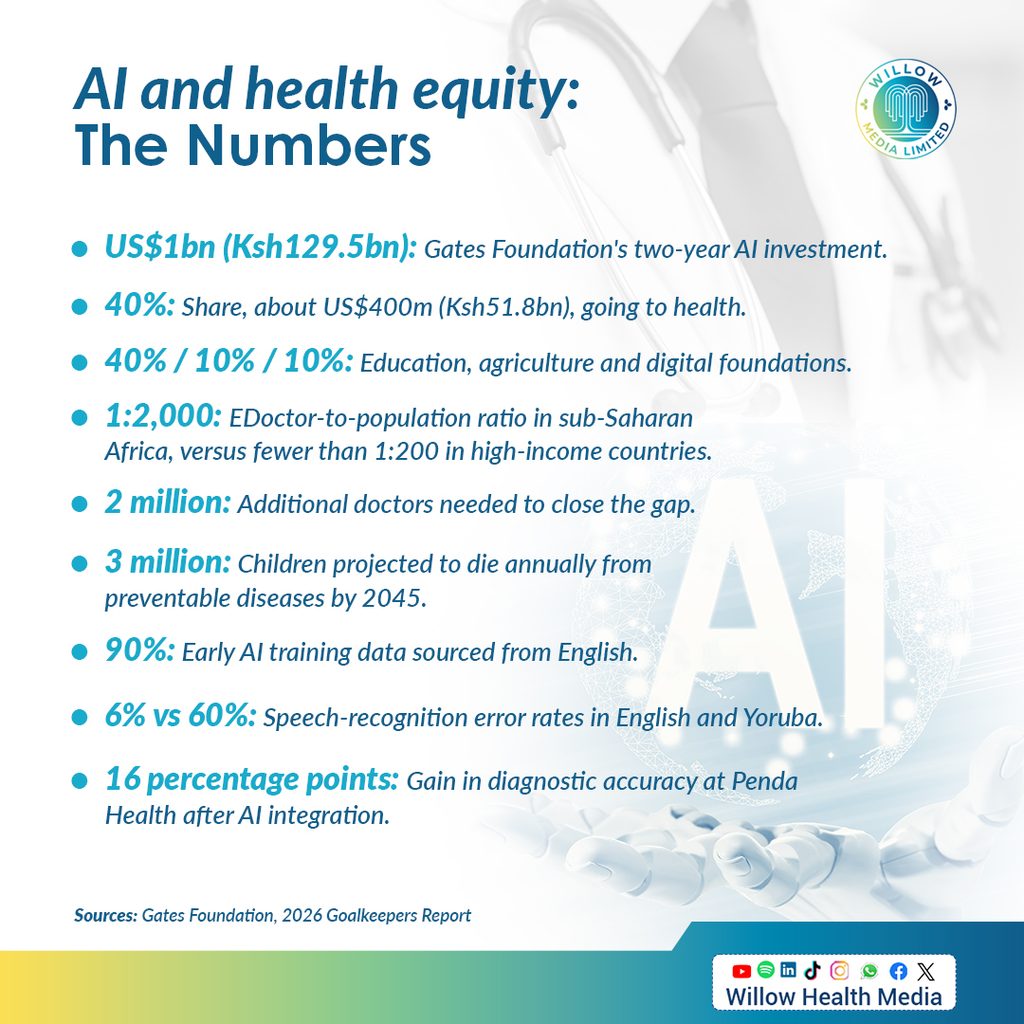
To support that goal, the foundation has announced plans to spend at least $1 billion (Ksh129.5 billion) over the next two years to expand access to AI and AI-enabled solutions, opportunities and knowledge. About 40 per cent, roughly $400 million (Ksh51.8 billion), is earmarked for healthcare.
The stakes are high. Health and opportunity gaps between the world’s richest and poorest populations are projected to remain wide unless there is significant change. By 2045, more than three million children are still projected to die each year from preventable diseases, while nearly 900 million people could remain in extreme poverty.
Kenya features in the report through Penda Health, a network of affordable primary-care clinics in Nairobi, where AI-supported consultations have improved diagnostic accuracy by 16 percentage points.
Community health workers are first to decide whether a fever can be managed at home, yet they have no access to tests
The report presents AI as a tool for extending scarce expertise to people with limited access to healthcare. It stresses, however, that technology alone will not automatically produce greater equity.
It illustrates the challenge through Gaudence Ngendahayo, a community health worker in Rwanda who is often the first person families turn to when someone falls sick. She decides whether a fever can be managed at home, whether a child may be in danger, and whether a patient needs care beyond what she can provide. Yet she often makes these decisions without immediate access to the tests, doctors and medicines available in better-equipped facilities.

“An AI-enabled phone could give frontline health workers timely clinical support, help them recognise early warning signs, identify patients who need urgent referral, make better-informed decisions and anticipate medicine shortages, ultimately bringing critical healthcare expertise closer to patients, especially in communities where doctors and specialists are scarce,” Gates says.
Such tools could also connect information gathered from individual patients to wider health-system knowledge.
The report is clear that AI should support health workers, not replace them. “There are only so many doctors, teachers, and advisors in the world,” notes the Gates report, arguing that AI could give frontline professionals more support while keeping human judgement and care central.
Closing health-worker gap needs over two million doctors, but AI-enabled tools can help bridge the gap
The shortage of health workers in sub-Saharan Africa is one reason AI could play a significant role. The report estimates that one doctor in the region serves roughly 2,000 people, compared with fewer than 200 people per doctor in high-income countries.
“Closing the health-worker gap through additional doctors alone would require more than two million doctors,” the report says. “Training more health workers remains essential, but patients cannot wait for the workforce gap to disappear.”

It therefore proposes strengthening nurses, community health workers and other frontline providers by giving them access to information and expertise through AI-enabled tools. Beyond diagnosis, these could guide decisions on referrals and treatment, bringing knowledge otherwise unavailable in remote or low-resource settings.
But promising tools must move beyond demonstrations and pilots before they can be trusted at scale. They need to work on ordinary phones, in the languages people speak and in the environments where health decisions actually occur.
Language is one of the biggest obstacles to equitable AI. More than 90 per cent of the data used to train early large language models came from English-language sources, leaving many communities poorly represented.
For AI to advance health equity in Africa, systems must understand the languages, dialects, accents and expressions people use
In healthcare, the consequences can be serious. Leading speech-recognition systems make errors less than six percent of the time in English but more than 60 per cent of the time in Yoruba.
In Malawi, a woman in labour speaking Chichewa may say her “water has broken”. A direct translation into English could produce a meaningless interpretation, and in an emergency, the report argues, such a misunderstanding could affect whether she receives timely medical advice.
For AI to advance health equity in Africa, systems must understand the languages, dialects, accents, and expressions people actually use. That requires investment in local-language datasets and evaluations designed around real-world use.
Language is only part of the challenge. “AI tools must reflect local realities, including the diseases affecting a population, the treatments available within its health system and the conditions in which health workers make decisions,” the report says.
A community health worker examining a child with fever in Rwanda faces different questions from a clinician in a well-resourced hospital, and the AI supporting each must reflect those differences. The report describes this as both a data and a design challenge.
At Penda Health, AI is built directly into clinical consultations, giving clinicians real-time guidance on diagnosis, dosing and when to escalate care
It calls for collecting local health records and other relevant information from the populations the tools are meant to serve. Countries and communities should also help decide how their data is stored, shared and protected, and with whom. This, the report argues, is essential if AI is to reduce rather than reproduce existing inequalities.
At Penda Health, AI is built directly into clinical consultations, giving clinicians real-time guidance on diagnosis, drug dosing and when to escalate care. The clinician remains responsible for deciding whether and how to act on its suggestions.
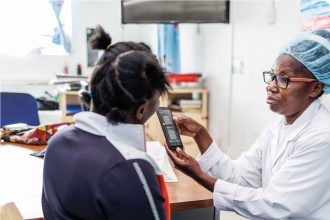
The report presents the 16-percentage-point improvement in diagnostic accuracy as evidence of what happens when AI is designed around frontline workers rather than developed as a general technology. It lists Penda Health alongside AI applications in education and agriculture already showing measurable results.
The foundation’s healthcare funding will support AI-enabled diagnostics and clinical decision-making tools for frontline health workers, maternal and newborn care technologies, and the discovery of new drugs and vaccines.
Another 40 per cent will go to education, including AI tutoring and teaching tools. Agriculture will receive 10 per cent, including tools that give smallholder farmers advice tailored to their soil, weather and crops. The remaining 10 per cent will build the digital foundation for equitable AI, including datasets in languages current systems do not adequately understand.
The people with the greatest needs often have the least power to shape where innovation and investment go
Doctors, nurses, community health workers, policymakers, technologists and data scientists also need opportunities to understand, evaluate and adapt AI tools to their own settings. Because access to AI models and computing remains concentrated in wealthier countries, the report says closing the gap will require lower prices, commitments from technology companies and investment from governments and philanthropy.
“The Gates Foundation was created in part to address a basic market failure: the people with the greatest needs often have the least power to shape where innovation and investment go,” notes the Gates report. “AI presents the same challenge, only at much greater speed.”

He warns that if AI is left entirely to market forces, the most capable tools could be built first for those able to pay rather than for communities that could benefit most.
For the foundation, the central question is not simply what AI can do, but who gets access to it, whose data and languages shape it, and whether it works where the need is greatest. “AI could follow a familiar pattern in which people with the most resources benefit first, leaving underserved communities behind as technology advances,” the report says. “If deliberately designed around underserved communities, AI could extend knowledge, expertise and opportunity to people historically left behind by previous technology revolutions.”
Equitable AI, the report concludes, will require more than powerful algorithms. It will require local data, inclusive language systems, investment in health workers and affordable access.