



A little-understood condition is weakening and killing mothers across Africa during and after childbirth. In Kenya, many of those deaths are recorded as something else entirely.
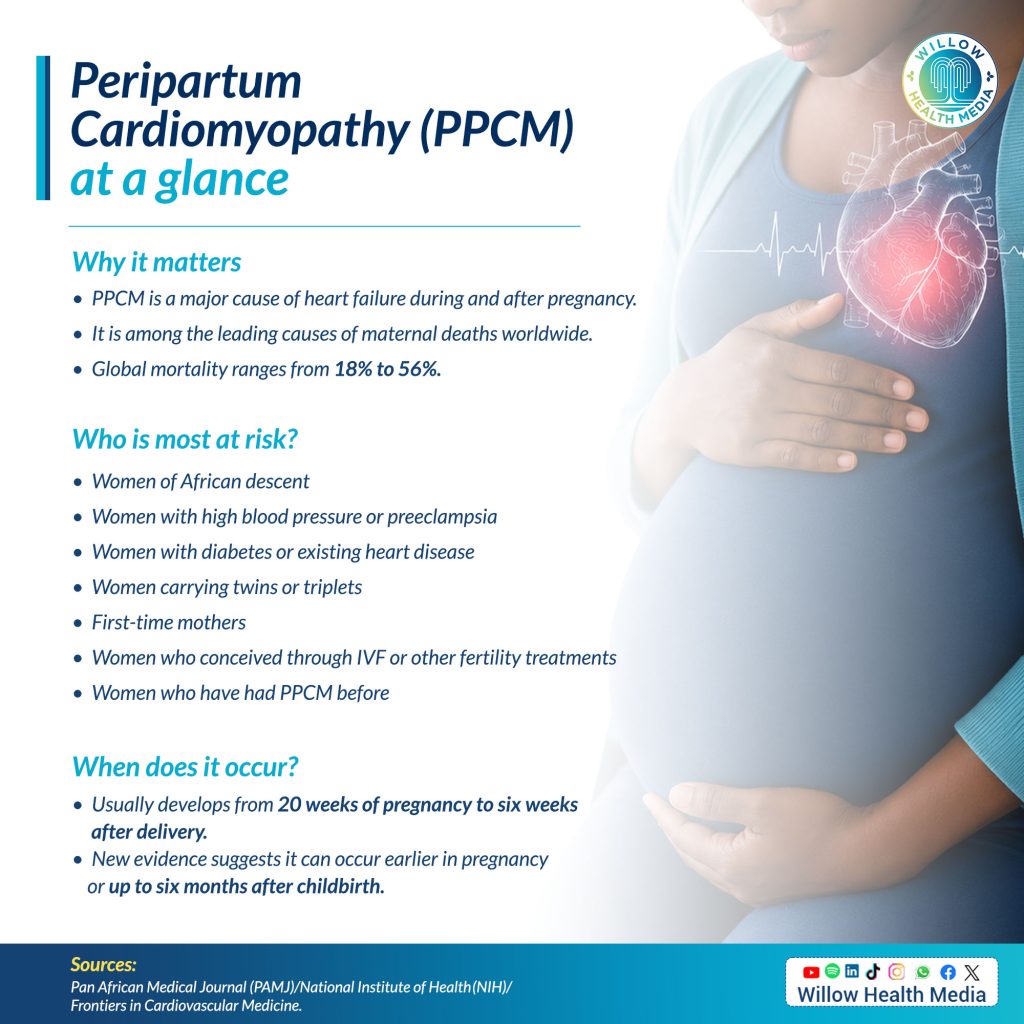
Pregnancy can trigger a serious and potentially life-threatening heart condition that is frequently mistaken for normal discomfort, goes undiagnosed until it becomes severe and carries a global mortality rate of between 18 and 56 per cent. Peripartum cardiomyopathy (PPCM), a form of heart failure that develops during late pregnancy or shortly after childbirth, has emerged as one of the leading causes of pregnancy-related maternal deaths worldwide, particularly among women of African descent. Experts say many of those deaths are preventable if the warning signs are caught in time.

PPCM weakens the heart muscle, reducing its ability to pump blood effectively throughout the body. Dr Yubrine Moraa, a consultant cardiologist, explains that the condition is traditionally defined as heart failure developing between 20 weeks of pregnancy and six weeks after delivery.
“It is called peripartum because it is associated with the duration of pregnancy and typically would start from 20 weeks of pregnancy until when we presume that pregnancy is over, which is about six weeks after delivery,” she says.
However, understanding of the condition is shifting. A 2025 review published by the National Institutes of Health (NIH) suggests PPCM can begin earlier in pregnancy or emerge several months after childbirth. Some specialists now argue the postpartum monitoring window should extend to six months, underscoring the need for continued observation of mothers well beyond delivery.
Why it is so hard to spot
One of the greatest challenges in addressing PPCM is that its symptoms closely resemble the normal discomforts of pregnancy, causing many women to delay seeking care until the condition becomes severe.
Women with PPCM may experience shortness of breath, fatigue and extreme exhaustion, swelling of the feet and ankles, chest pain, a persistent dry cough, dizziness and heart palpitations. Because these overlap with common pregnancy complaints, both women and healthcare workers can miss the signs.

Dr Moraa warns that symptoms should never be dismissed simply because a woman is pregnant. “Someone just walks a small distance, and they can barely move because when they walk, they sweat a lot because the heart is not able to do its normal function. What I tell women particularly is that if you have shortness of breath when you’re pregnant, don’t underrate it,” she says.
Diagnosis is further complicated by the need to rule out other conditions. Coronary artery disease, congenital heart disease and complications from severe hypertension can produce similar symptoms. “It is a diagnosis that you have to exclude other causes because we know there are other causes that can cause heart failure,” says Dr Moraa.
What causes it
The exact cause of PPCM remains unknown. Researchers believe a combination of hormonal, inflammatory, genetic and vascular factors may contribute. One leading theory centres on prolactin, a hormone of pregnancy. “We really don’t know, but we have postulates and hypotheses of why it could be happening. We think some of the hormones of pregnancy, including prolactin, could be related to why the heart muscle becomes weak,” Dr Moraa explains.

Some women may also carry an underlying genetic predisposition to heart disease that only becomes apparent when pregnancy places additional stress on the heart. “Sometimes there was already a problem that was genetic. The woman already had a genetic risk of developing heart failure later in life, but pregnancy puts a bit of stress on the heart muscle, and then it comes up,” she says.
While PPCM can affect any pregnant woman, certain groups face a significantly higher risk. Being of African descent is among the strongest recognised risk factors. Others include preeclampsia, chronic hypertension, diabetes, pre-existing cardiovascular disease, multiple pregnancies such as twins or triplets, first-time pregnancies, fertility treatments such as IVF and a previous diagnosis of PPCM.
A condition that hits Africa hardest
Studies consistently show that PPCM is more common in Africa than in most other regions. According to a 2025 NIH study, the estimated incidence in the United States is approximately one case per 4,000 live births. In contrast, rates in some high-burden regions of Nigeria reach one case per 100 live births. Research published in Frontiers in Cardiovascular Medicine in 2025 identifies PPCM as one of the leading causes of pregnancy-related maternal mortality across the continent.

The condition is also significantly more common among women of African ancestry regardless of where they live, suggesting that both genetic and environmental factors are involved.
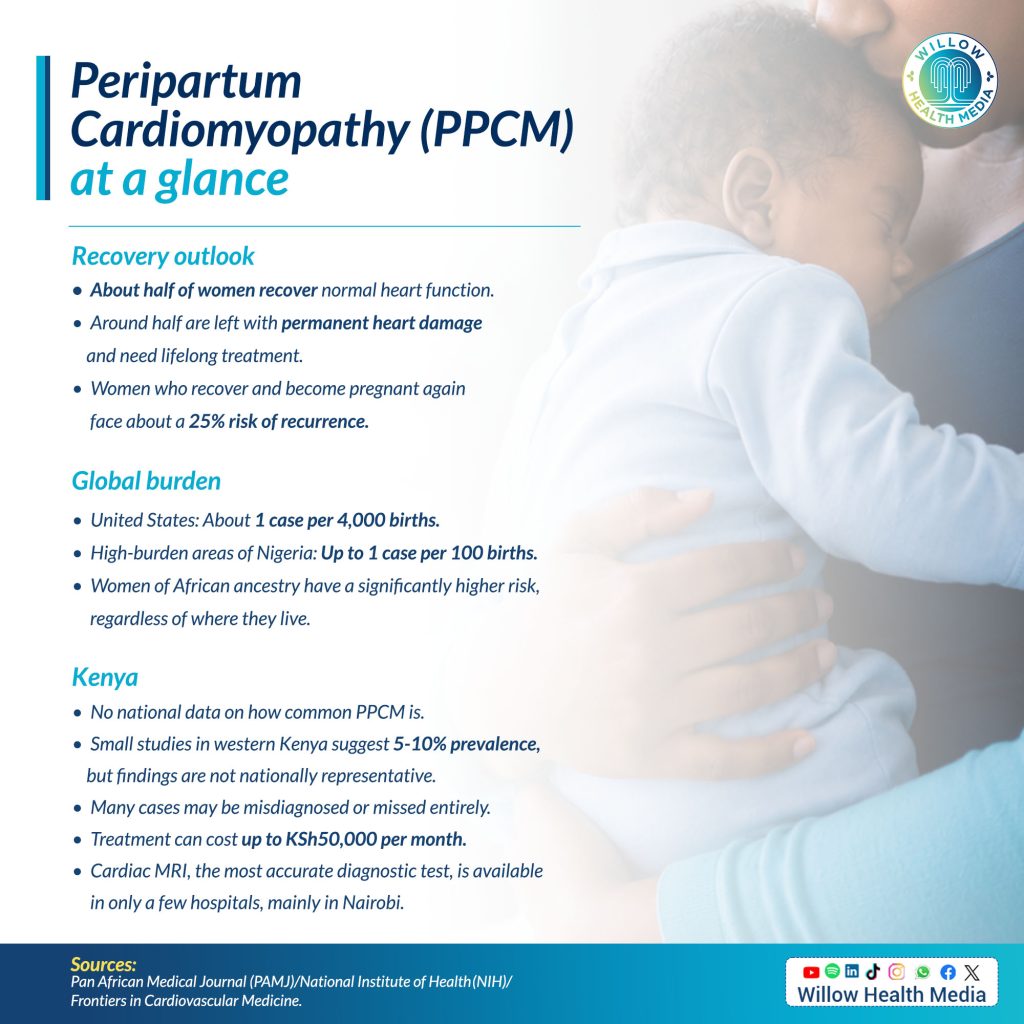
In Kenya, the true burden remains uncertain. “We don’t have exact numbers,” says Dr Moraa. “Some local studies, particularly in western Kenya, have suggested figures between five and ten per cent, but these are not true representations because we have not mapped our country well.” She believes many cases go undiagnosed or are incorrectly attributed to other causes of maternal death. “A lot of times these women die and we attribute maternal mortality to other things. Maybe we just miss them.”
Diagnosis and treatment
The cornerstone of diagnosis is an echocardiogram, an ultrasound scan that assesses the structure and pumping function of the heart. Additional tests may include blood tests, electrocardiograms, chest imaging and cardiac MRI. Dr Moraa notes that MRI provides the most detailed assessment of heart muscle disease, but availability remains limited in Kenya, with services concentrated in a small number of hospitals, mainly in Nairobi.
Treating PPCM requires a delicate balance between protecting the mother’s heart and ensuring the safety of the unborn baby. Many standard heart failure medications cannot be used during pregnancy because they may harm the fetus. “It is a very challenging time because most of the drugs we normally use are contraindicated in pregnancy. We always have to keep to only a few that we can safely use,” says Dr Moraa.
One medication attracting growing interest is bromocriptine, which suppresses prolactin production. “There is one specific drug called bromocriptine that we’ve tried because it can block that hormone called prolactin,” she notes. Treatment generally focuses on helping the heart pump more efficiently while reducing strain on the cardiovascular system.
Recovery, recurrence and cost
Approximately half of affected women recover normal heart function after pregnancy. “I’ll say 50 per cent of women tend to heal after pregnancy if it was just because of the pregnancy,” says Dr Moraa.

However, recovery does not eliminate future risk. Women who become pregnant again face a 25 per cent chance of recurrence. For the remaining 50 per cent of patients, the damage may be permanent. “They remain with the cardiomyopathy, and it means it is something we’ll have to treat for life,” she says.
Beyond the health consequences, PPCM imposes substantial financial strain. Management requires repeated clinic visits, regular echocardiograms, laboratory investigations and, in some cases, hospital admissions. Dr Moraa estimates monthly care costs can reach approximately Ksh50,000. “If someone gets the diagnosis at 20 weeks, that’s a very long time. There may be admissions as the pregnancy grows because the heart becomes overwhelmed,” she explains.
The case for earlier action
Experts say many PPCM deaths could be prevented through earlier recognition. Routine screening is not currently standard practice in most antenatal and postnatal clinics.

Dr Moraa believes maternal health education materials should be updated to include warning signs of heart failure. “We need to include shortness of breath. We need to include becoming very breathless when lying flat. These things are very important and should be picked up early.”
For expectant and new mothers, awareness may be the most powerful tool available. Severe breathlessness, persistent swelling, overwhelming fatigue, chest discomfort or palpitations should never be dismissed as simply part of pregnancy. Recognising these warning signs early could mean the difference between recovery and a life-threatening emergency.
We believe in the free flow of information
Republish our articles for free, online or in print, under Creative Commons licence.