

Fifteen years of data now show that for Kenya’s youth, the greatest barrier to critical healthcare was never simply access, it was timing; a fleeting window that can close within minutes and once lost, rarely reopens.
It is 2:17 a.m. and 19-year-old college student *Anne (not her real name) is still awake, blanket pulled up, phone screen dimmed so no one notices the light. She has missed her period. The internet has offered a dozen conflicting answers, and the clinic she might have called shut its doors hours ago. Her parents are out of the question; her friends are asleep.
For the first time since morning, Anne has something rare: privacy. She types the question she has been rehearsing for hours. “I think I’m pregnant, what should I do?”
Across Kenya, thousands of young people like Anne reach for their phones at hours like these, not because crises wait for nightfall, but because darkness offers something daytime rarely does: anonymity and freedom from judgment.

Shujaaz Inc. has spent more than 15 years learning to listen for moments like hers. The organisation built its name on comic books, radio, television and social media, turning relatable stories into openings for young Kenyans to talk about health, livelihoods and relationships. But mass communication, it discovered, could only go so far.
“We’ve always been speaking to young people through mass media,” says Paul Gitonga, Shujaaz’s Manager of Knowledge and Learning. “But we came to find the power of segmentation, so that we don’t have one blanket message or one blanket story targeted to every young person.”
That realisation led to Sema na Me, a WhatsApp chatbot built to give young Kenyans accurate health information and referrals to youth-friendly services, one conversation at a time.
“The engagement has happened on social media, but they want to take it a step further. They want to arrive at a resolution to their problem. Maybe they’re scared about a pregnancy. Maybe they’re facing abuse. We created the chatbot so young people can feel safe talking in a safe space, one-on-one,” Gitonga says.
One in every three of nighttime conversations is a crisis: a pregnancy scare, sexual violence, severe emotional distress, or thoughts of suicide
What the platform’s data revealed, though, went beyond a design choice. Some 60 per cent of conversations on Sema na Me happen between 10 p.m. and 5 a.m., hours when Kenya’s clinics, counselling services and support systems have already closed for the night. One in every three of those nighttime conversations is a crisis: a pregnancy scare, sexual violence, severe emotional distress, or thoughts of suicide.

For Jidraph Njoroge, Tech Lead at Shujaaz Inc., that pattern upended assumptions the organisation didn’t know it was making.
“When we started looking at the data, the aspect of when our audience would be actively engaged had not surfaced,” he says. “Once we reached a critical mass, we realised our service providers were operating business hours, but our users were operating between 10 p.m. and 3 a.m.”
The mismatch came at a cost. Referrals were often issued at night, but by the time partner organisations called back the next morning, many young people had already moved on.
“Somebody was referred at 11 p.m., then by 9 a.m. the partner was trying to do the callbacks. What we realised was that there was a big decline. By the time the partner was actually reaching out, either they (youth) were busy in class, or they had already moved on past their need,” Njoroge explains.
It is a problem bigger than one platform. For decades, Kenya has expanded youth-friendly clinics, contraceptive access and health education, but nearly always around the operating hours of the facilities delivering them, not the behaviour of the young people they serve.
Partner organisations recorded a 20-30% rise in uptake of sexual and reproductive health services linked to the platform’s referrals
Shujaaz data suggests the barrier was never simply access; it was timing, a window that can close in minutes and rarely reopens once it does. That window matters more than the numbers alone suggest.
In its first year, Sema na Me engaged 5,528 young people and generated 2,576 referrals to youth-friendly health providers, a 46.6 per cent conversion rate. More than 500 users later reported visiting a health facility, and partner organisations independently recorded a 20 to 30 per cent rise in uptake of sexual and reproductive health services linked to the platform’s referrals.
Each of those 500-plus visits is evidence that timing, not willingness, was the barrier all along: a young person who reached out at 1 a.m. or 3 a.m. and, unlike so many others, was still connected to care by the time it counted. Users self-report whether they followed up, while partners track service trends separately, an approach that measures impact without collecting personal data.
That approach, quick, anonymous, human where it matters, is where artificial intelligence (AI) does its most important work: not replacing care, but bridging to it. Trained on years of Shujaaz’s youth engagement, the chatbot answers immediately in familiar, non-judgemental language before referring users to accredited providers when necessary.

High-risk conversations involving suicide, sexual violence or medical emergencies are prioritised for immediate referral, with trained professionals kept central to the response. The goal was never to replace them.
“We’ve expertly managed that conversation up to there, but for some of these things we need an expert in that field, most often a medical expert or a counsellor who can get them the solutions they really want,” Gitonga says.
What Shujaaz did not anticipate was how far young people would take that safety.
“The shock was realising the impact that the bot has and also how people open up to it. A lot of deeper conversations would go on beyond even the referral,” Njoroge says.
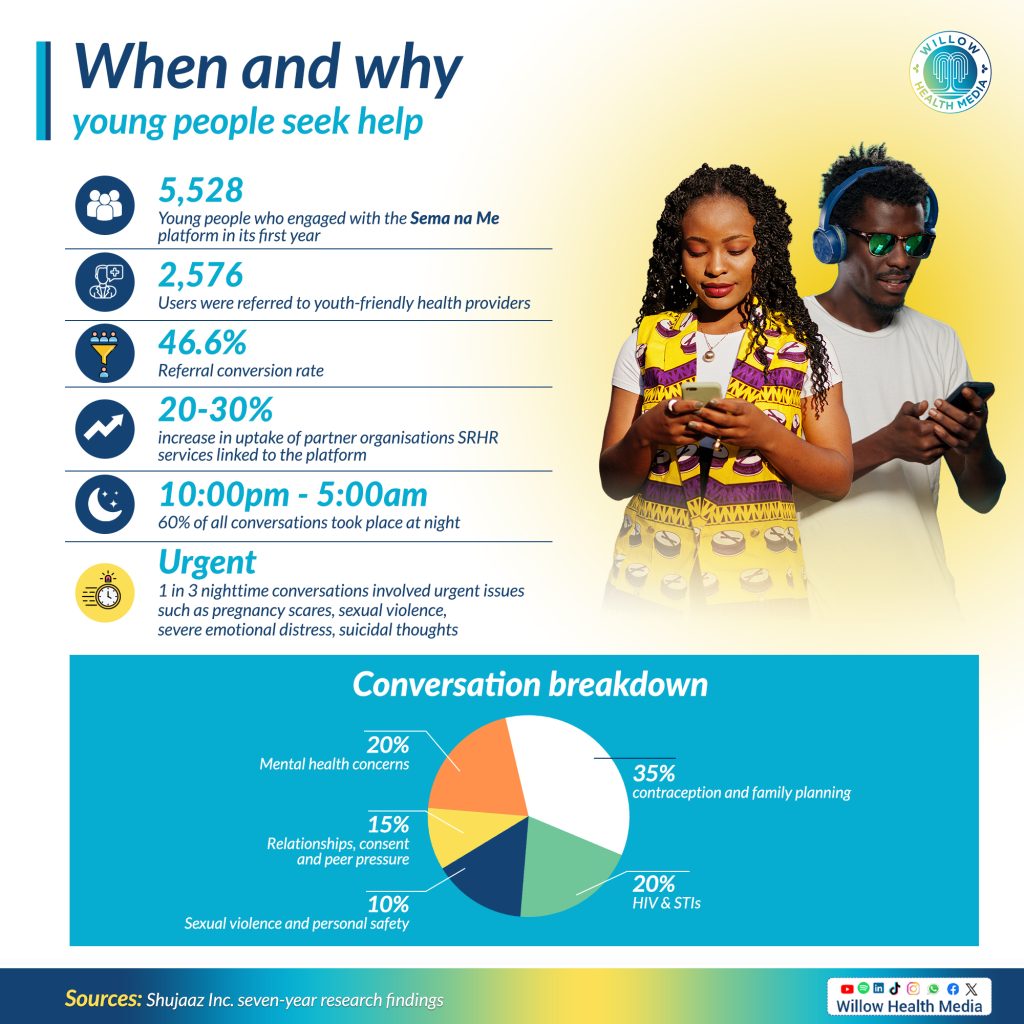
60 per cent of conversations touch on sexual and reproductive health, with contraception and family planning accounting for 35 per cent
Many users kept returning rather than treating the chatbot as a single exchange. “We’re now figuring out users actually want to have an ongoing engagement because, for the first time, we gave them immediate feedback,” he says. “The bot should almost be like a diary. If I’ve spoken to it for three months, it should remember where we left off.”
Those return visits reveal something the neat categories of a health system rarely capture: a pregnancy scare arrives bundled with anxiety; a HIV test becomes a conversation about trust or intimate partner violence; a request for contraception can uncover coercion or financial dependence.

Shujaaz’s first-year data reflects that complexity: nearly 60 per cent of conversations touch on sexual and reproductive health, with contraception and family planning accounting for 35 per cent, HIV and sexually transmitted infections 20 per cent, relationships and consent 15 per cent, and sexual violence 10 per cent. Mental health concerns, anxiety, hopelessness, and suicidal thoughts feature in 20 per cent of conversations, usually alongside reproductive health rather than on their own.
“Young people don’t experience their lives in silos,” Njoroge says. “When they come to the platform, they are not saying, ‘Today I’m only dealing with sexual and reproductive health.’ Everything is connected.”
The pregnancy scare is only one version of what comes through. A girl asks about contraception before she has ever used any, wanting to understand her options while the choice is still hers. A boy, ashamed, asks if something about his body is normal, half-expecting to be told off, and is told instead that he’s not alone. A young woman, five months pregnant and unsure where she stands with her partner, types out the whole situation just to have somewhere to put it. Others write about feeling low, anxious, or carrying a heaviness they cannot explain to anyone around them, in a mix of English, Swahili and Sheng’ (Slang), the way they would to a friend: “naskia aibu,” “poa,” or “nikupee more?” Some are in crisis. Many just want to be heard, without judgment.
That interconnection is not a surprise to Shujaaz; it is the finding that shaped the platform. Before building it, the organisation carried out more than 13,000 interviews with nationally representative samples of Kenyans aged 15 to 24, over seven years. The research found that one in two young people struggled with their mental health, and that many lacked the confidence to seek support because of stigma and fear of judgment.
Youth-friendly services must be available when young people are emotionally ready to seek help, not only when clinics happen to be open
Faced with referrals that arrived at night and follow-ups that could only happen the next morning, some partner organisations chose to adapt rather than wait. Health workers and counsellors began adjusting their schedules to respond during the same late hours their users were reaching out.

“We realised it would make sense to actually respond during that window rather than wait until the next day, where somebody is already in other situations in their life,” Njoroge says. Shujaaz now calls this model its “Digital Night Shift,” built on the premise that youth-friendly services must be available when young people are emotionally ready to seek help, not only when clinics happen to be open.
That readiness carries its own risks. As AI becomes a bigger part of how young people seek information, Shujaaz is watching closely for what safety demands alongside access.
“We’re increasingly aware of the digital scaling aspect,” says Nafeesa Punjani, Operations Manager at Shujaaz Inc. “It’s not just smartphone penetration. Once someone has access to the internet and AI, how do they stay safe? That’s something we’re developing programming around with our partners.”
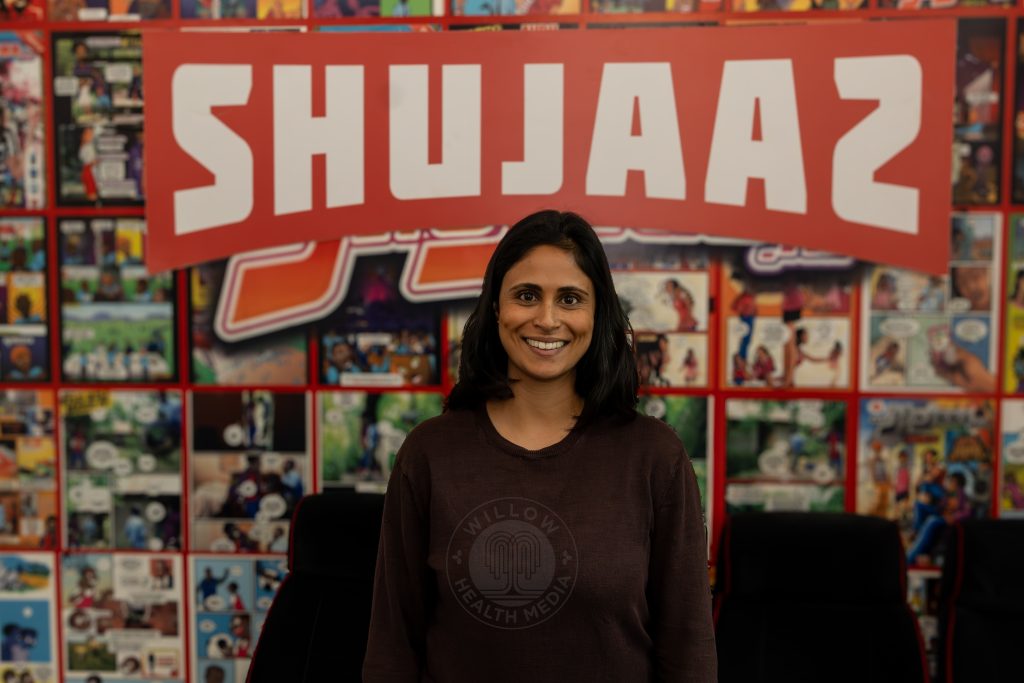
Digital literacy, she believes, has to grow at the same pace as digital health innovation. “If we’re able to pair these chatbots with digital skills, it’s helping us move the needle a little bit further in terms of how we engage with our audience,” she says.
The organisation’s approach follows Kenya’s Data Protection Act, preserving the trust that lets young people speak openly in the first place.
None of this suggests Kenya’s youth are reluctant to ask for help. The lesson of Sema na Me is closer to the opposite: they are asking, night after night, at the exact moment the system built to answer them has gone quiet. Closing that gap will not come from reinventing healthcare, only from resourcing it differently: night-shift counsellors, faster referral follow-up, AI tools that hold the line until a human can take over.
Technology alone will not fix adolescent health in Kenya, and neither will a chatbot. But by showing exactly when, why and how young people reach out, platforms like Sema na Me have exposed a blind spot health providers can now act on. The question is no longer whether young people are willing to ask for help. It is whether Kenya’s health system will be there, at 2 a.m., when they do.
We believe in the free flow of information
Republish our articles for free, online or in print, under Creative Commons licence.