
The Netherlands spends 10.1 per cent of its GDP on health under tight state rules. Kenya’s young Social Health Authority (SHA) is chasing the same promise on a far thinner budget.
The Hague, Netherlands
Universal Health Coverage (UHC) is not simply a promise on paper; it is a system built on money, rules, providers and trust. The Netherlands has spent nearly two decades refining a model that combines compulsory insurance, private delivery and firm public regulation. Kenya is now pursuing a comparable ambition through the Social Health Authority (SHA), which replaced the repealed National Health Insurance Fund (NHIF) in 2024.

Both countries seek to protect citizens from the financial shock of illness. But they begin from very different levels of wealth, institutional capacity and healthcare maturity.
The Netherlands operates a “managed competition” model. Every resident must buy basic health insurance from a competing private insurer who must accept all applicants and cannot discriminate against people because they are old, sick or poor.
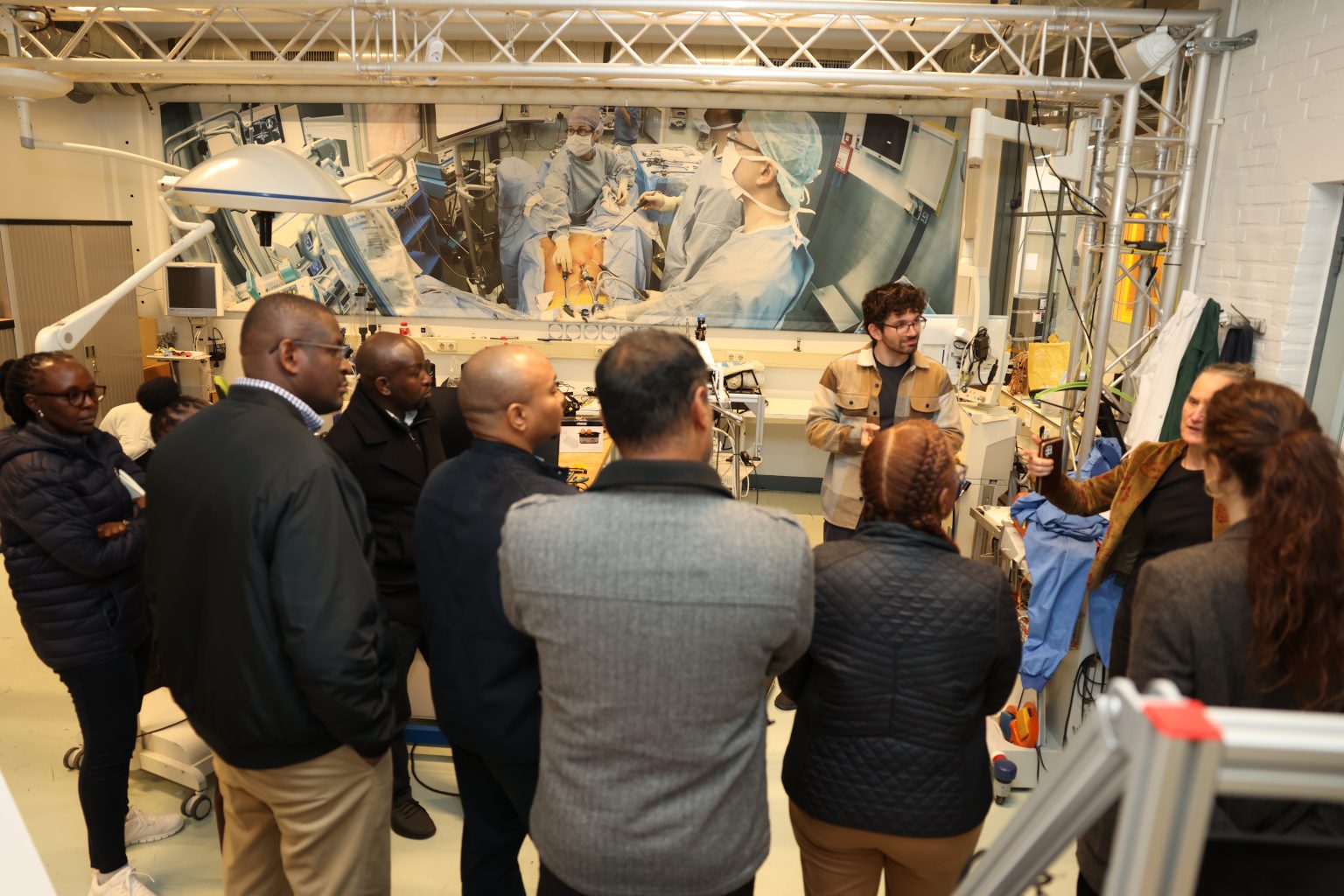
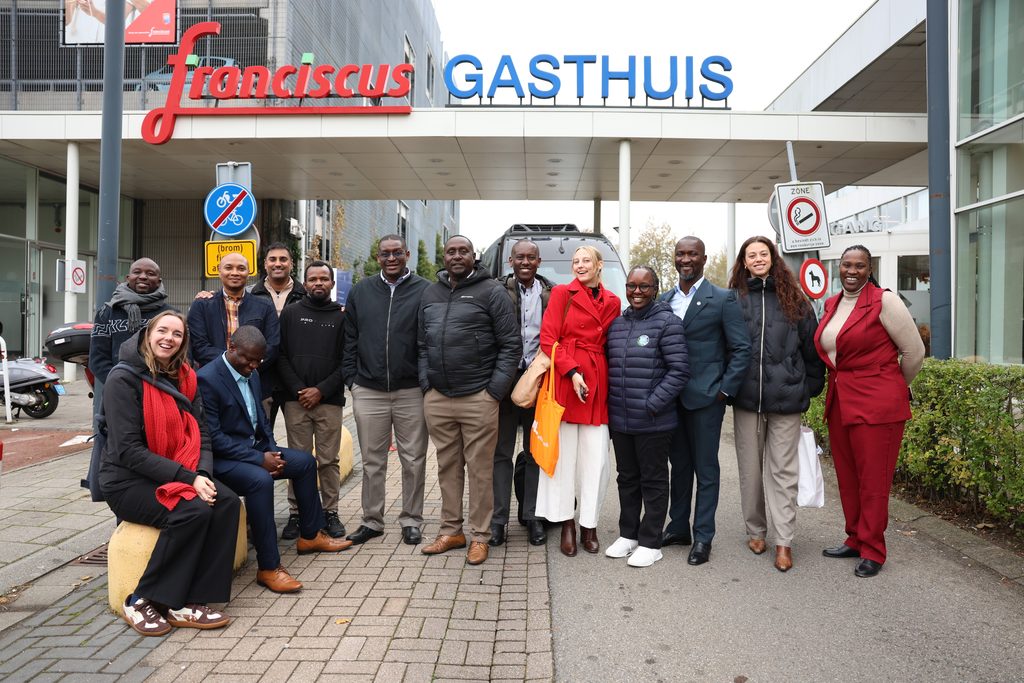
Speaking on the first day of the Kenya Impact Mission to the Netherlands, organised by Taskforce Healthcare Life Sciences and Health, Dr Mark van Passel, Policy Coordinator for Global Health Strategy at the Ministry of Health, Welfare and Sport, said the government creates the conditions for good public health in which people are first supported by family, friends and caregivers where necessary.
Health insurance in the Netherlands is mandatory and covers GP care, hospital treatment, medicines, specialist consultations, mental health
“Health insurance is mandatory. Every resident must buy basic health insurance, but the state sets the rules of the game,” he said. “It defines the standard benefits package, guarantees access to essential care and supervises quality, affordability and competition.”
The model was reshaped by the Health Insurance Act (Zvw) of 2006, which made basic insurance mandatory and covers GP care, hospital treatment, medicines, specialist consultations and mental healthcare.

Kenya’s SHA pursues universal coverage through a public social-insurance framework. It manages three funds: the Primary Healthcare Fund, the Social Health Insurance Fund (SHIF) and the Emergency, Chronic and Critical Illness Fund (ECCF). Together, they are intended to finance preventive and primary care, essential outpatient and inpatient treatment, and high-cost emergency, chronic and specialist services.
The Dutch system also rests on three pillars. Curative care is financed through mandatory basic insurance. Intensive, continuing care for people with severe disabilities, chronic illness or a need for round-the-clock support is funded through the Long-Term Care Act (Wlz) of 2015. Municipal social support and youth care are organised under the Social Support Act (Wmo) and Youth Act (Jeugdwet), both enacted in 2015.
Dutch financing blends individual premiums, income-related contributions, tax revenue and government grants
The similarity is strategic: both systems separate everyday care from expensive, catastrophic care. The difference lies in delivery. In the Netherlands, private insurers purchase care from largely independent providers under government rules. In Kenya, a public authority contracts providers and administers the funds.
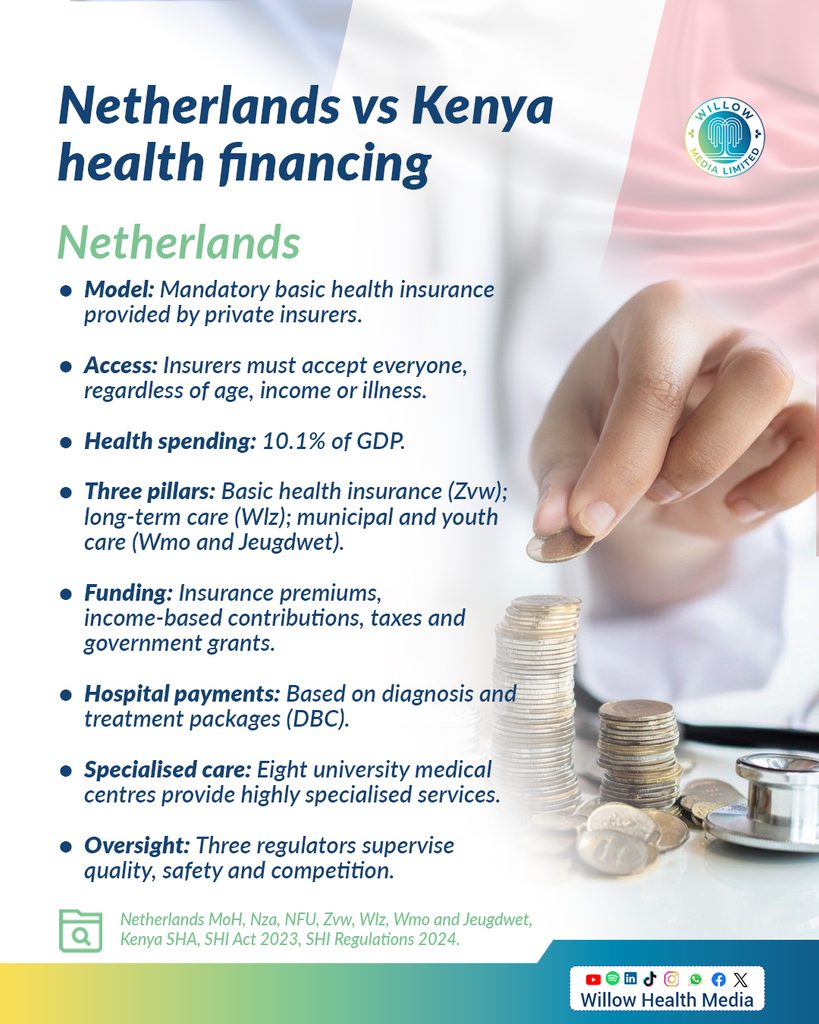
Dutch financing blends individual premiums, income-related contributions, tax revenue and government grants. A risk-equalisation mechanism redistributes money among insurers, ensuring that those covering older, sicker or more expensive patients are not financially penalised. This is central to making competition compatible with solidarity.
“You can make all the decisions as government, but in the end, it’s the private sector that will do some things,” Dr van Passel said. “We have an ageing population, and the country spends 10.1 per cent of its GDP on health.”
Kenya’s SHA uses a two-tier contribution system. Salaried workers contribute 2.75 per cent of gross monthly income, while non-salaried members are means-tested and contribute 2.75 per cent of household income, subject to a minimum monthly contribution of Ksh300. The government identifies and supports indigent households that cannot afford contributions.
Both models require people to contribute according to ability to pay while receiving care according to need. However, the Dutch system has a more established risk-pooling mechanism, stronger administrative systems and a larger tax base. Kenya’s challenge is to ensure that contributions are collected reliably, subsidies reach those who need them and providers are paid on time.
The Dutch need a GP referral for specialist care, Kenya is building the same through dispensaries, health centres and Primary Care Networks
In the Netherlands, general practitioners (GP), or huisartsen, are the first point of contact and gatekeepers to hospital specialists. Patients generally need a GP referral before accessing specialist care, although they may choose their hospital. GP posts also handle urgent but non-emergency cases outside normal hours, directing patients to the appropriate level of care.
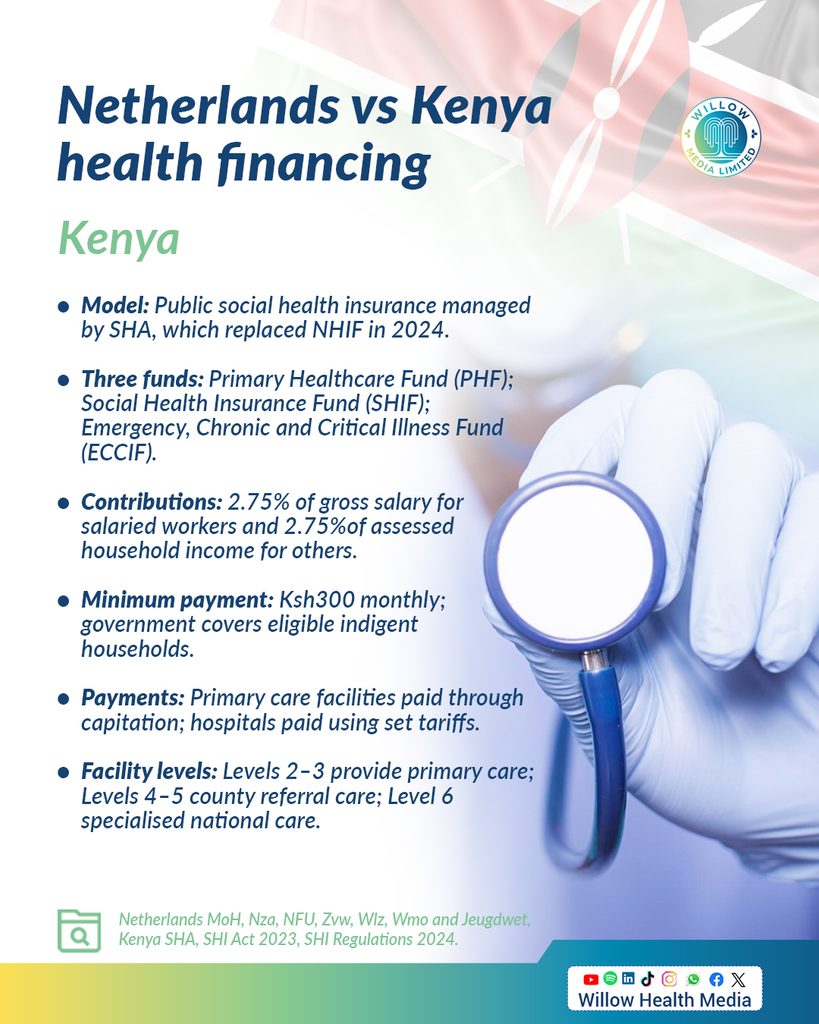
Kenya is building a similar foundation through dispensaries, health centres and Primary Care Networks. The Primary Healthcare Fund covers outpatient, preventive, maternal, child and basic chronic-care services at Levels 2 and 3, and selected Level 4 facilities.
The shared principle is clear: strong primary care reduces unnecessary hospital visits, supports early diagnosis and helps manage chronic disease. For Kenya, however, the test is whether primary-care facilities have enough staff, medicines, diagnostics and referral capacity to make that gatekeeping role meaningful.
Dutch hospitals are classified less by size than by clinical complexity. General hospitals provide routine inpatient, outpatient, emergency and specialist care. Teaching hospitals add training and more complex treatment, while the country’s eight university medical centres handle highly specialised care, research and medical education. Most Dutch hospitals are private, non-profit foundations, while university medical centres are public institutions affiliated with universities.
In Kenya’s a tiered hospital facility system, patients are mapped to a Primary Care Network and referred upward when necessary
Kenya uses a tiered facility system. Levels 2 and 3 provide primary care, Levels 4 and 5 serve as county referral hospitals, and Level 6 facilities provide national tertiary and highly specialised services. Patients are expected to be mapped to a Primary Care Network and referred upward when necessary.
Both systems depend on a functioning referral chain. In the Netherlands, that chain is supported by dense primary-care networks and established hospital contracts. In Kenya, its effectiveness will depend on clear referral rules, available beds, functioning emergency services and financial protection for patients moving between levels of care.
The Netherlands reimburses much hospital care through the Diagnosis Treatment Combination (DBC) system, a case-based payment model comparable to diagnosis-related groups. Insurers and hospitals negotiate prices for many services, while the Dutch Healthcare Authority regulates or sets prices for others.
SHA has introduced standardised tariffs and benefit packages to promote transparency, equity and affordability. Primary healthcare is financed through population-based capitation allocated to Primary Care Networks, while hospital and specialist services are paid according to defined tariffs.
The lesson is not that Kenya should copy Dutch payment mechanisms wholesale. Rather, it should ensure that payment rates are predictable, reflect the real cost of care and are paid promptly. Delayed reimbursements can push providers to demand cash payments, undermining the promise of financial protection.
Strong regulation matters because a health system can expand coverage on paper while failing patients in practice
Dutch oversight is shared among three institutions. The Dutch Healthcare Authority regulates access, pricing and affordability; the Health and Youth Care Inspectorate monitors quality and safety; and the Netherlands Authority for Consumers and Markets oversees competition.

Kenya’s Ministry of Health and SHA set benefits, tariffs and contracting rules. The country’s regulatory architecture is still developing, particularly in quality assurance, price monitoring and competition oversight.
Strong regulation matters because a health system can expand coverage on paper while failing patients in practice. Transparent tariffs, published provider performance, complaint mechanisms and independent quality inspection should help SHA build public confidence.
Kenya can learn from the Dutch how to manage workforce shortages, rising chronic disease and affordability without importing its costs
The Netherlands faces its own pressures: an ageing population, workforce shortages, rising chronic disease, affordability and the need to centralise highly complex care. Yet it has built institutions capable of managing those pressures through predictable financing, risk equalisation and strong primary care.
Kenya’s opportunity is to learn from that experience without importing its costs. A resilient SHA will require reliable contributions, timely payments to providers, transparent tariffs, effective risk pooling, functioning referrals and credible oversight.
If those foundations hold, Kenya can move closer to a system in which illness does not become a financial catastrophe, and care begins where people live, not only in the hospital.
We believe in the free flow of information
Republish our articles for free, online or in print, under Creative Commons licence.