

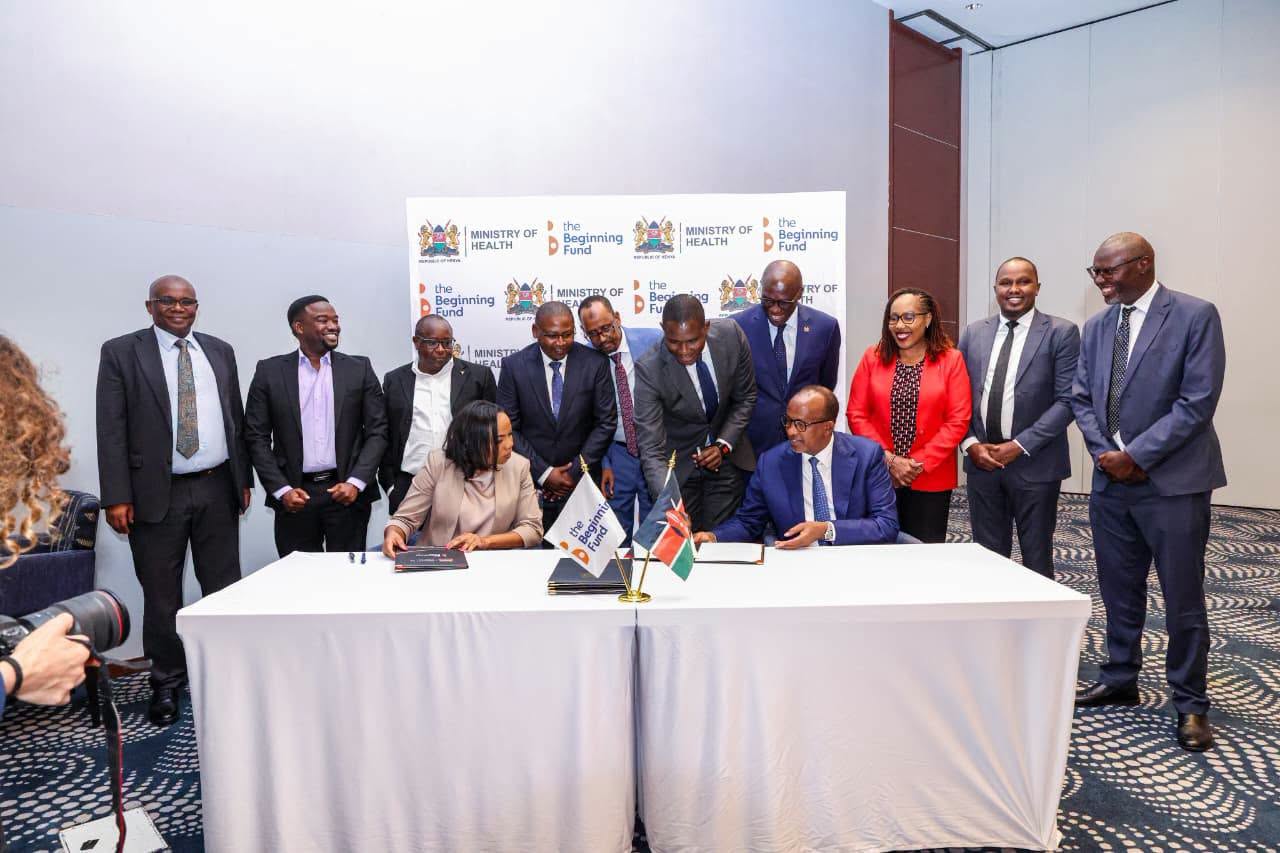

Kenya partners with the Beginnings Fund to bring better maternal and newborn care to 21 counties and 200 health facilities.
Kenya has signed a five-year partnership with the Beginnings Fund aimed at reducing maternal and newborn deaths across the country, with a sharp focus on the counties and health facilities where the burden is heaviest.
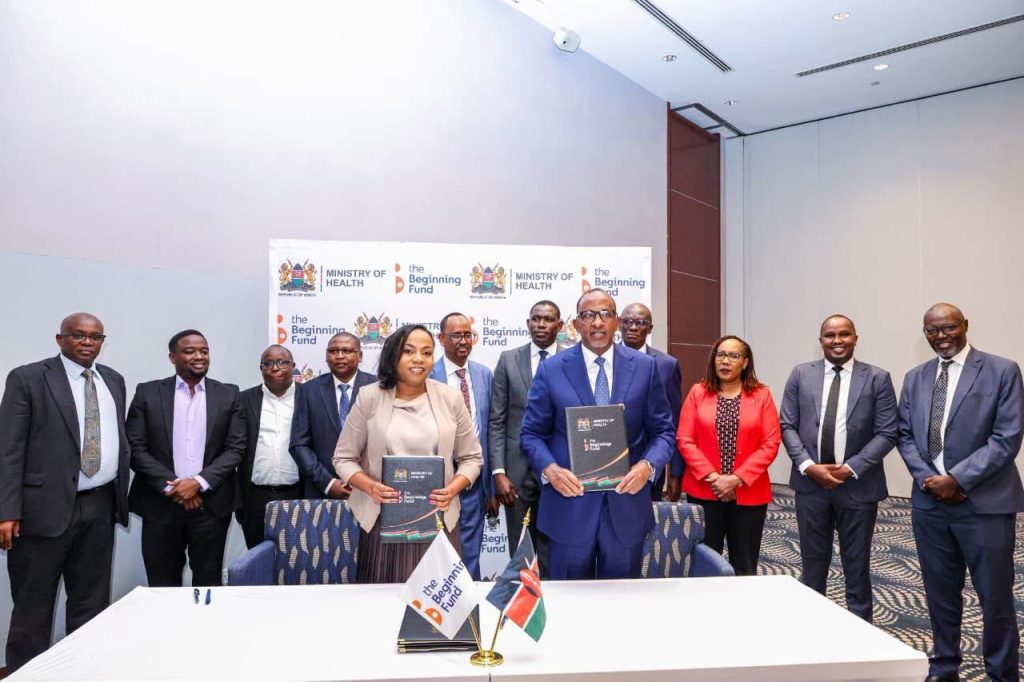
The agreement, signed between the Ministry of Health (MoH) and the Fund, channels catalytic funding into the health workforce, essential medicines and technologies, referral networks and health information systems, while reinforcing strategies already in motion under Kenya’s Universal Health Coverage (UHC) reforms and Taifa Care.
Cabinet Secretary for Health Aden Duale used the occasion to press partners on delivery rather than ceremony, while Beginnings Fund CEO Alice Kang’ethe framed the deal as a model of government-led partnership. Kenya joins a growing list of African countries backed by the Fund, at a time when global progress against maternal mortality has slowed in recent years.
The Cooperative Agreement is backed by US$80 million (Ksh10.4 billion) over five years, targeted at 21 priority counties and around 200 high-volume health facilities. Officials project the programme will reach about 5.9 million women and newborns and help avert an estimated 46,494 deaths by 2031. The funding is intended to complement, not replace, spending by national and county governments.
The Fund’s approach centres on what it describes as “people, products and systems”, investment in the health workforce, essential medicines and technologies, referral networks, and health information systems. The initiative is explicitly designed to reinforce existing national strategies, including the Every Woman Every Newborn Everywhere (EWENE) Acceleration Plan, the Maternal and Newborn Health Rapid Results Initiative, Universal Health Coverage reforms, and Taifa Care.
Close to 5,000 women and girls die every year from pregnancy and childbirth-related causes
The rationale is rooted in numbers MoH has itself been citing: a maternal mortality ratio of an estimated 355 deaths per 100,000 live births, a neonatal mortality rate of 21 per 1,000 live births, and a stillbirth rate of 19 per 1,000 births.
The UN Population Fund’s (UNFPA) Kenya office has put a number on that ratio. Close to 5,000 women and girls die every year from pregnancy and childbirth-related causes. Access to skilled birth attendance has improved, though. It rose from 62 per cent to about 70 per cent over the last seven years. Still, over 80 per cent of maternal deaths are attributed to poor quality of care.

Cabinet Secretary Duale used the signing to press implementing partners on delivery rather than ceremony. “Frameworks or agreements do not save lives. Implementation does,” he said, urging the Beginnings Fund, implementing partners and “all responsible institutions to move with urgency from signing to execution.”
He cautioned against delay: “Every delayed procurement, every postponed activity, and every missed milestone represent mothers and newborns whose lives remain at unnecessary risk.” Success, he added, would not be measured “by the amount of money disbursed, the number of meetings held, or the volume of reports produced,” but by reductions in maternal deaths, newborn deaths and stillbirths, alongside stronger health systems and greater public confidence in healthcare services.
Kang’ethe framed the agreement as an example of government-led partnership. “We believe lasting progress is achieved when governments lead, and partners work alongside them,” she said, praising Kenya for “placing mothers and newborns at the centre of its health agenda and bringing together government, counties, health workers, implementing partners and philanthropy around a shared vision.” She described the Fund’s role as providing “catalytic support that strengthens the people, products and systems needed to deliver quality care, building on the leadership, expertise and commitment that already exists within Kenya’s health system.”
The ambition of the Fund’s first five-year phase is preventing more than 300,000 deaths
Kenya joins Malawi, Zimbabwe, Rwanda, Zanzibar, Tanzania, Uganda, Ghana, Lesotho, Nigeria and Ethiopia as country partners under the Fund’s first phase, which runs from 2026 to 2031 across ten countries, with an overall ambition of preventing more than 300,000 deaths and reaching 34 million mothers and newborns.
As of July 2026, the Fund had raised US$495.4 million (Ksh64.4 billion) of its US$525 million (Ksh68.25 billion) target for this first phase, backed by founding donors including the Mohamed bin Zayed Foundation for Humanity, the Gates Foundation, the Children’s Investment Fund Foundation (CIFF), Delta Philanthropies and The ELMA Foundation.

According to H.E. Dr Shamma Khalifa Al Mazrouei of the Mohamed bin Zayed Foundation for Humanity, “Every birth should be a moment of hope, yet every day mothers and newborns die from causes we know how to prevent.” Similar sentiments were echoed by CIFF’s Faustina Fynn-Nyame, who said sustainable progress is achieved when governments lead, partners align behind shared goals, and investments strengthen national health systems. The Gates Foundation’s Dr Paulin Basinga tied the funds directly to access: “No family should lose a mother or newborn because lifesaving care was too far away, came too late, or remained out of reach.”
The announcement comes a little over a year after the United Nations Maternal Mortality Estimation Inter-Agency Group, comprising WHO, UNICEF, UNFPA, the World Bank Group and the UN Population Division, published its latest joint estimates, Trends in Maternal Mortality 2000 to 2023.
Globally, an estimated 260,000 women died from pregnancy or childbirth-related causes in 2023, equivalent to one woman every two minutes. That represents real long-term progress, a 40 per cent reduction in the global maternal mortality ratio since 2000, but the pace of improvement has stalled badly in recent years. The global maternal mortality ratio has declined by only 1.5 per cent annually since 2016, still nearly three times higher than the SDG target of 70 deaths per 100,000 live births by 2030.
Women in Sub-Saharan Africa face higher lifetime risk of dying in childbirth than in wealthier regions
Sub-Saharan Africa remains disproportionately affected, accounting for 70 per cent of global maternal deaths in 2023, with Central and Southern Asia contributing nearly 17 per cent. Fragility compounds the risk: 37 countries classified as being in conflict or experiencing institutional or social fragility accounted for 64 per cent of global maternal deaths that year, though Kenya is not among the most fragile settings in that group.
WHO’s Pan American regional arm, summarising the same MMEIG dataset, put sub-Saharan Africa’s share at almost three-quarters (182,000) of maternal deaths worldwide, with women there facing a dramatically higher lifetime risk of dying in childbirth than in wealthier regions. Still, there is a genuine silver lining: despite carrying by far the largest burden, sub-Saharan Africa cut its maternal mortality ratio by nearly 40 per cent between 2000 and 2023.
Kenya’s reported ratio of 355 per 100,000 sits above the regional pattern implied by these global datasets, though estimates vary by source and methodology. The World Bank’s modelled series and Macrotrends’ regression-based figures put Kenya’s ratio considerably lower in recent years, a reminder of how sensitive maternal mortality estimates are to data quality and modelling assumptions, a limitation WHO’s own country data pages acknowledge given gaps in Kenya’s vital registration coverage.
With Kenya now formally onboarded, the Beginnings Fund’s first five-year phase is close to being fully resourced, having raised the large majority of its US$525 million (Ksh68.25 billion) target across ten African countries.