



Uterine fibroid embolisation starves fibroids of blood in about 45 minutes, and most women go home within a day.
Women living with painful, heavy-bleeding fibroids have an option that avoids major surgery and keeps the uterus intact. Uterine fibroid embolisation (UFE) shrinks fibroids by cutting off their blood supply through a thin tube inserted at the wrist.
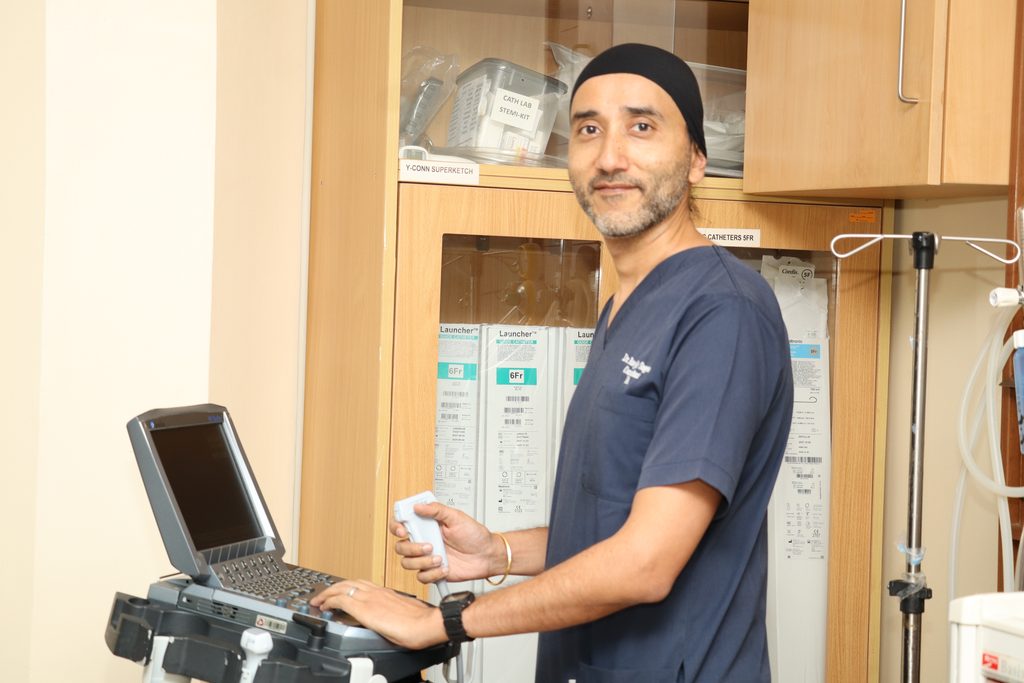
The procedure takes about 45 minutes, most patients go home the same day or after one night in hospital, and around 90 per cent of suitable patients report relief from their symptoms, according to consultant interventional radiologist Dr Ravjit Sagoo.
Yet awareness remains low among the public and even some healthcare professionals, and the procedure is only available where hospitals have a specialised catheterisation laboratory and trained staff.
What are fibroids?
Uterine fibroids are non-cancerous growths that develop in or around the muscular wall of the uterus. They are common among women of reproductive age and range from tiny growths to masses as large as a grapefruit.
“Fibroids are basically non-cancerous growths within the uterus. They’re extremely common, especially in this part of the world,” says Dr Sagoo.
Who gets them, and what symptoms do they cause?
Fibroids are particularly common among women of African ancestry. Dr Sagoo estimates that 70 to 80 per cent of these women will have fibroids during their reproductive years, but only about 10 to 20 per cent develop symptoms.
Many women have no symptoms at all. Others experience heavy menstrual bleeding, pelvic pain, pressure in the lower abdomen, frequent urination or constipation.

How are fibroids treated?
Treatment depends on the symptoms, the size and location of the fibroids and each woman’s circumstances. Options include monitoring the growths, medication and surgery. UFE is a minimally invasive alternative that treats fibroids without removing the uterus.
How is UFE done?
The procedure takes place in a catheterisation laboratory, or Cath Lab, a specialised room with X-ray equipment that lets the doctor see blood vessels and guide instruments inside the body.
The anaesthesia team first assesses the patient. UFE is usually performed under sedation, which keeps the patient comfortable and may make her sleep while she continues to breathe on her own. No large surgical incision is needed.
Dr Sagoo accesses a small blood vessel in the patient’s left wrist, then guides a thin, flexible tube called a catheter through the blood vessels, tracking it with X-ray imaging.
“I look for two blood vessels that are supplying the fibroids. They’re called the uterine arteries, which essentially supply the uterus as well as all the fibroids,” he says.
Once the catheter is in position, he injects tiny polyvinyl alcohol (PVA) particles into the arteries to block the blood supply to the fibroids. “And these are completely inert and they don’t react with the body.” For some very large fibroids, he may also use a gelatin sponge to help block the vessels.
Using X-ray imaging and contrast dye, he confirms that the targeted vessels are blocked. He then moves the catheter to the other uterine artery and repeats the process. Once both sides are treated, the catheter is removed.

Why does blocking the blood supply work?
Fibroids depend on blood for oxygen and nutrients. “The fibroids are very sensitive to having their blood supply blocked and if they don’t get their nutrients etc. they’re going to just shrivel up and degenerate and get absorbed by the body,” says Dr Sagoo.
As the body absorbs the treated tissue, symptoms can improve over the following weeks and months. Dr Sagoo estimates that larger fibroids shrink in volume by at least 50 to 60 per cent in the first year, and shrinkage may continue for up to 18 months.
What is recovery like?
Most patients go home the same day or spend one night in hospital, depending on their recovery and pain control. Dr Sagoo advises allowing about one to two weeks off work, although some women return sooner.
What are the side effects and risks?
Pain and cramping are the main side effects and can be managed with medication. “I tend to keep patients in hospital overnight so their pain medication can be adjusted according to their symptoms,” he says.
Other possible risks include reduced ovarian function and premature menopause, which Dr Sagoo says are more of a concern in women older than 45 and uncommon in younger women. Infection is also uncommon, and antibiotics are given before the procedure to reduce the risk.
Although UFE is considered low-risk, patients should discuss its benefits and possible complications with their healthcare providers before deciding on treatment.

Can a woman get pregnant after UFE?
Unlike a hysterectomy, which removes the womb, UFE preserves the uterus. Dr Sagoo says pregnancy is possible afterwards, and many women have conceived following the procedure.
However, women hoping to have children should receive detailed counselling from both their interventional radiologist and gynaecologist before choosing this treatment, as suitability depends on individual circumstances.
How common are fibroids?
The global burden is rising. The Global Burden of Disease (GBD) 2021 study, covering 204 countries and territories, estimated that the number of women living with fibroids rose from 65.69 million in 1990 to 119.54 million in 2021. New cases rose from 6.01 million to 10.10 million over the same period.

Kenya has no nationally representative estimate; the available evidence comes mainly from hospital-based studies. A 2024 study at Jaramogi Oginga Odinga Teaching and Referral Hospital (JOOTRH) in Kisumu found a 4 per cent prevalence among women admitted to its gynaecological ward. Women aged 35 to 39 made up the largest share of those diagnosed, at 31 per cent, and those aged 20 to 24 the smallest, at 9 per cent.
Why isn’t UFE more widely available?
The procedure needs a specialised Cath Lab, trained interventional radiologists and a supporting clinical team. Dr Sagoo says it could be offered in more hospitals where these facilities and staff exist, but low awareness among the public and some health workers holds it back.
What should women with fibroid symptoms do?
Understanding the treatment options is an important first step. A gynaecologist or interventional radiologist can help determine whether UFE is suitable, taking into account a woman’s symptoms, medical history and plans for future pregnancy.
We believe in the free flow of information
Republish our articles for free, online or in print, under Creative Commons licence.