


A 74-year-old diabetic man had four failing vessels bypassed at Kenyatta National Hospital without the heart-lung machine. Visiting surgeons say the technique can cut stroke risk, and Kenyan doctors are now learning it.
The 74-year-old man was wheeled into the cardiac theatre at Kenyatta National Hospital (KNH) for a coronary artery bypass, a heart operation that reroutes blood around narrowed arteries. He needed it because his heart was not getting enough blood. He tired easily and could no longer manage a flight of stairs.
Tests found four target vessels in need of bypass, and because he is diabetic, his disease was diffuse and, in the words of the surgeon who operated on him, “pretty bad.” His arteries were narrowed but not yet blocked. Without surgery, says Prof Hiroshi Niinami of Tokyo Women’s Medical University, a heart attack could have followed, and could have been fatal.
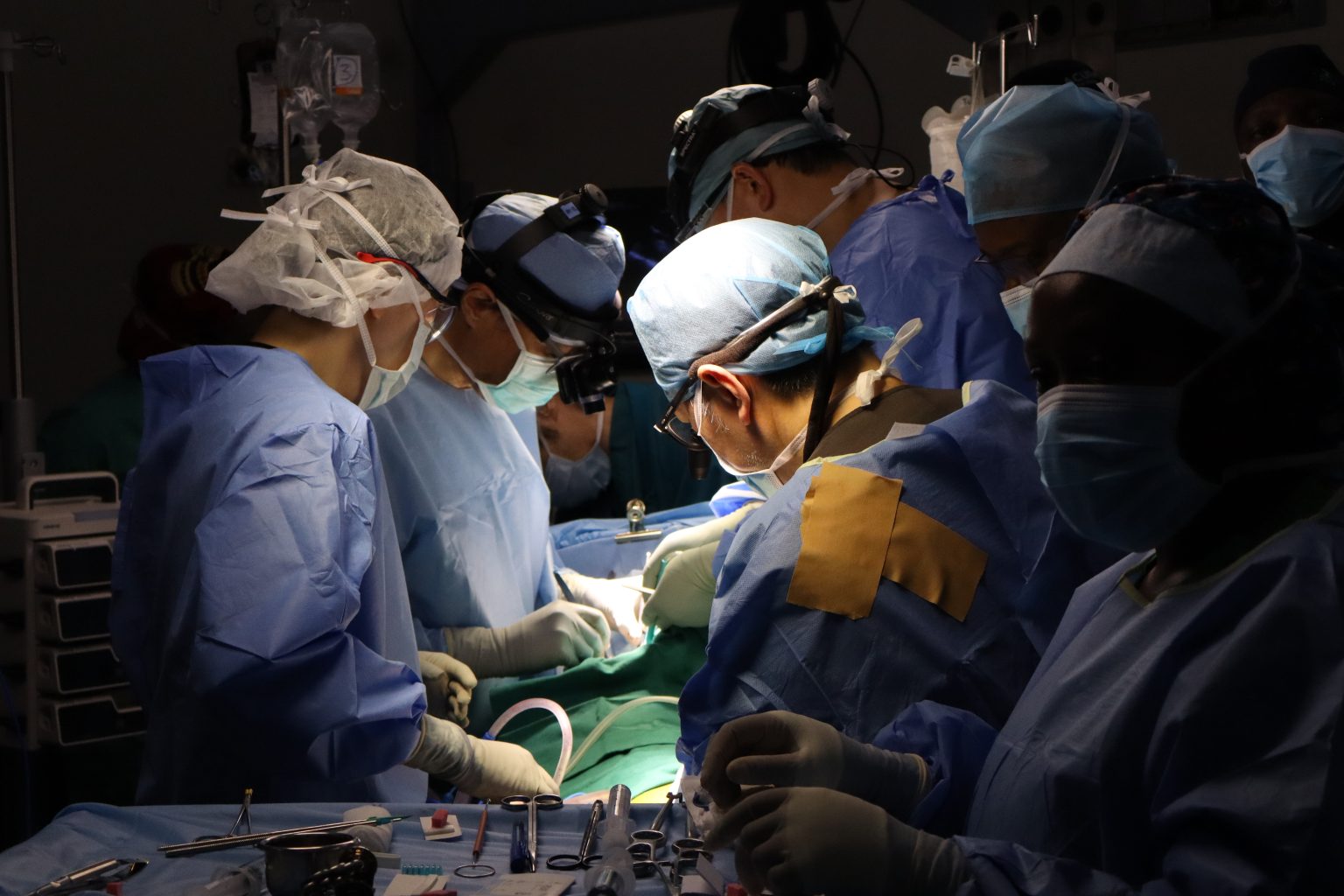
On the day the Willow Health Media team visited, a team led by Prof Niinami rebuilt the man’s coronary arteries while his heart was still beating. It kept its own tempo, pushing blood around his body, while the surgeons sewed new vessels onto it. A small stabiliser rested on the surface to calm the patch being worked on. Everything around it kept moving.
The operation is part of a programme to train Kenyan surgeons in the technique. Trainees watched it live from a classroom next to the theatre, and KNH has set aside a dedicated ten-bed intensive care unit for the programme.
Behind the operation sit three questions Kenya is only starting to answer: who gets this disease, how many Kenyans are affected, and who pays for the treatment. The listed tariff for the bypass alone is Ksh868,000.
In most heart operations, the heartbeat is first stopped, emptied of blood and handed to a machine
Climb a flight of stairs and the heart muscle demands more blood. Where the coronary arteries are narrowed or blocked, the muscle receives too little oxygen, and the result is the chest pain of angina. The feared end point is a myocardial infarction, when an artery closes and a piece of heart muscle dies.
Dr Simon Nderitu, Cardiothoracic Surgeon and Head of Unit at KNH, says the patient was easily tired for exactly this reason. The operation was meant to skirt a heart attack before it arrived.

In most heart operations, the first thing the theatre loses is the heartbeat. The organ is stopped, emptied of blood and handed to a machine, and the surgeon works on something that has gone still. Prof Niinami calls beating-heart surgery “technically demanding because the heart is still beating.”
Dr Fredrik Holmner, a consultant cardiothoracic surgeon from the University Hospital of Umeå in Sweden, was part of the visiting team. He has worked there for 34 years and headed his department until last year. He puts the difficulty plainly. “You are going to sew a small anastomosis,” he says, meaning the joint between new vessel and old artery, “and the heart is jumping. So it’s a little bit tricky.”
Dr Nderitu explains that work inside the heart needs a field free of blood. A beating heart is always in motion, which makes fine work harder.
Fortunately, the blood vessels that we are working on are on the surface of the heart
Bypass surgery is different because the vessels being reached run across the outside. “Fortunately, the blood vessels that we are working on are on the surface of the heart,” he says. Current thinking, he adds, is that stopping the heart can create problems of its own.
The visitors make a three-part case for leaving the heart-lung machine switched off. Prof Niinami points to stroke, saying the machine may raise the risk and that avoiding it removes that risk. Dr Holmner says running the machine for many hours can strain the kidneys and leave fluid in the lungs, which tends to lengthen intensive care stays. He also says operating without it costs less. Overall results from the two approaches are “pretty similar”, he says, with slightly lower stroke risk on the beating heart.

Prof Niinami says about 65 per cent of such operations in Japan are done off pump, and he performs 98 per cent of his own that way. In the United States, he says, the figure is about 20 per cent, and in Europe about 15 per cent.
Dr Nderitu is careful not to oversell it. Opinion is still divided, he says, and some centres that adopted the technique have returned to stopping the heart. “It is a new thing. It is a good thing. We are learning a new technology.”
To bypass the blockages, surgeons need new conduits. Dr Nderitu says arteries are the better choice because blood flows through them at high pressure, but they are limited in supply. Veins are more likely to block over time, he notes, which is why surgeons favour arteries wherever they can. For this patient, Prof Niinami used an internal mammary artery from the chest and a vein taken from the leg.
The patient leaves on aspirin, and sometimes a stronger blood-thinning drug
Operating time depends on the number of vessels. Dr Nderitu says it can run from three hours to four or five, and Dr Holmner expected this operation to take about four.
Afterwards, the aim is to wake the patient within the hour and remove the breathing tube. “But then there are two, three tough days,” Dr Holmner says. The patient leaves on aspirin, and sometimes a stronger blood-thinning drug, to keep the new vessels open. Patients given mechanical valves need warfarin, usually for life.
Dr Holmner does not soften the week that follows, but he weighs it against the alternative. Without surgery, he says, such a patient would probably not live long. “This tough week for them is worth it.”
Behind the surgeons, a second operation was underway, this one for an audience. Benjamin Mwambu, Africa deployment specialist for the Proximie platform, explains that it lets surgeons scrub in virtually from anywhere in the world. Trainees at KNH sat in a classroom and watched the surgery on screen. When a student asked a question, the surgeon could hear it and reply.
Mwambu says keeping students out of the theatre helps reduce infection risk. It also removes the limit on how many can learn at once. “You can teach an unlimited number of students,” he says, and not only at KNH.
For a patient on the table, the first question is cost. Coronary artery bypass grafting comes to Ksh868,000
Cardiovascular disease accounted for 13.8 per cent of deaths in Kenya in 2019, according to the World Heart Federation’s country report. Ischaemic heart disease and stroke are the leading causes of non-communicable disease deaths in Kenya, ranking fifth and seventh among all causes of death. Analyses of the 2015 national STEPs survey put hypertension at roughly a quarter of adults.

For a patient on the table, the first question is cost. The Ministry of Health’s published benefit package tariffs under the Social Health Insurance Act list coronary artery bypass grafting at Ksh868,000. That rises to Ksh1,220,800 when combined with a mitral or aortic valve replacement, and Ksh1,442,000 with a double valve replacement. By comparison, coronary angioplasty with single or multiple stents is listed at Ksh537,600, and diagnostic coronary angiography at Ksh78,400. That puts the bypass roughly 60 per cent above the price of a stenting procedure.
Prof Niinami says the skill does not arrive overnight. In Japan, young surgeons practise on simulators that mimic a beating heart. So far, 14 Kenyan doctors have been involved in the programme.
The visitors will leave, which is the point of the exercise. “We are building our local capacity,” Dr Nderitu says, “and we’ll be able to continue treating them even after the visitors are gone.”
For the man on the table, the surgeons hope that when he wakes, the chest pain that stopped him climbing stairs will be gone, and the heart that never stopped will be doing its work with a better supply of blood.
We believe in the free flow of information
Republish our articles for free, online or in print, under Creative Commons licence.