


From arranged marriages, delayed C-Section over husband’s consent, choosing prayers over treatment to Zoom chats, Ambassadors trace where women’s voices go missing.
Twenty years ago, Sonja Dinner lost a cousin and several close friends to breast cancer. Deaths, she has said, that did not have to happen.
That loss became the founding impulse behind DearYou, and it was Dinner who opened this week’s webinar by reminding a room of Ambassadors from across the world why the initiative exists at all. She told participants she hopes the conversation will prove life-changing for millions of women, and that every single country represented in the network matters to that goal.

Around 30 Ambassadors joined the session, alongside members of the DEAR Foundation Switzerland, representing Africa, Asia, the Middle East, South America and Europe. Scheduled to run for an hour, the webinar stretched to 75 minutes as participants kept the conversation going well past its planned close, much of it playing out quietly in the Zoom chat, where Ambassadors who did not speak aloud still shared reflections, examples and questions throughout.
Ask a woman what stands between her and better health, and the answer is rarely just a missing clinic or an unaffordable prescription. Oftentimes, it is the inability to say, plainly, that something is wrong, or the fear of what happens next after admitting it.
That is the premise behind the webinar: what actually stops women across the network from speaking openly about their health, and what happens to their wellbeing when they cannot?
Women’s voices or lack of them, shape health outcomes worldwide
Steering the keynote conversation was Dr Mercy Korir, founding CEO and Editor-in-Chief of Willow Health Media, who joined the panel alongside moderator Stacy-Ann Smith and Eliakunda “Ellie” Kaaya. Dr Korir and Kaaya were recently named DearYou Ambassadors, a recognition that placed them at the centre of a discussion built around the very question their appointment now obliges them to answer: how women’s voices, or the lack of them, shape health outcomes worldwide.
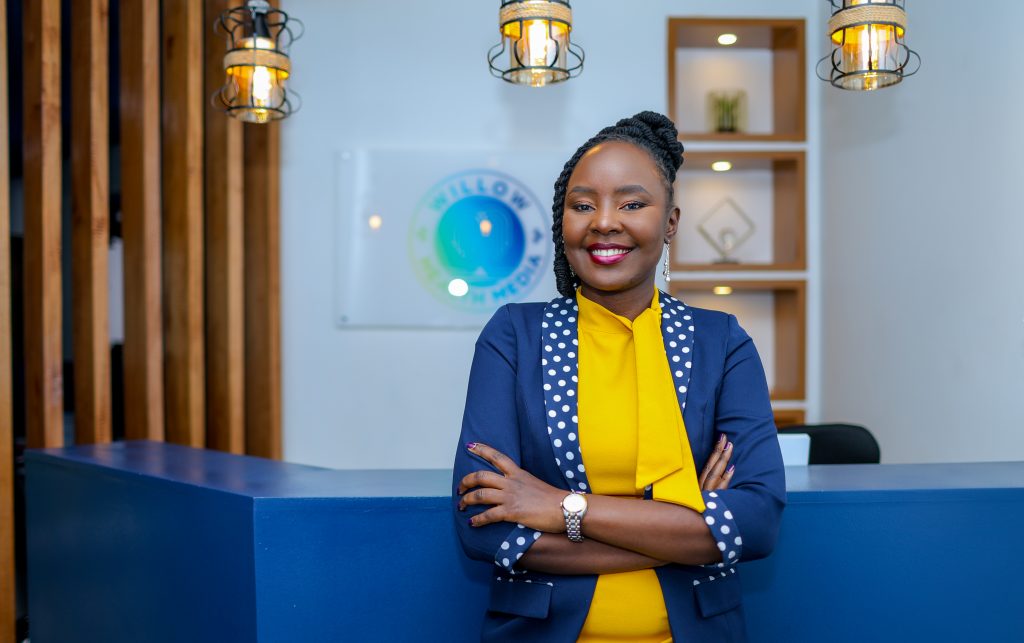
Dr Korir’s presence brought a distinctly Kenyan, health journalism lens to the conversation, linking its themes to the kind of on-the-ground reporting Willow Health Media has built its name on. Her contributions leaned on her clinical background, returning repeatedly to the importance of listening to women, catching symptoms early, and building healthcare environments where women feel respected enough to seek care in the first place.
Kaaya drew on her work with girls and young women in Tanzania to show that meaningful change does not always require confronting deep-rooted community norms head-on. Her examples pointed instead to working constructively within local culture, finding room to shift attitudes without provoking resistance.
Dr Korir grounded the discussion in a case that has stayed with her: a woman who needed a caesarean section but could not consent to her own surgery. She had to wait for her husband’s permission first.
“That delays the treatment,” Dr Korir said, “and also brings down the confidence of the woman.” It is a small phrase carrying a large diagnosis: that the harm done by such systems is not only medical but psychological, eroding a woman’s belief that her own judgement about her own body counts for anything.
In some households, raising concerns risks having financial support withdrawn altogether
The pressures compound from there, she explained. Women are burdened to be perfect because society pressures them to fit a certain category, and speaking up can carry a financial cost too. In some households, raising a concern risks having financial support withdrawn altogether, so women learn to stay quiet instead.
Fear, in Dr Korir’s account, operates on several levels at once, and not all of them are rational responses to real danger. “Women fear the unknown,” she said, tracing some of that fear to history rather than instinct. She pointed to research she has reported on involving Black women and women of colour, whose pain has long been minimised by a medical establishment with a documented habit of doing so.
“Society minimises pain from a historical point of view,” she said, “because some were used to experiment, and they were told women of colour can withstand pain.” That inherited scepticism, she argued, still shapes how symptoms get taken seriously today.
Even when fear is set aside, calculation gets in the way. “If I feel alarmed, I am thinking of two things,” Dr Korir said. “If it is cancer, I am thinking finances, or I may have the funds, but it takes time, so I think if I go to hospital it takes a whole day. So women take a while to take action on their issues because of this fear.”
Kaaya widened the lens to culture. In some communities, a woman’s silence is set in motion before she can even speak, decided the moment she is born. Among the Maasai, marriage is arranged for girls with no say of their own in the matter, leaving them without the standing to raise objections about anything else either. Even where language exists to voice a concern, Kaaya noted, the barrier can be as literal as sign language failing to carry the nuance a woman needs.
Trauma sits alongside the practical burden of learning to breastfeed while still a child
Underneath both, she said, sits a more universal fear: that confiding in someone will not stay confided. “Will you use anything I share with you,” she asked, “and use it to embarrass me and shame me?”
“Their childhood is stolen,” she said of child brides. Trauma sits alongside the practical burden of learning to breastfeed while still a child, compounded by stigma and the blunt question of how they got pregnant in the first place. Many rely on traditional midwives to deliver, and mothers-in-law to help raise the child that follows, while their own mental health goes entirely unaddressed.

Taken together, the barriers Ambassadors described fell into four connected layers. Personally, women carry fear of diagnosis or judgment, low confidence, and the internalised expectation that they must always appear strong. Within families, caring responsibilities, financial dependence, and the need for permission before seeking care all play a role. Culturally, patriarchal decision-making, harmful gender norms, stigma and child marriage delay women from acting on their own health. Within the health system itself, women’s concerns are too often minimised by overburdened workers, compounded by a lack of empathy and by how few women sit in leadership roles where these patterns could be changed.
Dr Korir argued the problem is structural as much as cultural. Nurses and midwives, she said, are largely comfortable keeping women exactly where they already are, rather than being deliberate about moving them into higher decision-making roles. “If a woman is in the key decision-making position in the health system,” she said, “we don’t have places for women to take care of their babies, breastfeeding, or resting and expressing and storing milk.”
Kaaya offered a counterexample: a community health promoter living with HIV who began walking alongside other mothers, encouraging them to take their antiretrovirals. Many now do, and their children have been protected as a result.
Media can become a space where conversations happen without stigma or consequence
For Dr Korir, part of the answer lies in media. Women with supportive partners can already share their stories, she said, but media can become a space where conversations happen without stigma or consequence, amplifying a single account until it reaches a million people, provided dignity is protected. “It’s important for media and communicators to share the stories in a dignified manner,” she said. “Protect their dignity and people will trust the outlet.”

Kaaya described a radio programme, Ijue Afya Yako (know your health), built on the principle of women speaking anonymously, sharing experience and accurate health information without attaching their names to it.
Trust surfaced repeatedly as the thread tying these barriers together, not just between women and their healthcare providers, but in how women relate to digital health tools such as DearYou itself. It also explains one of the panel’s more difficult findings: that some women turn to traditional or spiritual healers rather than trained medical professionals, particularly for terminal illnesses like cancer, a choice Dr Korir linked to cost, noting a healer might charge a dollar, a fraction of what professional treatment demands.
The conversation also pointed to Ambassadors themselves changing shape, from a role focused on promoting the DearYou app towards community facilitation: creating safe spaces for women to talk, working with schools, journalists and faith leaders, and deliberately drawing men in as allies rather than bystanders.
Dr Korir offered the closing line of the session, one that doubled as a mission statement for the network itself. “For women, no voice is too small, and no experience is too insignificant,” she said. “Give them space to speak up, and encourage one another.”