


Dr Ganda has stood inside a pilot area where not one mother died the whole year. The question that follows him home every night: why is that miracle still a secret, and why isn’t everyone demanding to know?
On any given day in Kenya, a woman prepares to deliver, to give life. She folds tiny clothes, counts the weeks, and imagines the first cry that will fill a room and change everything. It is a moment shaped by anticipation and hope, and by the fragile promise of tomorrow. But for too many families, that promise is broken. Mothers continue to die during childbirth, not in silence, but often inside systems that were built to protect them. Hospitals exist. Skilled professionals are trained. Policies are written and rewritten. And still, the losses persist.
Dr Gregory Ganda, the Kisumu County Executive Committee Member for Medical Services, Public Health and Sanitation, has spent years trying to understand why. His answer is both unsettling and precise. Maternal deaths, he argues, are not sudden tragedies of the delivery room. They are the end point of failures that began much earlier, in decisions made far from the bedside, by people who may never know the consequences of what they left undone.
“Leadership is about accountability,” Dr Ganda says. “When a mother dies, then somebody has failed somewhere.”
For years, the conversation around maternal mortality has focused on infrastructure, funding, and clinical capacity. Dr Ganda does not dismiss these factors, but he insists the roots of the problem run deeper. Behind every statistic is a story that rarely makes headlines. A journey to a health facility that took too long. A call for help that went unanswered. A decision delayed by uncertainty. “Before a clinical mistake occurs, there is a leadership mistake,” he says.
He speaks not in abstractions but in realities that play out daily across the country. A doctor who does not respond when called. An ambulance that cannot move because there is no fuel. A nurse, distracted by personal strain, working inside a system that does not see her as human. Each moment, small on its own, becomes part of a chain. And when that chain breaks, it is the mother who pays the price. “These things are preventable,” Dr Ganda says. “That is what makes them so painful.”
If a facility lacks essential equipment, that’s a management failure. If a patient can’t afford care, it’s a policy failure
Kenya’s devolved health system means that authority is shared across multiple levels, between national and county governments and individual health facilities. But for Dr Ganda, shared responsibility does not mean diluted accountability. “Leadership is at every level,” he says. “From the president to the person on the ward.”

It is a view that challenges the tendency to assign blame narrowly. A clinician may be the last point of contact, but the conditions in which they work are shaped by decisions far beyond their control. If a facility lacks essential equipment, that is a management failure. If an ambulance cannot respond, that is a resource failure. If a patient cannot afford care, that is a policy failure. Each layer contributes to the final outcome. “When something goes wrong, we must ask, who was responsible for making sure it did not happen?” Dr Ganda says.
Despite the presence of skilled professionals and modern facilities, Dr Ganda believes Kenya’s healthcare system suffers from a less visible weakness: fragmentation. “It’s not about individuals,” he says. “We have very good people.” What is missing, he argues, is cohesion.
In more developed systems, patient care is coordinated through integrated teams where each professional understands their role within a larger framework. In Kenya, that structure is often inconsistent. Excellence exists in one place while gaps persist in another, and that inconsistency can mean the difference between life and death. A complication that could be managed in one facility may become fatal in another. A delay that might be absorbed in a well-functioning system becomes catastrophic in a fragmented one.
Compounding this is a growing perception among patients that care abroad is superior. “It’s not always true,” Dr Ganda says. Kenya has specialists trained in some of the world’s best institutions. The knowledge exists. The skills exist. But visibility does not always follow. “We publish in journals, we present at conferences, but the public does not always see that.”
Maternal deaths were treated with an urgency and seriousness that left a lasting impression
Dr Ganda, who is also an obstetrician-gynaecologist and specialist in women’s cancers, argues that once trust is eroded, it becomes extremely difficult to rebuild, and that erosion is a key reason Kenyans seek treatment abroad, sometimes at a significant personal cost, believing it to be the safer option.

Dr Ganda’s training in Uganda offered a contrasting perspective. There, he recalls, maternal deaths were treated with an urgency and seriousness that left a lasting impression. “Every case was accounted for, and there were no excuses.”
Healthcare workers were expected to explain their decisions, actions, and outcomes. Failures were examined openly, and accountability was enforced. In some cases, consequences were immediate and harsh, but Dr Ganda says they created a strong sense of responsibility. Back home, the absence of similar consequences has, in his view, allowed complacency to take root. Too much goes unchecked, and that weakens the entire system.
In Kisumu, Dr Ganda has sought to address these challenges through practical interventions, starting with visibility. Using digital tools, healthcare providers can now track patient data in real time. High-risk cases trigger alerts visible to supervisors, creating a system where decisions are monitored as they happen. “It changes behaviour,” he says. “People act differently when they know they are accountable.”
These systems are complemented by regular case reviews, where healthcare workers come together to discuss outcomes and share responsibility. “You move from blame to collective ownership,” he explains.
Community health workers operate at the most local level, visiting homes, educating families, identifying risks
The results have been tangible. In one pilot area, maternal and infant deaths were reduced to zero over the course of a year. Rates of anaemia among pregnant women dropped significantly, and more women sought care in health facilities. Dr Ganda is careful not to overstate the progress. The real challenge, he acknowledges, lies in scaling these interventions to reach the wider health system.
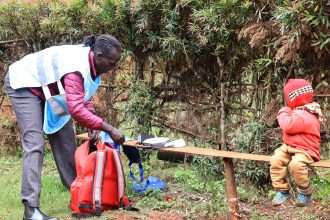
Beyond hospitals and systems, one of the most significant drivers of change has been the strengthening of community health services. Community health workers operate at the most local level, visiting homes, educating families, and identifying risks early. Their role, Dr Ganda says, is indispensable. “They are the only ones who can reach every household.”
In Kisumu, the expansion of community health services has led to a marked increase in skilled birth attendance and a reduction in maternal deaths. By intervening early, these workers help prevent complications before they escalate. “It’s the foundation of everything,” he says.
Traditionally, health systems have been reactive, waiting for patients to arrive
Underlying these efforts is a broader shift in how healthcare is delivered. Traditionally, health systems have been reactive, waiting for patients to arrive. Dr Ganda argues that this approach is no longer sufficient. “Healthcare must go to the people.” It is a model already seen in other sectors where services are delivered directly to homes, and he believes applying the same principle to healthcare could transform outcomes.

Kenya’s push towards digital health represents another opportunity, but Dr Ganda cautions against expecting quick results. “We are still at the beginning.” The real work, he says, lies not in building infrastructure but in changing how healthcare workers use technology. “Digital transformation is about behaviour. You cannot hide. Everything leaves a trace.”
He also acknowledges that accountability often meets resistance, driven by fear of scrutiny, loss of informal benefits, and discomfort with new systems. Addressing what people stand to lose, he argues, is central to making change stick.
Despite the focus on systems and structures, Dr Ganda returns repeatedly to a simple truth: healthcare is about people. His advice to young doctors is not technical but philosophical. “Do not chase money. Chase purpose.” And what should a patient see when they look at a doctor? “Hope,” Dr Ganda says.