
First imported case of Ebola followed a series of misdiagnoses, temperature checks came back normal, thermal scanners switched off or broken at Jomo Kenyatta International Airport (JKIA).
A 40-year-old Kenyan businessman fell ill in the eastern Democratic Republic of the Congo (DRC) in mid-September, crossed into Uganda and flew into Nairobi on October 3. Two days later he was dead of Ebola, having passed several screening points on the way.
He is Kenya’s first imported case of Bundibugyo virus disease, a species of Ebola, and the only confirmed patient so far. His journey has exposed gaps in the country’s surveillance: temperature checks that came back normal, thermal scanners switched off or broken at Jomo Kenyatta International Airport (JKIA), port health offices empty by mid-afternoon and a series of misdiagnoses.
Of his 122 contacts, 108 are in quarantine and none has symptoms. The Ministry of Health (MoH) has not said where the other 14 are. Even so, the Africa Centres for Disease Control and Prevention (Africa CDC) has held up Kenya’s speed in declaring the case as a model for other governments.
Dr Wessam Mankoula, who leads Africa CDC’s continental Ebola incident management support team, traced the man’s movements at the agency’s weekly briefing on October 8.
The man, who had lived in the DRC for seven years, developed malaise on September 15 and 16 and was treated at home by a nurse. Between September 17 and 19 he visited a health facility with fever and a skin rash and was diagnosed with a skin infection. He then spent about 11 days in Kisangani, still receiving care.
The patient presented with fever, a sore throat, muscle pain and bleeding at injection sites
On October 1 he flew to Beni, crossed into Uganda at Kasindi and travelled through Kampala to Entebbe. He landed at JKIA at 1.10pm on October 3, and a relative drove him straight to the Nairobi hospital.
There he presented with fever, a sore throat, muscle pain and bleeding at injection sites. Health workers suspected Ebola from his symptoms and travel history. Samples collected on October 5 tested positive by noon. He died at about 11.30pm that night and was given a safe and dignified burial the next day.
Officials reviewed the journey’s screening forms and temperature records. “Unfortunately most of those temperature measures were normal,” Dr Mankoula told reporters. One theory is that the patient was taking antibiotics before travelling, which could have masked a fever.
Clinicians also missed it. A Nairobi journalist said he had learnt the patient was at one point treated for Rift Valley fever. Dr Mankoula did not dispute that misdiagnosis happens, since early symptoms such as fever, body aches and a sore throat are not specific. “It is expected that some of these cases may be misdiagnosed at the beginning,” he said, “then later on you discover those cases.” He urged clinicians to raise their suspicion when such patients do not respond to treatment.
The same journalist said that when he visited JKIA on the day the case was announced, the thermal devices at the gates were not working, the port health offices were empty by 2pm and there was no epidemiologist familiar with Ebola. Willow Health Media’s team found a screening sensor switched off at JKIA on September 28.
Exit screening is being considered, and more health workers and thermal scanners are planned
Dr Mankoula’s experience differed. Arriving at about 2.30am after the declaration, he found health workers on duty, a mandatory QR code form on travel history and symptoms, hand sanitiser and thermal scanners. But a visit with the Principal Secretary had identified areas needing improvement, he said. Exit screening is being considered, and more health workers and thermal scanners are planned. “We know some challenges may happen at the time of the implementation,” he said, “but it is good all the time to start fixing those challenges while we are moving.”
Dr Mankoula was firm on definitions. Kenya, he said, has “An imported case…. We are not speaking about an outbreak of Ebola happening in Kenya.” An outbreak is declared only when contacts fall ill and are confirmed. France, which received a case from a returning health worker, has reported none since June.
His strongest praise was for speed: the case was confirmed on October 5 and declared on October 6. “This kind of transparency, this kind of sharing the information quickly, this is commendable behaviour,” he said, commending the Minister of Health by name. He warned that blanket travel bans do not prevent spread and send the wrong signal to countries that declare emergencies promptly.
He credited more than three months of preparedness, backed by Africa CDC simulation exercises and biosecurity training, for Kenya’s swift activation of its emergency operations centre and national task force.
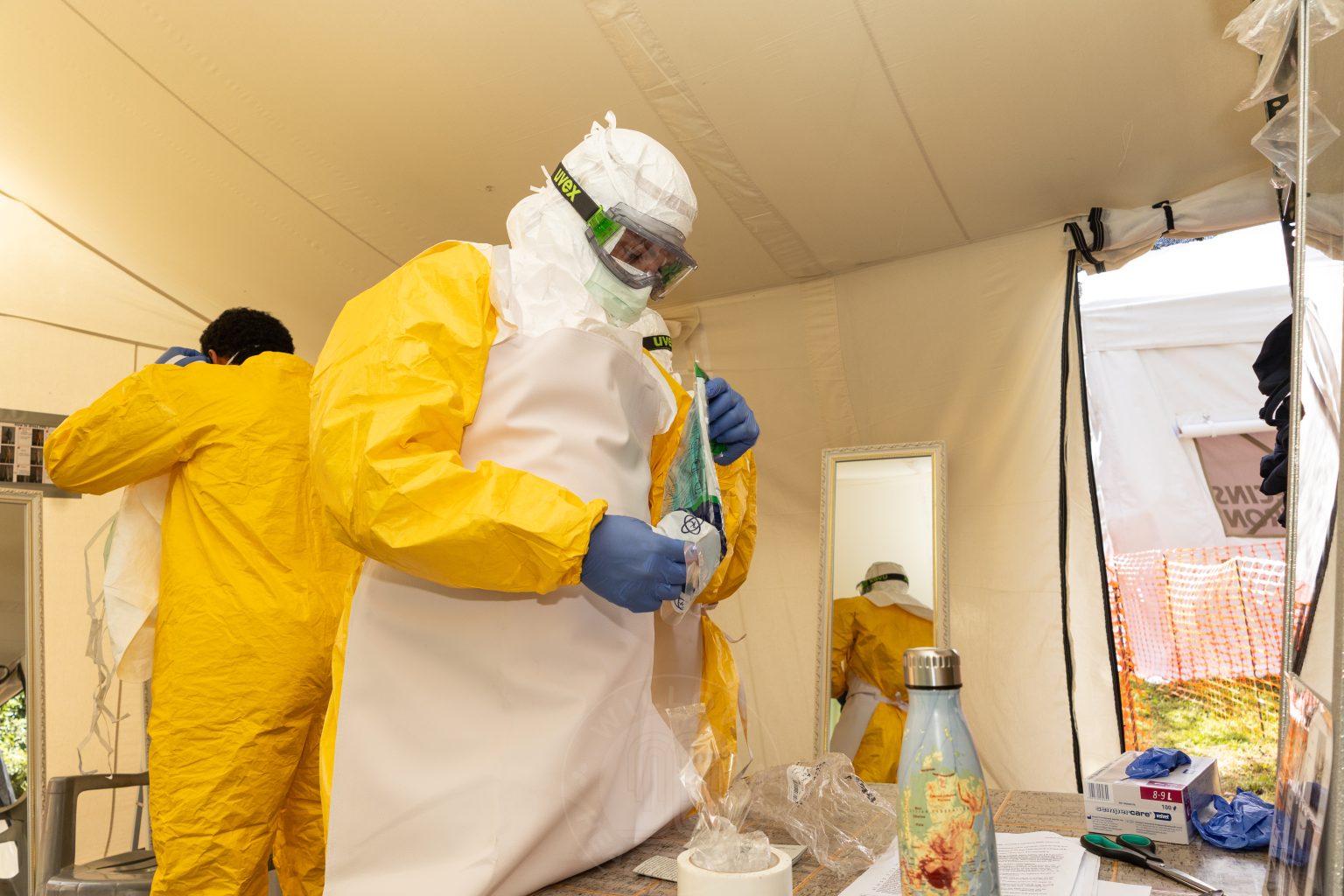
In a statement, Health Cabinet Secretary Aden Duale said no new case has been recorded. “We extend our heartfelt condolences to his family,” it reads. Kenya has tested 293 samples from 289 alerts, with one positive, and screened 667,675 travellers at 26 points of entry. Up to 241 isolation beds are ready in five hospitals, and 4,917 health workers have been trained.
Anyone with symptoms or exposure concerns to visit a health facility or call toll-free line, 719
“Kenya remains open,” the statement reads, with no restrictions on travel, trade or gatherings. The MoH notified the World Health Organization (WHO) within 24 hours, as the International Health Regulations require.
The response plan is yet to be costed. Dr Mankoula pointed to about $2.9 billion (Ksh375 billion) pledged after a G20 meeting, mainly for the DRC and its neighbours, some of which could reach Kenya.
That money has fed suspicion. Asked about Kenyans who believe the case was invented to attract funds, Dr Mankoula said Africa CDC’s rumour tracking had picked up posts linking the declaration to the pledges. The MoH urges anyone with symptoms or exposure concerns to visit a health facility or call the toll-free line, 719.
Coming weeks will show whether 122 traced contacts and thousands of trained health workers are enough
Dr Mankoula asked travellers with fever who have been near a confirmed case to declare it at borders and not mask symptoms with medicine. “When people seek medical care early, we see better outcome,” he said.
Kenya’s single case sits against the fastest growing Ebola outbreak on record, with more than 8,700 cases and more than 4,200 deaths in the DRC since mid-May. “Ebola is not over,” Dr Mankoula told member states. “Invest in preparedness during the peace time. Be prepared, be ready.”
For Kenya, the coming weeks will show whether 122 traced contacts and thousands of trained health workers are enough, and whether the gaps at its borders close before the next sick traveller lands.
We believe in the free flow of information
Republish our articles for free, online or in print, under Creative Commons licence.