

WHO declares outbreak a global health emergency as the Bundibugyo strain of Ebola, which has no cure or vaccine, crossed from DRC into Uganda’s capital, infected 246, and left health workers among the dead.
Kenya has activated emergency health measures and placed border screening on high alert after the World Health Organisation (WHO) declared Ebola a Public Health Emergency of International Concern (PHEIC), its highest level of global alarm, following a deadly outbreak in the Democratic Republic of Congo (DRC) and Uganda that has left 80 people suspected dead and nearly 250 infected, with no approved vaccine or treatment available.
Kenya’s Ministry of Health (MoH) confirmed on May 16 that no Ebola case has been detected in the country but cautioned that the risk of importation remains moderate due to regional travel, trade and cross-border population movement.
“We are closely monitoring the evolving situation together with regional and international public health partners,” said Dr Patrick Amoth, Director General for Health.

The Ministry has constituted a National Ebola Preparedness Team and placed the National Public Health Emergency Operations Centre (PHEOC) on high alert for real-time monitoring and coordination. Screening has been strengthened at airports, border crossing points and other points of entry, laboratory diagnostic capacity enhanced, and healthcare workers are undergoing continuous sensitisation and training.
Dr Amoth urged Kenyans to remain calm but vigilant, maintain high standards of personal hygiene, avoid contact with the bodily fluids of sick individuals, and rely only on official updates from the MoH or recognised international public health agencies. Anyone experiencing symptoms, particularly after recent travel to affected areas, was advised to seek immediate medical attention. Kenya is coordinating closely with WHO and the Africa Centres for Disease Control and Prevention (Africa CDC).
As of May 16, outbreak stood at 246 suspected cases, 80 suspected deaths and eight lab-confirmed cases
The WHO declared the Ebola Bundibugyo Virus Disease (BVD) outbreak a PHEIC on Sunday, 17 May, following its rapid spread from DRC’s Ituri Province into Kampala.
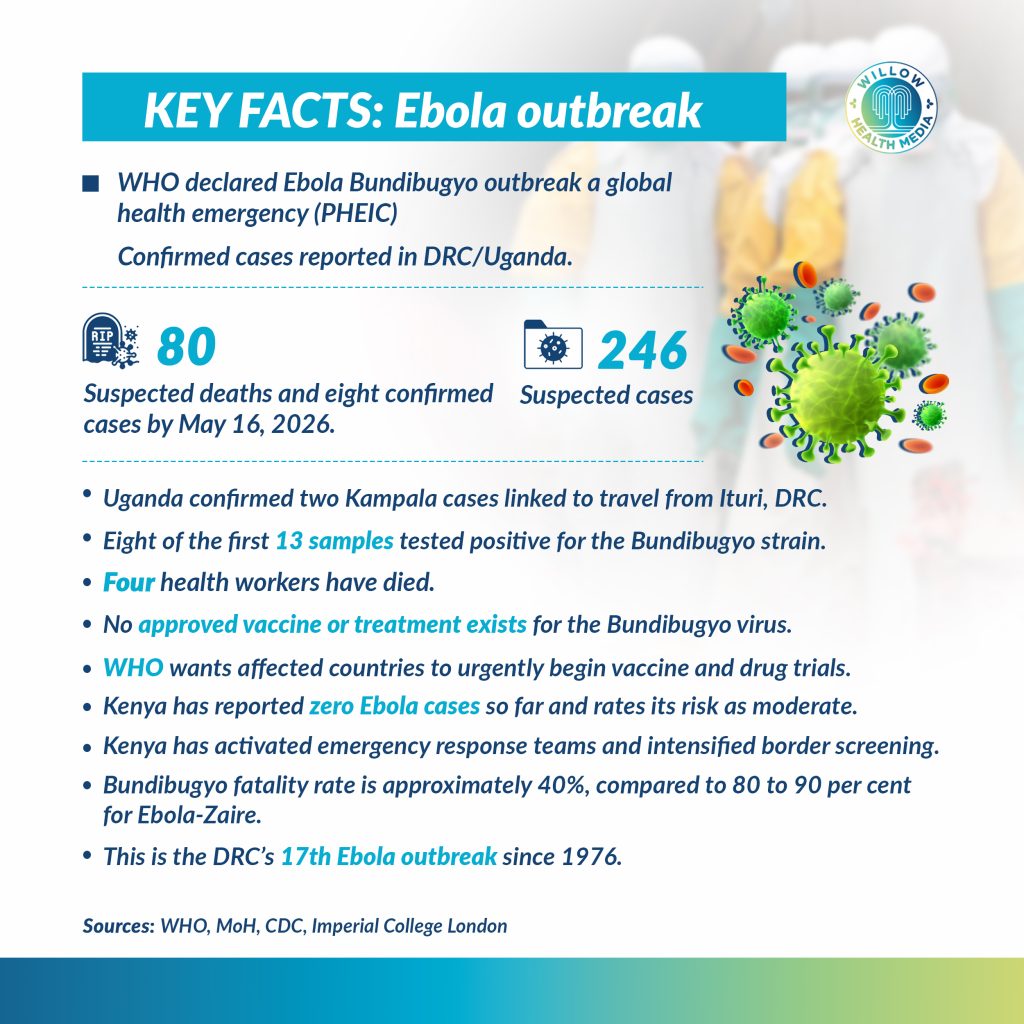
As of May 16, the outbreak stood at 246 suspected cases, 80 suspected deaths and eight laboratory-confirmed cases. It is centred in Ituri Province, spanning the Bunia, Rwampara and Mongbwalu areas.
On 15 and 16 May, Ugandan authorities confirmed two cases in Kampala, both involving individuals who had travelled from Ituri. “Both confirmed cases were admitted to intensive care units in Kampala,” said WHO Director-General Dr Tedros Adhanom Ghebreyesus.
Four health worker deaths have also been reported, raising serious concern about hospital-based transmission.
The Bundibugyo strain presents with symptoms that can appear suddenly: fever, fatigue, muscle pain, headache and sore throat, progressing to vomiting, diarrhoea, rash and, in severe cases, internal and external bleeding. While these signs mirror those of the more familiar Ebola-Zaire strain, the two viruses differ critically in their lethality and treatability.
Bundibugyo carries a fatality rate of about 40 per cent, lower than the 80 to 90 per cent recorded in Zaire outbreaks.
More consequentially for this outbreak, the two approved monoclonal antibody treatments – Inmazeb and Ebanga – were developed specifically for Zaire and offer no protection against Bundibugyo. There are no licensed therapeutics or vaccines for the current strain.
The diagnostic gap compounded the crisis from the outset. Initial laboratory samples tested negative because early field diagnostics were only capable of detecting the Zaire strain, delaying identification of the Bundibugyo variant and allowing the outbreak to grow undetected before the correct tests were applied and the first positive results confirmed on 14 May.
Ongoing conflict in DRC deepening crisis due high population mobility, lack of health facilities
Eight of the first 13 samples tested positive, and WHO warned the true number of infections could be significantly larger than reported. Clusters of community deaths compatible with BVD have been reported across several health zones in Ituri, with suspected cases spreading into North Kivu.
Ongoing conflict in eastern DRC, a deepening humanitarian crisis, high population mobility and a lack of formal health facilities compound the risk, the same conditions that drove the 2018-2020 epidemic in North Kivu and Ituri, which resulted in about 2,280 deaths from at least 3,470 cases, according to UN figures.
WHO has classified Kenya, Tanzania, Rwanda, South Sudan, Zambia, Burundi and the Central African Republic as high risk, directing all to urgently enhance preparedness. “Establish access to a qualified diagnostic laboratory; ensure health workers are aware of, and trained in, appropriate Infection Prevention and Control. Establish rapid response teams with the capacity to investigate and manage BVD cases and their contacts,” the WHO statement read.
Neighbouring countries were further directed to establish national and sub-national coordination mechanisms and to report and manage any detected case within 24 hours. At-risk countries were advised to fast-track approvals for investigational therapeutics as an immediate priority.
For DRC and Uganda, WHO directed the activation of national disaster emergency management mechanisms and the establishment of emergency operation centres under the heads of state. Required measures include enhanced surveillance and contact tracing, infection prevention and control, risk communication, laboratory testing and case management, with communities engaged through local, religious and traditional leaders. “The population should be made fully aware of the benefits of early treatment,” WHO stated.
Cross-border transfer of bodies prohibited, burials to be conducted by trained professionals
No international travel is permitted for confirmed BVD cases or contacts unless part of a medical evacuation. Health workers who were improperly protected face 21-day travel restrictions, and mass gatherings are to be postponed until transmission is interrupted.

Cross-border transfer of bodies is prohibited unless specific legal provisions are in place, while burials are to be conducted by trained professionals with allowances for cultural practices.
Despite the severity, WHO explicitly asked all countries not to close borders or impose trade and travel restrictions. “Such measures are usually implemented out of fear and have no basis in science. They push the movement of people and goods to informal border crossings that are not monitored, thus increasing the chances of the spread of disease,” the agency stated.
National authorities were urged to work with airlines and the transport and tourism industries to ensure adherence to WHO guidance, and to prepare for the evacuation and repatriation of exposed nationals, especially health workers.
WHO Director-General Dr Tedros will convene an Emergency Committee as soon as possible to advise on temporary recommendations for state parties.