




For decades, a lost booklet meant a lost medical history. Kenya’s digital health drive is finally closing that chapter.
Emmanuel Ojiambo remembers when a small hospital booklet could determine how quickly he received care. The 34-year-old from Nambale in Busia County grew up with medical records kept on cards and booklets, with diagnoses, treatments and interventions written down and stored in files that patients often had to carry from one facility to another.

At Busia County Referral Hospital and facilities such as Matayos Sub-County Hospital, Ojiambo recalls spending long periods waiting for records to be retrieved, sometimes without success. His parents guarded their medical cards carefully, since losing one could mean trouble at the next hospital visit. When a file went missing, the patient’s medical history could disappear with it. “Losing those booklets meant losing your entire medical record,” he says.
Today, he walks into a health facility without carrying his medical history in a booklet. His hospital visits, he says, take less time. “The time I spend at the hospital has also reduced significantly. I do not worry about losing my records, not anymore,” he says.
His experience captures the promise behind Kenya’s digital health transformation, in which information that once depended on a physical file can now be stored electronically, retrieved at the point of care and, where systems are connected, shared beyond the facility where it was first recorded.
Dandora Sub-County Hospital in Nairobi uses AfyaKE digital health platform to register patients
After years of digitising individual services and facilities, the country is now putting national infrastructure, standards and governance mechanisms in place to link them together. The harder task is no longer getting facilities to adopt technology, but making the different systems work together reliably, securely and at scale, a challenge that stretches from patient records and referrals to health financing, connectivity and cybersecurity.
At Dandora Sub-County Hospital in Nairobi, clinical officer Winfred Mutheu has seen what that shift means in practice. The facility uses the AfyaKE digital health platform to register patients and maintain electronic health records, allowing clinicians to retrieve information without searching through paper files.

“Having a patient’s full history available at the point of care has transformed how we work; we no longer waste time searching for paper files that can be lost, misfiled, or simply unavailable,” Mutheu says.
The benefit becomes more significant when a patient moves between facilities. “When a patient moves from one facility to another, their record travels with them in the system, so the next clinician can see what has already been done and continue care without repeating tests or missing critical information,” she adds.
For a health system trying to connect thousands of facilities, this is the practical meaning of interoperability: the ability of different systems to work together seamlessly. A referral should carry more than a patient walking through a hospital gate; it should carry the information needed to continue care.
Interoperability helps ensure the right patient info is available to the right doctor at the right time, anywhere
Interoperability may sound like a technical concern, but its consequences are ordinary and personal. It is the difference between a referral that carries a patient’s history and one that sends the patient back to the starting point, and between a laboratory result reaching the clinician who needs it and another form being requested because the first one cannot be found.
“Interoperability helps in ensuring that the right patient information is available to the right doctor or health practitioner at the right time, anywhere,” says Beryl Owaga, a health records officer. “Without interoperability, we just build fancier, more expensive silos,” says Dr Hope Simiyu, a digital health communications adviser.

Kenya has been building the infrastructure meant to support that model. At the 2026 Kenya Health Summit, Health Cabinet Secretary Aden Duale presided over the launch of four documents covering health data governance, digital health architecture, the country’s Digital Health Strategy 2025-2030 and standards for digital health solutions. Together, they set out how health information should be governed, how digital systems should connect and how digital health technologies should be developed and scaled.
In a statement, Duale tied the reforms to accountability, noting that digitalisation is strengthening transparency by streamlining processes, improving traceability, identifying anomalies and reducing opportunities for fraud.
The investment is also physical. Eng Anthony Lenaiyara, Chief Executive Officer of the Digital Health Agency (DHA), said in an earlier interview with Willow Health Media that digitisation is one of the four pillars supporting Universal Health Coverage (UHC). “Digitisation is anchored as one of the pillars of UHC. It is among the four pillars. The government has invested heavily in digitisation of healthcare,” he said.
Kenya is the first African country to have a sovereign health cloud for storing and hosting health data
The DHA says more than 42,000 digital devices have been distributed in public health facilities against a target of 74,000, supporting electronic medical records, patient verification and the processing of Social Health Authority (SHA) claims.
Lenaiyara also points to the establishment of a sovereign health cloud for storing and hosting health data. “Kenya has become the first African country to have a sovereign health cloud. Before, our data didn’t have specialised storage or access. That has changed. It is now stored in line with the 2019 Data Protection Act. Digital infrastructure is a public good,” he affirmed.

The scale of that investment makes the quality of implementation increasingly important. A device does little for a clinician if electricity fails or internet connectivity is unreliable, and a digital record is of limited value if staff are not trained to use the system or if information is entered incorrectly.
Davis Oenga, a health information systems specialist, believes Kenya does not necessarily need to keep adding new technologies. “We have enough technologies. Maybe we just need to expand the already existing ones,” he says.
The expansion has to account for the information itself. Digital systems can make records easier to retrieve, but they cannot correct poor information simply because it has moved from paper to a screen. “If you have wrong things entered in there, it means even at the end of the day you will have wrong things,” Oenga says. “Garbage in, garbage out.”
Electronic records can reduce the loss and physical destruction of files while making previous diagnoses and medication easier to retrieve. Owaga says facilities still have to contend with electricity, internet connectivity, equipment and training gaps, while some health workers remain more comfortable with paper systems.
Risks for digital health records include weak passwords, outdated software, inadequate encryption, poor backups, lost phones or laptops
Those practical problems matter because Kenya’s digital health ambitions extend beyond the consultation room. Electronic information increasingly feeds referrals, community health reporting and health financing. The SHA reports more than 32 million enrolments, while over 10,000 health facilities have been accredited under the new financing framework, bringing an increasingly large share of healthcare transactions into digital systems. The more services that depend on digital information, the more disruptive a weak connection can become.

The risks also change as records become easier to move. Owaga identifies weak passwords, outdated software, inadequate encryption, poor backups, and lost phones or laptops as potential vulnerabilities. A misplaced paper file can disrupt one patient’s care, but a compromised digital system can expose information on many patients at once.
Danstan Akwiri, a cybersecurity consultant and chief executive of Neurobytes, describes the sector’s cybersecurity readiness in one word: “Uneven.” Kenya, he says, is “wiring together a national nervous system for health data faster than we are hardening each of its nodes.” Akwiri argues that security has to be built into the infrastructure rather than added after systems are deployed. “Cybersecurity should be treated as core infrastructure spend, not an optional add-on,” he says.
The same question of durability applies to the country’s growing collection of digital health innovations. Dr Simiyu describes the tendency for promising digital projects to remain confined to pilots as “pilotitis.” A pilot may have dedicated funding, technical support and motivated staff, but a national health system has to survive staff transfers, budget pressures, connectivity problems and changes in leadership. “Strong cross-sector collaboration is non-negotiable,” Dr Simiyu says.
Things are now better. Whenever we go to the hospital, we don’t need to carry any booklets
The government is presenting the new architecture partly as a way out of that cycle. Standards can give different systems a common language, while national infrastructure can provide the connections through which existing platforms exchange information, rather than forcing facilities to start again with every new programme.
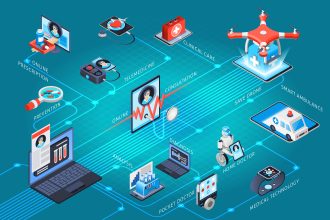
Kenya’s digital health transformation has therefore reached a point where success cannot be judged only by the number of devices distributed, platforms launched or policies published. The more useful measure is whether those investments make a difference along the patient’s journey: whether information can follow a referral, whether a clinician can trust what appears on the screen, whether a claim can be traced and whether sensitive records remain protected.
Oenga describes that process as continuous. “We keep learning. So, we keep adapting,” he says.
Ojiambo does not describe the change in terms of enterprise architecture or data governance. He remembers the frustration of waiting for a missing file. His measure of progress is much simpler. “Things are now better. Whenever we go to the hospital, we don’t need to carry any booklets,” he says.
That is the standard Kenya now has to carry into its next phase of digital health: not simply more technology, but a system in which information can safely move with the patient, clinicians can use it when they need it, and the infrastructure behind it can be trusted to keep working.
We believe in the free flow of information
Republish our articles for free, online or in print, under Creative Commons licence.