Billions pledged for the DRC’s Ebola response remain promises on paper, as the virus crosses borders faster than fragmented global health funds reach the frontlines. With more than 9,000 cases, shrinking aid risks worsening situation, global health leaders warned during the 2026 World Health Summit in Berlin, Germany.
Much of the money donors promised to fight Ebola in the Democratic Republic of Congo (DRC) never reached the country, Africa’s top public health official told global health leaders in Berlin. His remarks exposed deep cracks in how the world pays for health emergencies.
Leaders at the World Health Summit said the funding system is broken into overlapping programmes with little accountability. This, they said, has let the virus stay ahead of the response and spread from the DRC to the United States, Uganda, Europe and now Kenya.
As aid shrinks, they called on countries to take charge of their own health financing.
Africa Centres for Disease Control and Prevention (Africa CDC) Director-General Dr Jean Kaseya said partners reported disbursing $700 million (Ksh91 billion). Yet the DRC government knew of only $160 million (Ksh20.8 billion).
As of October 13, the DRC had recorded 9,066 confirmed cases of Ebola Bundibugyo and 4,381 deaths, according to the Health Ministry’s situation report. On October 14, Kenya announced that a family member of its first imported case had tested positive for the virus. A second family member, a 65-year-old woman, has since tested positive for the virus.
The summit ran from October 11 to 13 under the theme From Crisis to Resilience: Innovating for Health. Reshaping Financing and Governance Across the Global Health Ecosystem was among its six core areas.
Financial discrepancies complicated Ebola response though outbreak was identified on time
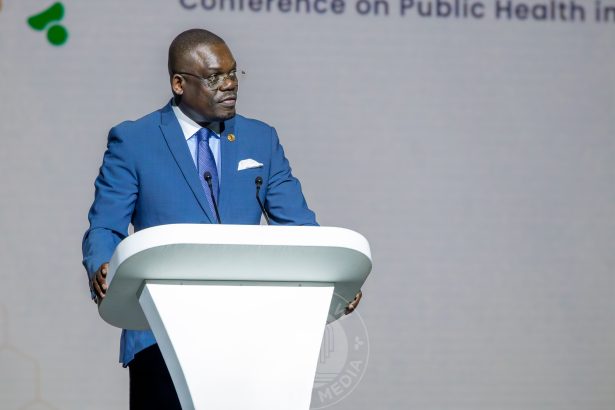
Dr Kaseya spoke during Keynote 3, Pandemic Preparedness at a Crossroads: Financing and Governing Global Health Security. He said financial discrepancies complicated the response even though the outbreak was identified on time.
“How can we translate conversation about Global Financing Architecture, Lusaka Agenda, Accra Reset if the money cannot be translated into concrete action? This contributed to community mistrust because communities could not understand what caused the huge discrepancies,” Dr Kaseya posed.
The Lusaka Agenda seeks to shift power, priority-setting and financing back to national governments, particularly in Africa. The Accra Reset champions rebuilding international development and health cooperation on practical sovereignty. “Ebola is a translation of all recommendations we are making from the Global Finance Architecture, The Lusaka Agenda and the Accra Reset. Concepts that need (to be) implemented quickly,” Dr Kaseya said.
He said Africa CDC declared the outbreak and notified African leaders on May 15. The World Health Organization (WHO) declared it a Public Health Emergency of International Concern (PHEIC) two days later.
“We sent a letter to all African leaders before sending to other partners. We wanted to use domestic resources to address the outbreak and 28 countries, about 50 per cent of African nations committed $130 million (Ksh16.9 billion]) immediately,” Dr Kaseya disclosed.
Countries and donors had pledged $2.997 billion (Ksh389.6 billion) in total, but much of it had not reached the ground
African leaders and WHO developed a response plan within three days of the declaration. “We launched response plan valued at $518 million (Ksh67.3 billion). On June 16, after a meeting led by African leaders, we got a pledge of $1.2 billion dollars (Ksh156 billion) out of which $700 million was reported to be disbursed,” he recounted.

Dr Kaseya said countries and donors had pledged $2.997 billion (Ksh389.6 billion) in total, but much of it had not reached the ground.
On September 23, a G20+ ministerial meeting hosted by the United States in New York announced that the DRC had secured $2.9 billion (Ksh 377 billion). Most of it was donor commitments rather than immediate cash.
“We are making all donors accountable. We want to know where money is going,” Dr Kaseya said. He added that funding gaps kept the outbreak ahead of the response and fuelled cross-border transmission.
Priya Basu is Executive Head of the Pandemic Fund at the World Bank. She called for optimal use of every dollar invested in Pandemic Prevention, Preparedness and Response (PPPR).
The Fund has disbursed $220.6 million (Ksh28.7 billion) to support the response in the DRC, Uganda and the region. “We revolved from preparedness to response by speeding up the work that was already in progress ahead of the Ebola outbreak. It’s indisputable that response done well can help with preparedness in future,” Basu stated.
Official Development Assistance (ODA) is projected to fall by 29 to 46 per cent between 2024 and 2026. That is a reduction of $5 billion to $8 billion (Ksh650 billion to Ksh1.04 trillion). With outbreaks surging, affected countries will need new ways to finance pandemic capacity.
“Our biggest lesson from the Covid-19 pandemic is that the world needs more dedicated financing in PPPR and capacity building to prevent the next outbreak from escalating into a pandemic. Success for us is when the outbreak doesn’t get to the media because it was contained in time,” Basu explained.
The system has not kept pace with shifts in national sovereignty, regional capacity, disease burden, science, digital technology and declining financing
She said grants from multilateral institutions must draw in more money and private sector partners. That way, every dollar is owned by countries, embedded in national health security plans and sustained. “Catalytic financing is our important building block at a time when aid is scarce. So far, for every dollar of grants we have awarded has mobilised four dollars of financing from international partners,” Basu said.
Low- and middle-income countries (LMICs) have raised three dollars for every grant dollar. “We allocated over $600 million (Ksh78 billion) to Africa and the continent mobilised thrice the amount, raising $1.8 billion (Ksh 234 billion),” Basu added.
Roche Pharmaceuticals CEO Teresa Graham said speed in a crisis depends on stable health systems.
“Pre-Covid, our systems were not in good shape. We took a system that was already strange and put a pandemic plan on top of it and broke it. We lost physicians, nurses, a lot of resilience and moved on like nothing happened,” Graham said.
“Everyone is a patient and we need to care how global healthcare systems function. When industry is not at the table, we don’t have an opportunity to be part of the solution. Bring us on the table,” she added.
Dr Kaseya said the Global Health Architecture (GHA) means different things in each region. Multiplying concepts that ignore this, he warned, would slow progress. “In Africa, the Global Health Architecture means more local resources, alignment of partners, local manufacturing and owning our data,” Dr Kaseya said.
WHO has called for GHA reform. It says the system has not kept pace with shifts in national sovereignty, regional capacity, disease burden, science, digital technology and declining financing.
We believe in the free flow of information
Republish our articles for free, online or in print, under Creative Commons licence.