




Eating disorders, comprising binge eating, purging behaviours and bulimia, are the largest single contributors to morbidity, with most university students facing mental health challenges alone.
Valentine Kwega knows what it looks like to be struggling and say nothing. The second-year law student at the University of Nairobi describes a campus life of back-to-back lectures from eight in the morning until five in the afternoon, financial pressure, family expectations and emotional distress that students learn, very quickly, to hide.
“When I came to Nairobi from the village where I came from, the people there are saying, so-and-so’s child went to the University of Nairobi, let us see what they will come back home with,” she told a recent public webinar. “So, society is setting a very, very high standard for students who are at campus, and this makes some of them numb.”

The coping strategy of her generation, she says, is strategic concealment. “We are in a generation where we are told that, oh, life must go on, time waits for no one. So, when I am showing up, I will not show you how I am feeling emotionally.”
Kwega was speaking at a webinar convened by Aga Khan University Hospital’s Brain and Mind Institute, where researchers had just released some of the most detailed data yet on the mental health of Kenyan university students. What the numbers revealed was both sweeping and, for anyone paying attention to campus life, unsurprising.
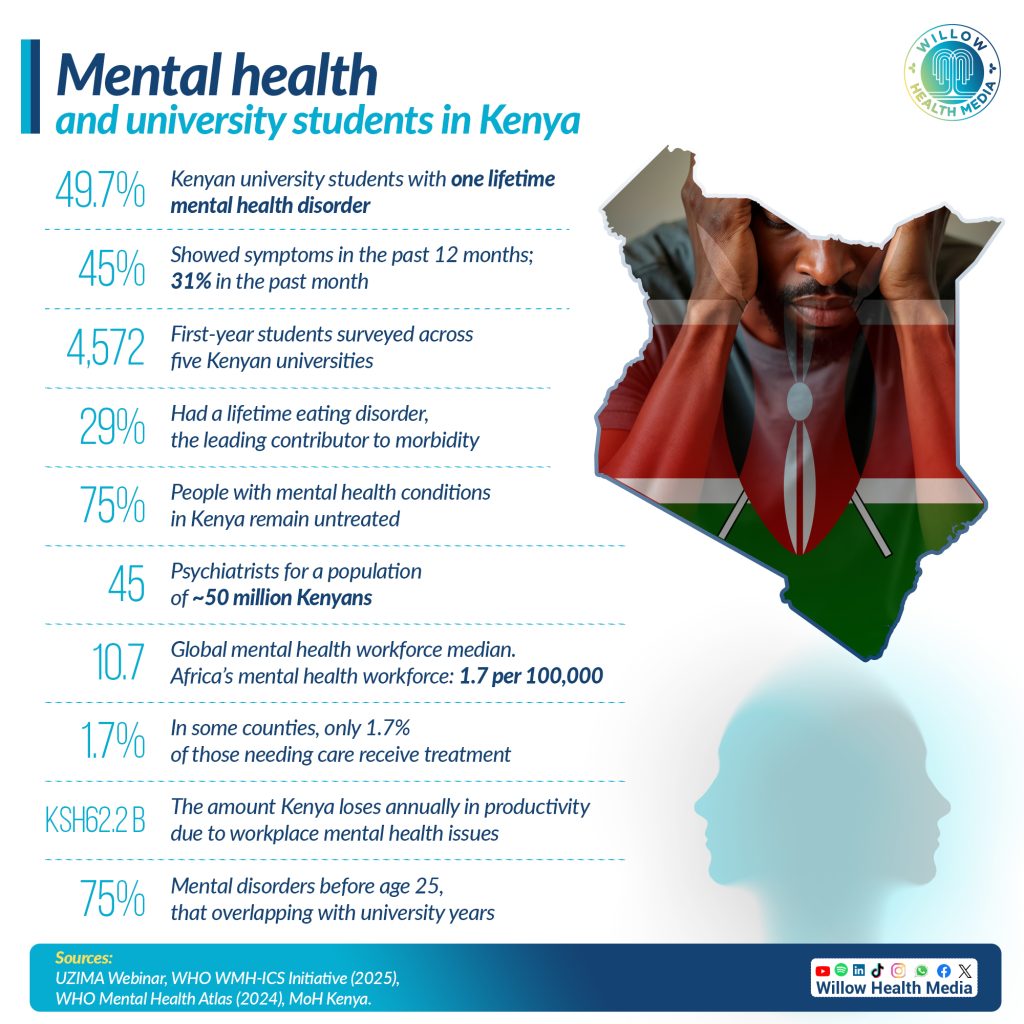
Nearly half of students enrolled at Kenya’s universities meet the diagnostic criteria for at least one mental health disorder over their lifetime, according to the Uzima Data Science Study, a multi-site research initiative spanning the University of Nairobi, Kenyatta University, Moi University, Rakan University and Daystar University.
Some 49.7 per cent of students met the criteria for at least one lifetime mental disorder
Using the World Mental Health International College Student Survey tool, the study recruited 4,572 first-year students and represents one of the most rigorous attempts Kenya has made to understand what is happening inside the minds of its young scholars.
Prof Lukoye Atwoli, the study’s principal investigator and Dean at the Aga Khan University Medical College East Africa, presented the headline figures. Some 49.7 per cent of students met the criteria for at least one lifetime mental disorder. In the past 12 months alone, that figure was 45 per cent. Within the past month, 31 per cent were actively symptomatic.
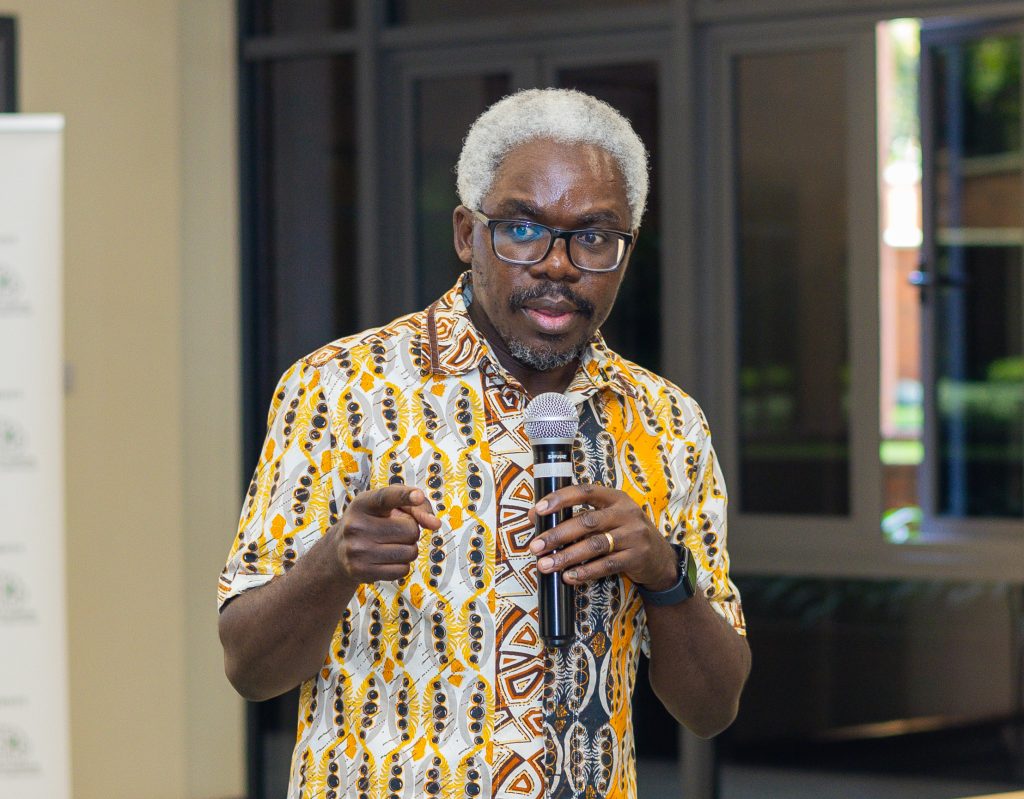
“More than 75 per cent of mental disorders will manifest before the age of 25,” Prof Atwoli told the webinar, “which is the period when most of these young people are at the university.”
For context, the WHO’s World Mental Health International College Student Initiative, which surveyed 72,288 first-year students from 77 universities across 18 countries between 2017 and 2023, found that 65.2 per cent screened positive for lifetime mental disorders and 57.4 per cent for 12-month disorders. Kenya’s figures sit below those global averages in some respects, but that offers little comfort given the scarcity of mental health services available to respond.
The largest single contributor to morbidity was not depression or anxiety. It was eating disorders. Some 29 per cent of students reported a lifetime eating disorder, 25 per cent in the past year and 17.6 per cent in the past month. The categories included binge eating, reported by roughly a quarter of students, purging behaviours at 13 per cent and bulimia at 8.7 per cent.
Social media creates conditions for comparison, idealised body images, amplifies eating disorders
Prof Atwoli described this as a genuine demographic shift. “Eating disorders were more commonly reported in North America and Europe compared to Africa and this part of the world,” he said, “but now there is a homogenisation of culture with social media, with the internet, and so we are seeing a rise in those kinds of disorders today.”

The research literature supports that reading. A 2023 scoping review published in PLOS Global Public Health, examining 50 studies across 17 countries, found that social media creates conditions for social comparison, promotes idealised body images and amplifies eating disorder pathology among young people.
Researchers at University College London concluded that social media use is a plausible risk factor for the development of eating disorders and that the scale of the problem warranted treatment as an emerging global public health issue. A 2024 study in Frontiers in Psychiatry further established that misuse of social media platforms is likely a significant contributing factor to the rise in eating disorder diagnoses, particularly among adolescents and young adults.
Beyond eating disorders, the study found social anxiety in nearly a quarter of students on a lifetime basis, post-traumatic stress disorder in 15 per cent, substance use disorders in 10 per cent and generalised anxiety disorder in 8.5 per cent. Major depressive disorder sat at 3.2 per cent, lower than global averages, though researchers note that depression in this population does not always present in ways that existing measurement tools are designed to capture.
Students in religious activities showed lower odds of meeting the criteria for mental disorder
Two factors stood out as significant in determining risk. Students who participated in religious activities at least a few times a month showed lower odds of meeting the criteria for mental disorder, and the protective effect increased with frequency of participation.
Prof Atwoli offered a measured interpretation. “My own take on this is that frequency of socialisation, being with other people, being part of a community, seems to be something that is protective.” Female gender, by contrast, was a consistent risk factor. Males showed 37 to 41 per cent reduced odds of meeting diagnostic criteria across lifetime, 12-month and 30-day periods, a pattern consistent with global epidemiological data.

The study’s qualitative arm, involving in-depth interviews with around 90 students who had screened positive for at least one disorder, put texture on the statistics. Students described wanting to seek help but fearing judgment. They worried that confidentiality would be broken, that their parents would be told, that their peers would find out. Some had sought professional care and come away feeling worse. Others had simply adjusted their expectations of themselves downwards without ever naming what was happening.
“Many students do not come out to speak about what happens to us,” Kwega said. “We have the fear of judgment, the fear of being dismissed, or the fear of being told, you know, we went through that same thing, why can’t you also go through it in a strong way?”
Dr Caroline Ayuya, Director of Research, Innovation and Entrepreneurship at Daystar University and one of the study’s co-investigators, said the data only tells part of the story. “We are missing the story behind the scope. The data has given us the levels of depression, the levels of eating disorders, but we are missing the story behind this. Each of them is struggling differently, and each of them has a different burden.”
More than half of students reported insufficient sleep, yet universities demanded attendance, submission deadlines, grade point averages
She described a student repeatedly asking for assignment extensions, and another who was active and engaged through orientation week and then simply vanished from the dormitory. “They had had the first five days in a university,” she said. “That is some of the things that you are talking about, the first years coming.”

A 2025 survey by Chegg of 11,706 students across 15 countries found that 44 per cent experienced daily feelings of anxiety and 43 per cent experienced academic burnout. More than half reported insufficient sleep, yet institutional responses in most countries, including Kenya, remain focused on the visible and measurable: attendance, submission deadlines, grade point averages.
The broader national context makes the stakes clearer. Kenya’s Ministry of Health estimates that 75 per cent of people with mental health conditions remain untreated. The country has approximately 45 psychiatrists for a population of roughly 50 million people. In some counties, only 1.7 per cent of individuals with a need for mental health treatment actually receive services. A 2021 study estimated that Kenya loses Ksh62.2 billion annually in productivity due to workplace mental health challenges.
Wellbeing strategist Alice Munyua framed the university’s role within that pipeline directly. “The untreated student mental health challenges represent something more structural: a reduction in starting capacity for every future workforce cohort. One is an annual loss. The other is a baseline shift, and that is what makes it more dangerous.”
Mental health is not just a personal problem but a collective responsibility
Prof Atwoli was unambiguous about what institutions should be doing. “The data is telling us that half of your students have at least one lifetime mental disorder, and up to a third of them have an active, symptomatic mental illness going on with them. And one would think that with such a magnitude of a problem, you would have a corresponding size of mental health services available.” He called on regulators to include mandatory standards on mental health access in university licensing frameworks and recommended screening students at the point of entry.

Dr Ayuya questioned not just whether services exist but whether students trust them. “Universities should not just measure these conditions by looking at whether counselling services exist. We should ask whether the students trust these counselling services, whether they understand them, whether they can access them.”
Munyua’s proposed framework, built around early signal detection rather than crisis response, starts with weekly emotional check-ins, academic pressure mapping and attendance tracking read alongside emotional indicators. “If it cannot be repeated easily, it will not scale, and if it does not scale, it will not sustain,” she says.
For Kwega, the question is simpler and more urgent. “Mental health is not just a personal problem. Mental health is a collective responsibility. The question comes in not as what can we do to help these students, but what can we do to ensure that students are seen, students are heard, and students are helped.”
We believe in the free flow of information
Republish our articles for free, online or in print, under Creative Commons licence.