




Kenya usually has two flu seasons a year, from July to November and February to March. But this year, the flu arrived in January with cases breaking past normal levels in Nairobi, Kisumu, Mombasa and Uasin Gishu- where crowded dwellings and busy matatus make it easy for the virus to spread.
One Tuesday morning earlier this year, Joseph Otinya, a tout along Nairobi’s Dandora/CBD route, was ferrying commuters through Nairobi’s traffic when he noticed a relentless, hacking cough had taken hold of the passengers.
“It was non-stop, like everyone had swallowed sand,” said Otinya, 42, a tout who has worked the Nairobi routes for years. “This is something that could only be noticed from June onwards. It was not normal.”

It was not. What Otinya witnessed has been playing out across Kenya, prompting the Ministry of Health to issue a nationwide public advisory.
Since January 2026, an unusually early wave of influenza -specifically Influenza A – with surveillance data from the Kenya National Public Health Institute (KNPHI) showing public health facilities recorded more than 3,700 acute respiratory infection cases in a single week during early this year, a figure that has remained on the rise into March.
Health authorities have confirmed that the main driver behind the surge is Influenza A, a type of flu virus that tends to cause more severe illness than seasonal flu.
Unlike common flu strains that only infect humans, Omu Anzala, a professor of medical microbiology and immunology, says that Influenza A changes its genetic makeup quickly and can jump from animals, like birds and pigs, to humans.
Kenyan health authorities have detected two variants of the virus circulating in the country. One of them – commonly known as swine flu – has been around for years. The other, a strain first identified in Australia, has been spreading aggressively across the world and is proving particularly difficult to bring under control.

Surveillance data from the Kenya National Public Health Institute (KNPHI), in collaboration with counties, has shown a spike in flu cases reported across the country.
The symptoms troubling many Kenyans are strikingly similar to COVID-19: intense headaches, aching joints, high fevers and fatigue that can linger for more than a week. Despite this, health officials have confirmed there has been no significant concurrent uptick in COVID-19 cases.
“Many people might be tempted to think that they are infected with Covid 19 because the symptoms exhibited by the people who have the flu are quite similar to covid 19 virus,” Dr Anzala notes. However, he says that this is just a seasonal occurrence that will disappear, insisting that people have no reason to worry.
The experience of Mary Wambui, a Nairobi mother from Shauri Moyo, Kamkunji constituency, shows how quickly the virus moves through a home. Her six-year-old son left for school seemingly healthy one morning. By evening, she said, he was coughing so violently that his chest was rattling.
“The following morning, the whole house was coughing,” she recalled.

Children under five are among those most at risk, together with older people, pregnant women and those with long-term conditions such as diabetes or weakened immune systems. The Ministry of Health has warned that these groups face the highest risk of developing serious complications, including pneumonia and respiratory failure.
Kenya’s Director General of Health, Dr Patrick Amoth, issued a formal public advisory on 5 March 2026, confirming that the country is “currently experiencing an increase in influenza cases in several regions.” He described influenza as a viral infection that spreads easily through tiny droplets released when we cough or sneeze, making places like matatus, schools and markets particularly risky.
“As a ministry, we continue to monitor the situation closely through strengthened surveillance and laboratory testing,” Dr Amoth said.
The KNPHI has stepped up monitoring at health facilities across the country. Most affected people, officials stress, recover well with supportive care, rest, fluids and medication to manage fever.

Preventive advice from the ministry includes washing hands regularly, covering the mouth when coughing, wearing a mask in crowded spaces, and staying home when feeling unwell.
Kenya’s seasonal flu patterns are well understood from years of data. The country typically experiences two distinct flu peaks each year: one between February and March, and a second between July and November. The July-to-November wave usually accounts for about 58 per cent of annual cases.
What has concerned health workers this year is that the surge began as early as January – months before Kenya’s usual first peak – and that the number of cases in January alone has already surpassed normal levels for that time of year. Nairobi, Kisumu, Mombasa and Uasin Gishu have historically recorded the highest numbers of cases nationally, a pattern linked to population density and the high volume of travel on public transport.
Research has also shown that flu spreads more easily in Kenya during cooler, drier conditions, which helps explain why cases go up during the rainy seasons.

Kenya is among the most affected countries in East Africa, both in terms of its ability to track the disease and the number of cases it records. A ten-year study of flu outbreaks across 25 African countries mapped the different seasonal patterns of Kenya’s neighbours.
Uganda follows a southern-hemisphere pattern, experiencing a single six-month flu season beginning in June or July. This means Uganda’s main wave arrives months after Kenya’s first peak.
Tanzania’s pattern is closer to the northern hemisphere, with flu activity tending to peak between January and April, meaning it may be experiencing a similar surge in early 2026.
Rwanda presents a more complex picture, with no clear seasonal pattern and generally low numbers of flu cases recorded.
Kenya’s flu tracking system is the oldest in the region – launched in 2006 – which partly explains why its case numbers are higher than its neighbours: it has simply been counting for longer.
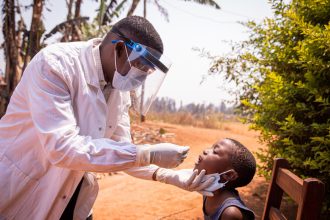
Seasonal flu vaccines are available in Kenya, mainly through private hospitals and clinics, ranging between Ksh2500 – Ksh5000, according to Gavi, the vaccine alliance data. However, take-up remains low, hindered by limited public awareness, cost and poor access outside major cities.
The WHO updates its recommended vaccine recipe each year based on global monitoring, including data from Kenya. The H1N1 (pdm09) strain – first detected in Kenya in 2009 – has remained under close international watch because of its potential to evolve into more dangerous forms.
For now, health authorities are urging Kenyans not to let their guard down. For Joseph Otinya, still driving his matatu through the city each day, the lesson has already been learned.
“I am now wearing a mask every day,” he said. “I cannot afford to be sick, and I cannot afford to make my passengers sick either.”