

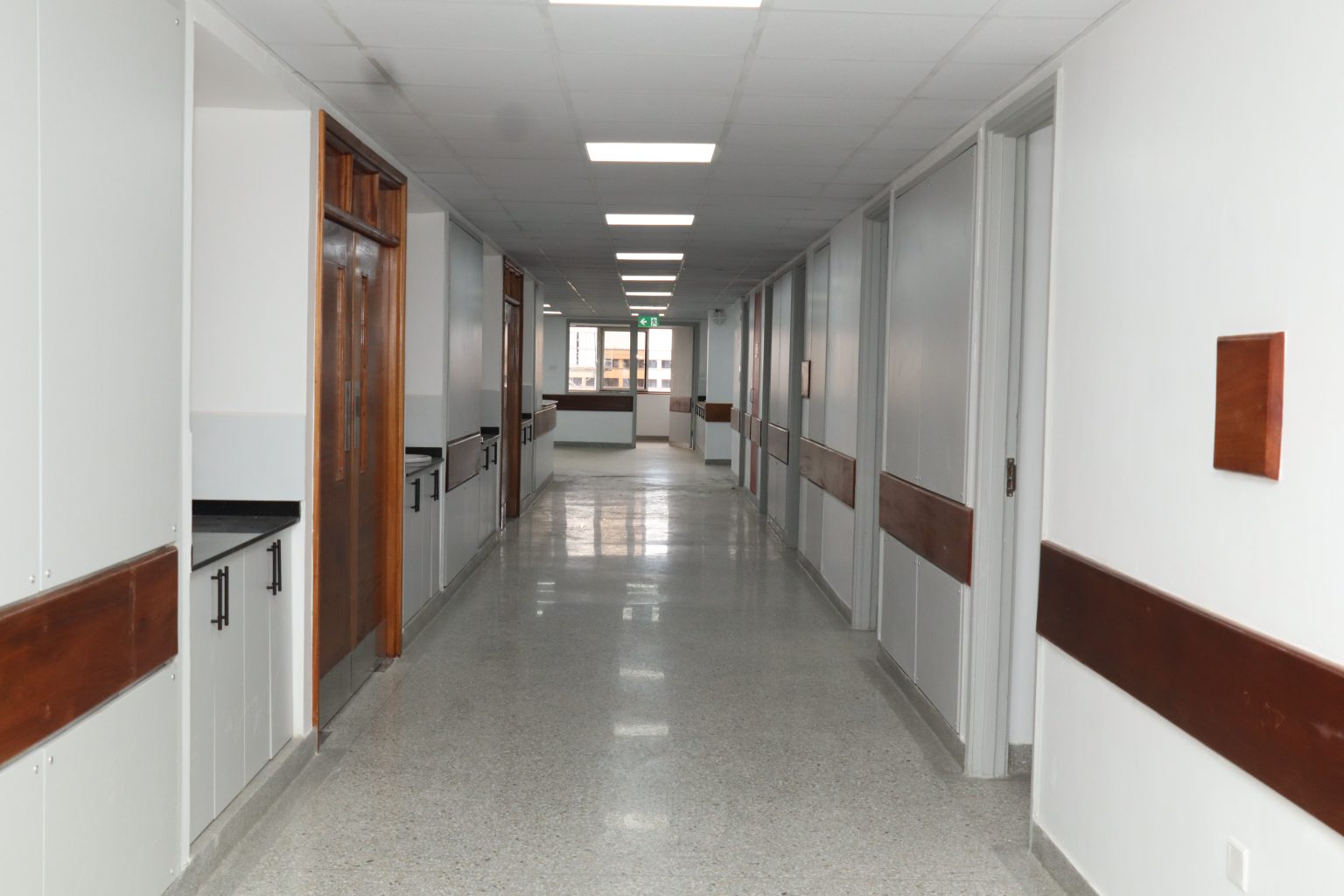

Refurbished washrooms now have tiled walls without cracks, wall-mounted chrome flush systems, and granite sinks with running water, hot showers and mirrors; a world away from the video that shamed the hospital a year ago.
One year ago, a video filmed secretly by a patient inside the maternity ward at Kenyatta National Hospital (KNH) shocked the country. The video showed blocked toilets flooding onto bare floors, crumbling walls, and no sanitary bins, a dire situation that forced new mothers to stuff used pads into cracks in the wall because there was nowhere else to put them. To make matters worse, there were no grab bars for the new mothers to steady themselves on the wet floor, posing a risk of falling and injury.
The exposé by Willow Health Media in May 2025 carried a headline that captured the public outrage. ‘Patients,’ it read, ‘were better off carrying their own potty into Kenya’s largest referral hospital.’ The video went viral, was picked up across newsrooms, and forced an uncomfortable question: how had an institution treating roughly a million patients a year let its most basic facilities fall this far?
Twelve months later, the wards on level five of KNH’s tower block are barely recognisable. Terrazzo floors shine under brand-new lighting. Wood-panelled nurses’ stations line freshly painted corridors. In the same wing is a wall-mounted chrome flush system and a three-basin granite sink with running water, a hot shower and mirrors; a world away from the video that shamed the hospital a year ago.
The transformation is the signature project of KNH Board Chairman Dr Abbas Gullet, appointed by President William Ruto in July 2025, just weeks after Willow’s exposé had gone viral.
“Because it’s needed,” Gullet said bluntly in an interview with Willow’s Dr Mercy Korir, when asked what was driving the renovations. “This hospital, this year, November, will be celebrating 125 years. The tower block where we are in is close to 70 years old, and the entire hospital has 58 wards, and some of these wards are in dire need of refurbishment.”
“There’s this perception always that public hospitals and public institutions are dull, they’re old, they’re not nice, they’re not taken care of, well…”
For Gullet, the anniversary became the trigger for a bigger reckoning with the hospital’s image. “There’s this perception always that public hospitals and public institutions are dull, they’re old, they’re not nice, they’re not taken care of well,” he said. “But if we’re in this serious business, it doesn’t matter whether you’re public or private. We want to compete with the best in this country and in this region.”
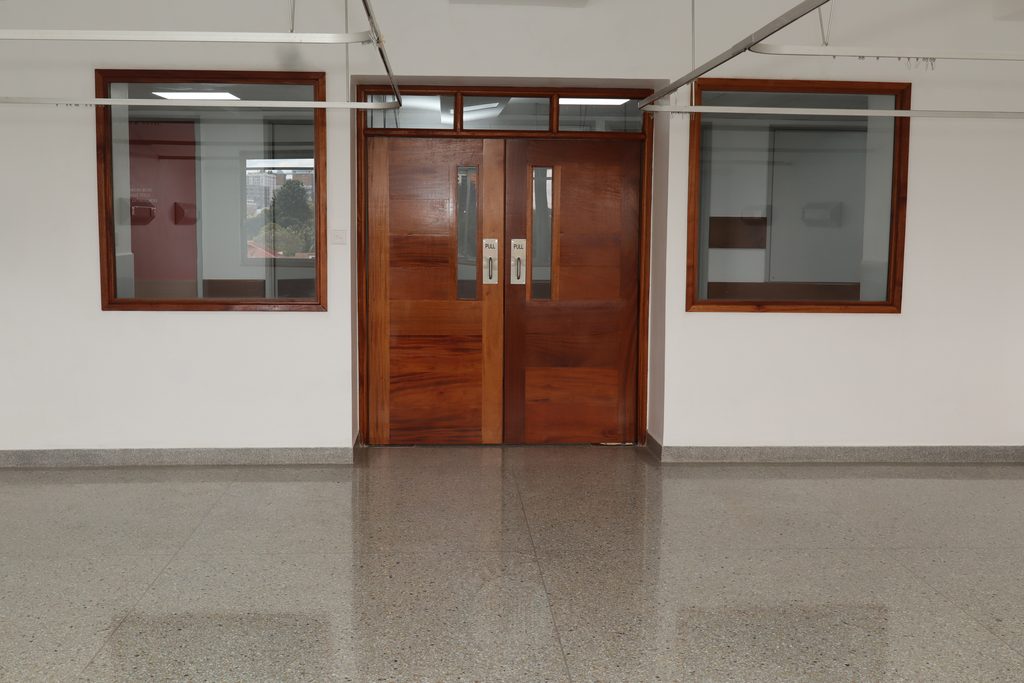
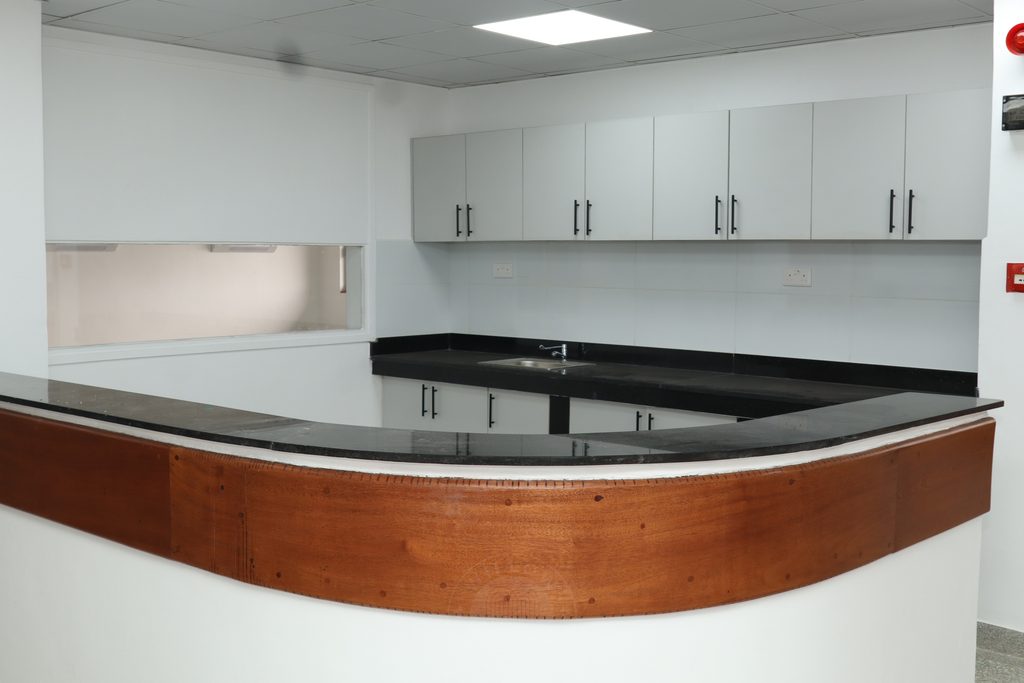
The redesign leans on local materials. “This country has a lot of wood. It’s a healing process too…,” he said, noting that the choice of Terrazzo for the floors is because it is durable, clean, and easy to wash in a hospital setting. Gullet revealed that the entire project is being run by young, local architects, quantity surveyors and designers rather than external consultants, and, more strikingly, by a largely Gen Z team of contractors breathing new life into wards that were once dull and lifeless.
Maxine Wanjiru, Construction Manager at Vinct Engineering Limited, which is renovating orthopaedic wards 6A, 6B and 6D, is one of them. She says her team found the hospital in a dilapidated and “quite depressing” state.
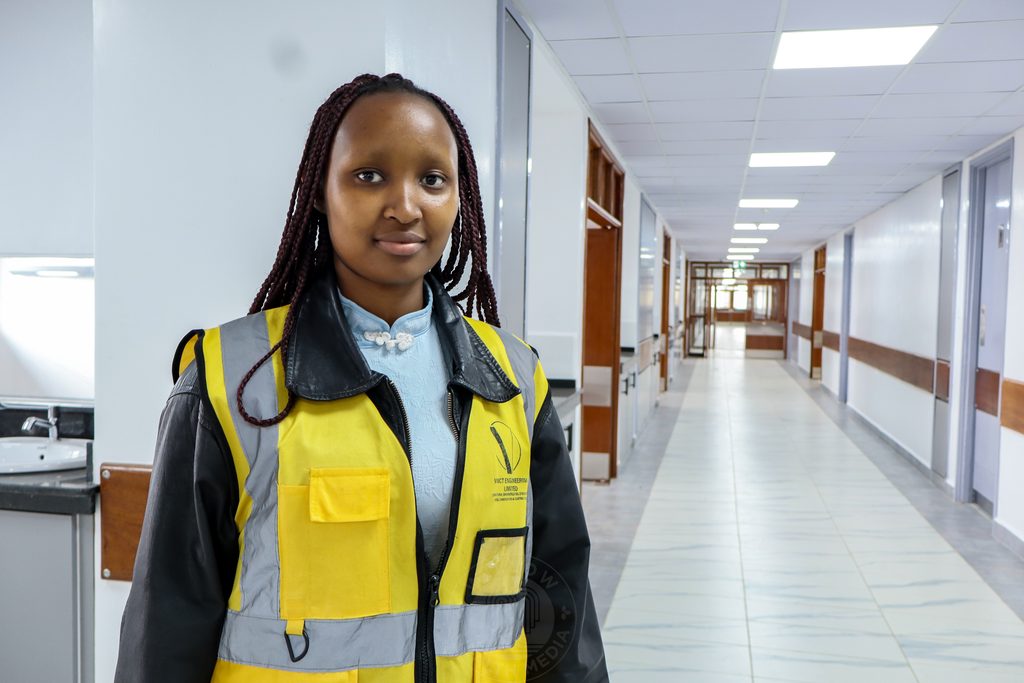
“When we began the project, we found a lot of mixed colours, and a lot of black. So, I think for a patient, that would be quite depressing. Even for visitors. But for us, we decided we don’t want to go with those colours anymore,” she says. “We changed the colours; they are like a burst of sunshine. So, once you get in, it’s bright everywhere. We decided on white and grey, a very light grey. So, once you get in, you feel the brightness.”
Beyond aesthetics, Wanjiru says the team chose materials that clean easily, like grey grouting, terrazzo floors and marble counters. “Healed” is the word she wants a patient to feel stepping into the ward she has redesigned. “For me this has been more than just an opportunity,” she says. “It’s all about humanity and giving sick people a place where they can feel at home.”
What makes the turnaround remarkable is how it was paid for. Gullet, who spent years raising resources at the Kenya Red Cross Society, went straight to the private sector.
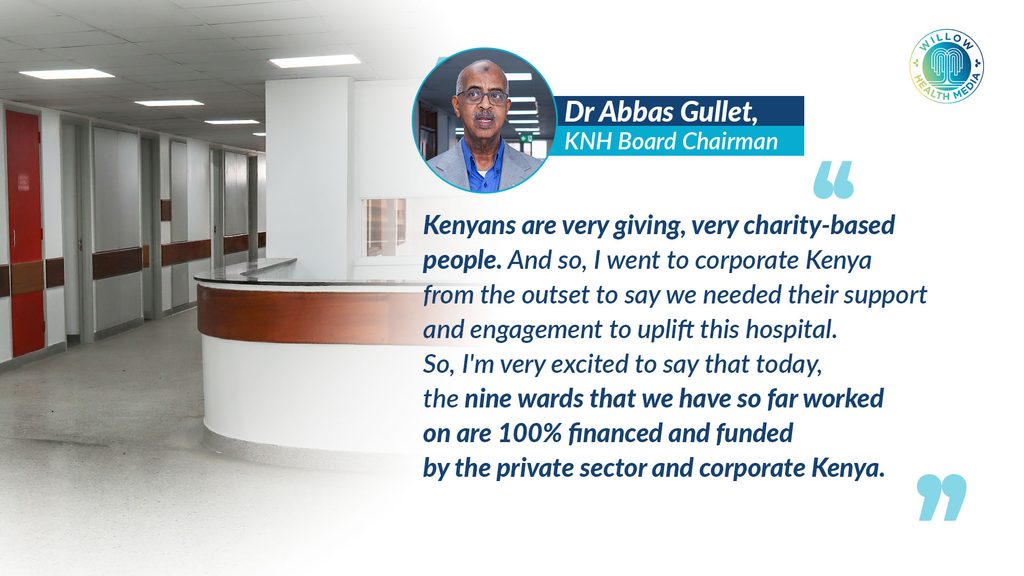
“The nine wards that we have so far worked on (are) 100 per cent financed and funded by the private sector, corporate Kenya,” he said. “What we told them is we were not looking for money to come into the coffers of Kenyatta, but they could adopt a ward.”
Co-operative Bank of Kenya took three wards on level six; a foundation adopted one on level four. Ward 5D, now showcased, was financed by Prime Bank through its Chairman, Dr Rasik Kantaria. A second ward on the same floor went to Equity Bank, honouring its group chairman, Prof Macharia Muthure, who worked at KNH for 35 years as head of ENT.
Safaricom’s M-Pesa Foundation, which had already renovated one ward two years earlier, has now taken on three more at the maternity wing. The Kenya Ports Authority has agreed in principle to fund another. Gullet put the cost of a single ward at roughly Ksh30 million, which covers Ksh20 million for refurbishment and Ksh10 million for equipment, and said he is pressing the Ministry of Health for funding to complete two floors (3rd and 4th) that remain untouched.
KNH’s own staff handle design and supervision, releasing payment certificate by certificate as work is completed, cutting out tender delays
The private financing model, he argued, is also why the work has moved so fast. “Where it may take one year to do a government-funded ward, it takes three months to do this one,” Gullet said. “We haven’t collected any money into KNH coffers. We’ve told them to pay directly, and they are paying directly to the contractors.”
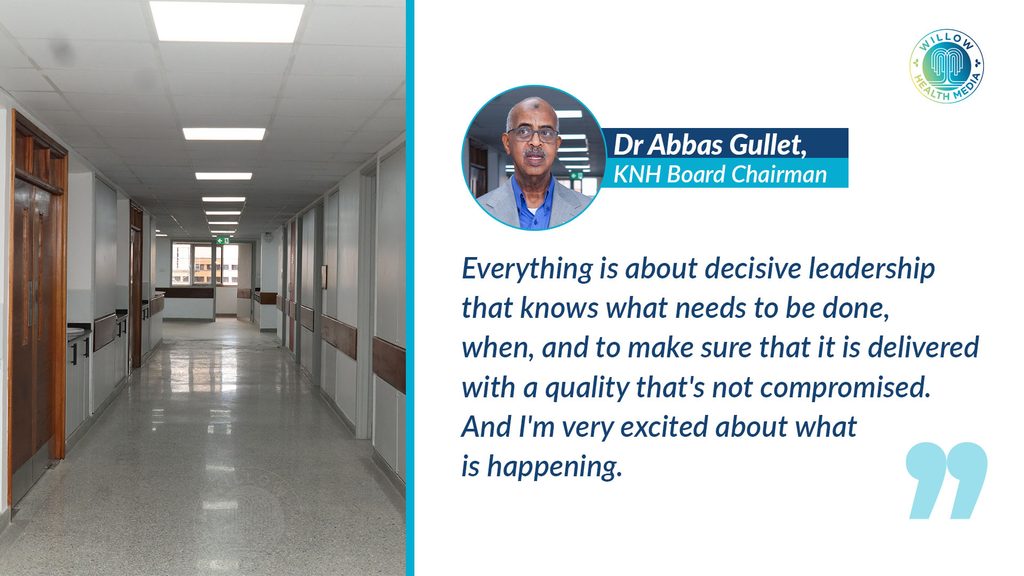
KNH’s own staff handle design and supervision, releasing payment certificate by certificate as work is completed, cutting out the tender delays he says slow down government-funded projects. “Everything in this world is about leadership,” he said, “decisive leadership that knows what needs to be done and by when, and to make sure that it is delivered with a quality not compromised.”
Dr Joel Lessan, KNH Senior Director of Clinical Services, has walked the hospital’s corridors for years and offers a clinician’s view of what the old washrooms meant for patient safety.
“After 70 years of use, there was a lot of wear and tear,” he said. “Most of the infrastructure would have been debilitated extensively, particularly areas which are sensitive, like the washroom areas. They were completely almost… not usable. Almost condemned.”
Beyond aesthetics, he said, the rebuild is about breaking chains of infection: “In terms of infection control, you would find some of the structures need to be removed and put anew, so that you can break the cycle of infections in the units.”
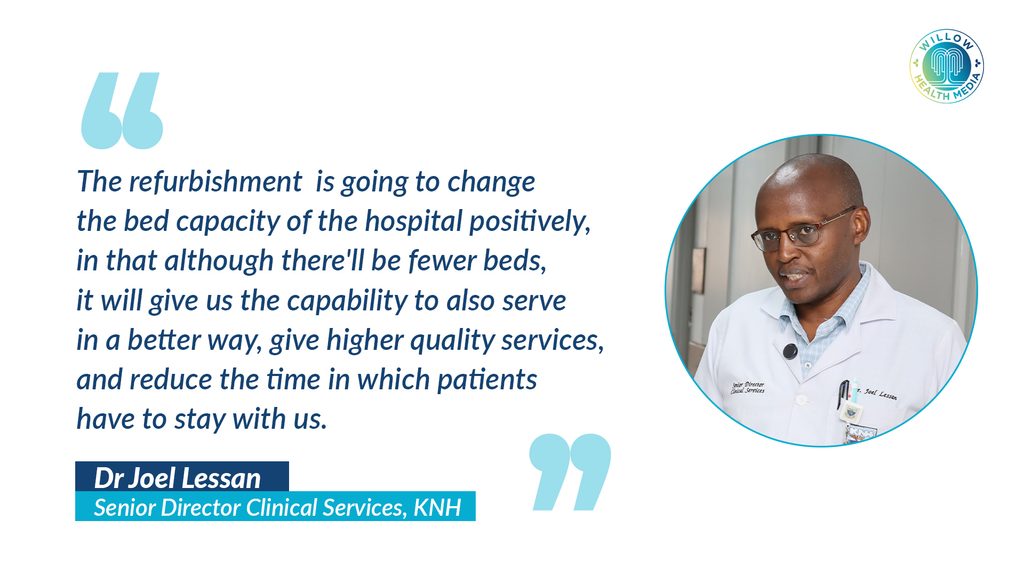
The refurbishment will mean fewer beds, a trade-off both men describe as deliberate. “It’s going to probably change the bed capacity of the hospital, but positively,” Lessan said, “in that there’ll be fewer beds, but it will give us a capability to also serve in a better way, give higher quality services and reduce the time patients have to stay with us.”
Other upgrades include modern diagnostic equipment, renovated theatres and mortuary facilities
Gullet agreed the roughly one million patients KNH sees annually should not fall: “It’s about the quality and the turnaround time. It is possible to even have higher figures than we are currently doing.”
Lessan also pointed to less visible upgrades, including modern diagnostic equipment, renovated theatres and mortuary facilities, that he says will sharpen diagnoses.
“Well-aerated, very clean, very tidy, would make patients happier. Having well-spaced areas with privacy would be a very nice, decent place to give services,” he said.
Lessan credits the pace of change to a Chairman who, unlike his predecessors, showed up on the ground. “Dr Gullet himself would spend the first two months when he arrived here to tour each and every part of this hospital, every corridor, every clinical area, every washroom area. Even the funeral home, he has toured every corner of this hospital,” Lessan said. “Before, we used to have leadership that would be well away from the clinical team.”
He also credits the corporate partnerships for a shift in culture. “Before, we were not seeing people like Equity Bank or Co-operative Bank coming to work with us. This is the first time that we are partnering more with the society in improving the care of the patients”, a change staff are feeling even in wards not yet renovated. “You start seeing a lot of changes even when the construction has not taken place,” he said.
Two floors of the tower block, and two more wards on the ground and first levels, still await sponsors. But for a hospital that a year ago was synonymous with a viral video of flooded toilets and crumbling walls, the wards already delivered mark a visible reversal, one that Gullet frames as unfinished business ahead of KNH’s 125th anniversary in November.
“This is the apex hospital of healthcare in this country,” he said, “and it deserves better than it is today, and we are on the road to getting there.”
We believe in the free flow of information
Republish our articles for free, online or in print, under Creative Commons licence.