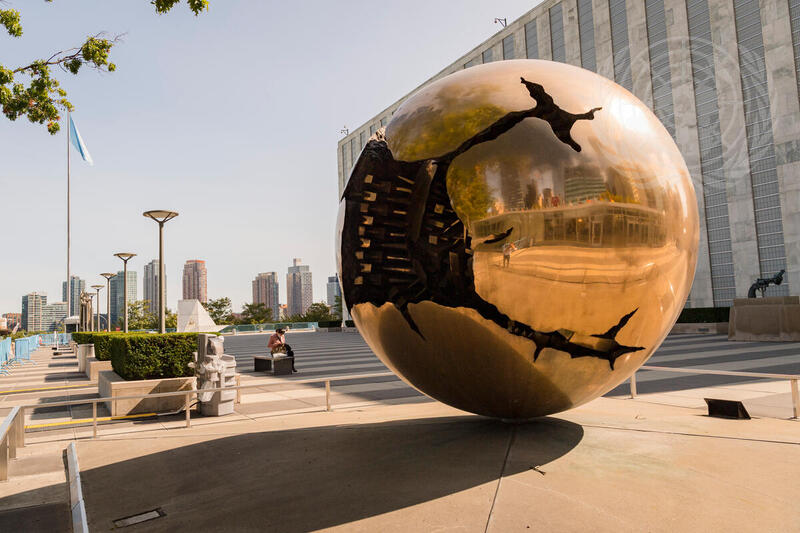

Kenya arrives at the 81st UN General Assembly facing three health crises in the same fortnight. The pandemic treaty is unfinished. Health aid to Africa has diminished. And an Ebola outbreak next door is still climbing by dozens of cases a day.
On September 25, heads of state will meet in New York for the Second UN General Assembly High-Level Meeting on Pandemic Prevention, Preparedness and Response. They are expected to adopt a political declaration renewing support for the Pandemic Agreement, which World Health Organization (WHO) member states adopted in May 2025. But a key part of the treaty, on how countries share disease samples and the benefits that flow from them, remains unfinished four months past its deadline.
The pressure on Africa is mounting. Africa CDC says health aid to the continent has halved in four years, from roughly $26 billion (Ksh3.4 trillion) in 2021 to around $13 billion (Ksh1.7 trillion) in 2025. In the neighbouring Democratic Republic of Congo (DRC), the Bundibugyo Ebola outbreak had reached 7,672 confirmed cases and 3,699 deaths by September 19. There is still no approved vaccine for this strain. Kenya has recorded no cases.
In response, African leaders are pressing for health sovereignty: paying for and producing more of their own care. Meanwhile, climate shocks are adding a second strain on already stretched health systems.
The Pathogen Access and Benefit Sharing (PABS) annex would set rules how countries share virus samples and data
Health Cabinet Secretary Aden Duale has spent the past 16 months making Kenya’s position plain at every forum that would have him. He argues that the country’s stake in a fairer global health system goes well beyond any single clause of any single treaty.
At the 78th World Health Assembly in May 2025, Duale told delegates the newly adopted Pandemic Agreement was a milestone reached only after years of negotiation. “We have managed to achieve a monumental task that was set out before us,” he said, adding that it would leave the next generation better prepared for the emergencies still to come.

That promise now hangs on the unfinished annex. The Pathogen Access and Benefit Sharing (PABS) annex would set the rules for how countries share virus samples and data, and how they share in the vaccines, medicines and tests developed from them. The Intergovernmental Working Group drafting it wrapped its eighth round of negotiations on September 18, having missed its original May 2026 deadline.
Aggrey Aluso of the Pandemic Action Network has argued that without a finished annex, the Agreement has no engine. The deeper problem PABS was meant to start solving, he says, is Africa’s manufacturing gap. The continent carries roughly a quarter of the world’s disease burden yet produces almost none of the vaccines it consumes.
According to the European Centre for Disease Prevention and Control, the DRC’s 7,672 confirmed cases include 886 patients still in isolation. Ituri remains the epicentre, with 5,913 cases and 2,703 deaths across 28 of its 36 health zones. North Kivu, Haut-Uélé, Tshopo, Bas-Uélé and Sud-Ubangi have also reported cases. Altogether, 63 of 167 health zones across seven provinces are affected.
The Abuja Declaration put 15 per cent of national budgets into health. Today, only three of Africa’s 54 countries are on track
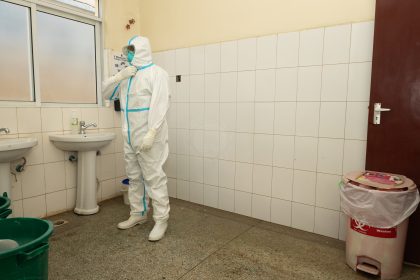
On September 21, WHO allocated 20,000 doses of Ervebo, a vaccine developed for a different Ebola strain, for a research vaccination programme among frontline workers in Ituri. Kenya, meanwhile, has four testing laboratories operational. The outbreak shows how quickly the abstractions of financing architecture and trust deficits become a body count on the ground.
Africa CDC describes the continent as facing an unprecedented financing crisis, as donor governments turn their attention and budgets elsewhere. Its Director-General, Dr Jean Kaseya, has described the funding collapse as “an equally dangerous threat” as the outbreaks it leaves the continent less able to fight. He issued the warning while launching an initiative for African self-reliance in health financing earlier this year.
African governments have long promised to fill the gap themselves. In 2001, African Union states pledged under the Abuja Declaration to put at least 15 per cent of national budgets into health. Today, only three of Africa’s 54 countries, Rwanda, Botswana and Cape Verde, are on track.
That gap has hardened into a political demand this year. The language took shape at the World Health Summit Regional Meeting in Nairobi in April, where the overriding theme was health sovereignty.
‘We don’t have the virus, but we have a political virus,’ said World Health Summit President Axel Pries in describing funding cuts
Prof Lukoye Atwoli, the meeting’s international president, told reporters that the aid system built on the idea of “poor medicine for poor people” was finished. “That era is gone,” he said.
World Health Summit President Axel Pries put it more starkly. “We don’t have the virus, but we have a political virus,” he said, describing the funding cuts as a second wake-up call after Covid-19.
Rosemary Mburu of WACI Health spoke ahead of a separate summit involving President Ruto and French President Emmanuel Macron. She offered the clearest definition yet of what sovereignty should mean in practice. “Sovereignty is a pathway with milestones,” she said, insisting it must be measured in budget lines and functioning systems, not communiqués.
Climate and health financing are increasingly hard to separate. Amref Health Africa has named climate-resilient primary healthcare as one of four pillars of its UNGA81 engagement. The others are health security, sustainable financing and sovereignty, and preparations for the Africa Health Agenda International Conference in Kigali next February.
Amref wants climate and health assessments turned into costed, funded national plans. That way, health facilities can keep delivering basic services when extreme weather strikes, rather than treating climate risk as a problem to address only afterwards.
General Assembly President Khalilur Rahman of Bangladesh named climate action, adaptation and resilience among his six priorities. He pledged to advance the Loss and Damage Fund ahead of COP31 and to “champion greater climate finance for those most vulnerable and on the frontlines of climate impacts.”
For African health systems absorbing shock of donor withdrawal, extreme heat, flooding and shifting disease patterns leave less room to manoeuvre
“The climate crisis cannot be separated from the health of our ocean and biodiversity,” he said. For African health systems already absorbing the shock of donor withdrawal, a second shock of extreme heat, flooding and shifting disease patterns leaves even less room to manoeuvre.
President Rahman also warned that conflicts, fragile development gains and climate impacts had put “trust in multilateralism under tremendous strain,” a deficit he said could only be closed “through dialogue, renewed cooperation and delivery,” and urged member states to pay their UN dues “in full, on time and without conditions,” a crisis of confidence now mirrored in health budgets across Africa.
When the General Debate opened on September 22, Secretary-General António Guterres described a world of deep division, escalating conflicts, climate shocks and a financing crisis for developing nations. His message to leaders was simple: “Come together for peace, for dignity, for justice and for humanity.”
Rahman’s closing line could as easily describe the pandemic talks as the institution he now leads. “Trust cannot simply be requested,” he said. “It must be earned.” For Kenya’s delegation, watching the pandemic treaty, the financing crisis and the climate agenda converge on New York, that is exactly the test the coming days will apply.