



How Kenya’s hospitals are losing their best nurses to a world that pays better, treats them better, and never looks back.
Kenya is training nurses at public expense, only to watch them leave for better-paying jobs in Europe, North America and the Gulf. Hospitals across the country are understaffed, patients are waiting longer, and a new global report warns the trend is worsening, with an emerging threat of AI-generated fake credentials adding fresh danger to an already strained system.
A 2025 Nurse Migration Report by TruMerit reveals a growing global imbalance where rich nations are absorbing internationally educated nurses at record rates, while poorer regions, particularly in Africa, are losing the professionals they need most.

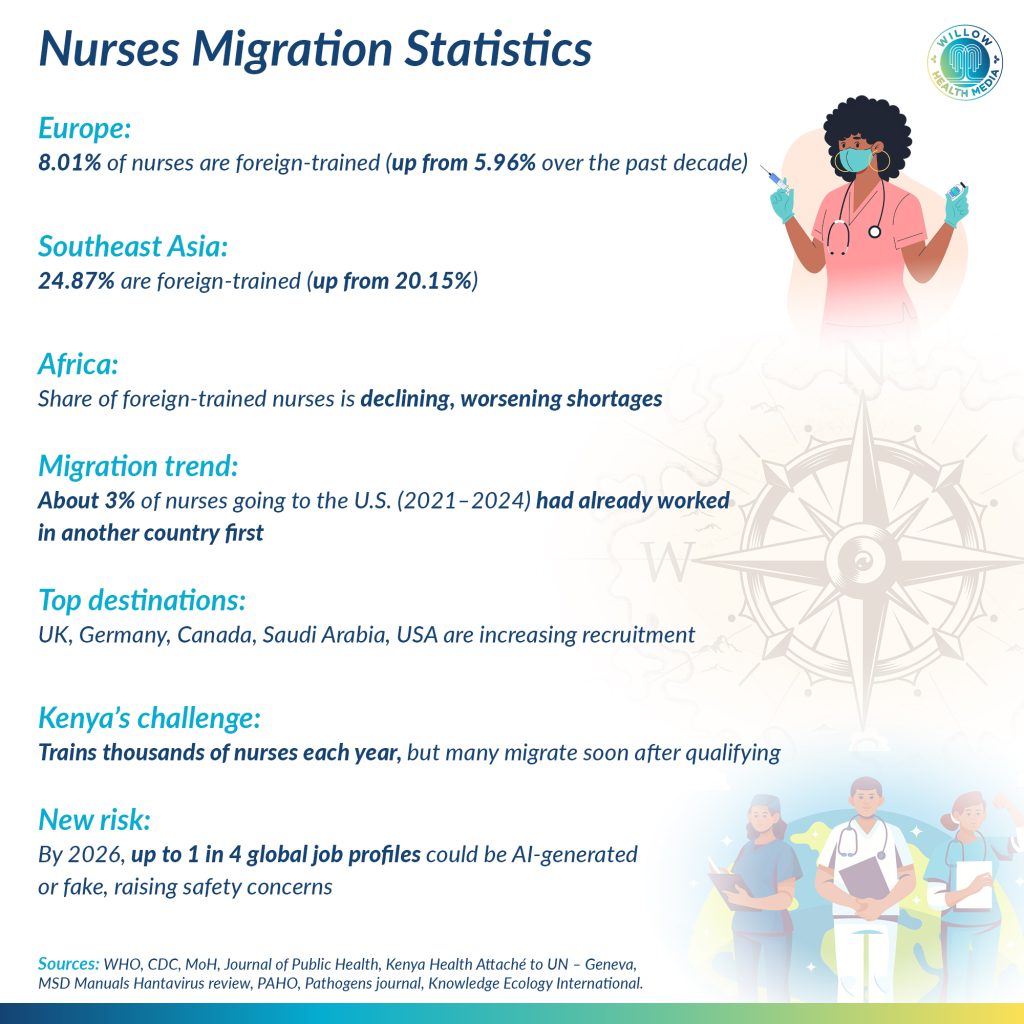
For Kenya, the warning feels painfully familiar. In county hospitals, sub-county facilities, and rural dispensaries, the strain is visible. Nurses work double shifts. Salaries arrive late. Promotions stall. Burnout has become routine, strikes interrupt services, and emergency rooms grow thinner by the day. The United Kingdom, Germany, Canada, Saudi Arabia, and the United States have intensified international hiring drives, with Kenyan and other African nurses increasingly becoming prime targets.
According to TruMerit’s analysis of the World Health Organisation (WHO) nursing workforce data, Europe now employs internationally educated nurses at 8.01 per cent of its healthcare workforce, up from a ten-year average of 5.96 per cent. Southeast Asia has recorded figures as high as 24.87 per cent, against a decade average of 20.15 per cent. Meanwhile, the proportion of internationally educated nurses working in Africa and the Eastern Mediterranean has declined, deepening already severe shortages.
Dr Peter Preziosi, President and CEO of TruMerit, described the findings as revealing “a widening global imbalance,” where stronger health systems were rapidly attracting internationally educated nurses while regions already facing severe shortages were steadily losing the ability to retain “the very professionals they urgently need.”
For many Kenyan nurses, migration is no longer a dream of adventure but a strategy for survival
He said correcting this disparity would require “coordinated action” from both source and destination countries, grounded in ethical recruitment policies, stronger bilateral agreements to offset training costs, and sustained investment in nursing education in underserved regions.
For many Kenyan nurses, migration is no longer a dream of adventure but a strategy for survival. At home, nurses spend years on locum contracts, waiting for confirmation of employment and working without adequate equipment. Abroad, there is structure, predictability, and professional respect. The pull is powerful, and the consequences are devastating.
Kenya spends public resources training nurses through medical colleges and universities, only for many to leave shortly after qualification. It amounts to a silent subsidy to wealthier nations, where poorer countries bear the cost of education while richer countries reap the benefits. The question the TruMerit report raises is uncomfortable but urgent: is Kenya training nurses for its own hospitals, or for export?
The migration is also growing more complex. Between 2021 and 2024, approximately 3 per cent of nurses migrating to the United States had already worked internationally in another country before applying for US authorisation. Many now follow a multi-country path, first to Gulf states such as Saudi Arabia or Qatar, then onward to Europe or North America, making the drain deeper and harder to reverse.
Rodrigo Gouveia, Chief Global Affairs Officer at TruMerit, said the issue went beyond supply and demand. “The data in this report make clear that nurse migration is not simply a matter of supply and demand; it reflects deeper structural inequities in how healthcare education, employment capacity, and healthcare resources are distributed globally,” he said.
Fake nursing credentials, forged qualifications, and fraudulent recruitment pose serious risk to patients
In simpler terms, countries are not losing nurses because nurses want to leave. They are losing them because systems are failing to make staying possible. Ethical recruitment has therefore become one of the most urgent debates in global health policy.
Dr Preziosi argues that destination countries must move beyond simply hiring from abroad and instead participate in stronger bilateral agreements that compensate source countries for training costs and strengthen local nursing education systems. Without that balance, migration stops being an opportunity and starts becoming an extraction.
A new threat is also emerging. The report warns that by 2026, one in four job candidate profiles could be fabricated using AI-generated occupational fraud. Fake nursing credentials, forged qualifications, and fraudulent recruitment systems pose serious patient safety risks. For countries like Kenya, where verification systems are already stretched, the danger is significant. It strengthens calls for tighter international credential checks and stronger professional regulation.
The real story, though, remains in hospital corridors: in the lone nurse struggling to cover an overcrowded neonatal unit, in the mother waiting too long in labour, in the cancer patient whose review was delayed because the clinic was understaffed.