
What Kenya decides now on health funding, leadership and rebuilding trust will determine the quality of its healthcare for years to come.
The retreat of donor funding presents Kenya with a genuine opportunity to redesign how its health system is financed, governed and sustained, panellists said at a joint webinar by Willow Health Media and Strathmore University Business School.
“For decades, Kenya’s health system has been significantly supported by the generosity of partners from outside the country,” said Dr Ahmed Ogwell Ouma, a public health expert, former Deputy Director General of Africa CDC, and current CEO and President of VillageReach. “Donors have funded HIV, malaria, reproductive health, maternal and child health, and immunisation. These partnerships have saved lives and expanded access to millions of Kenyans. But external support carries risk.”

That risk became reality when the United States government suspended significant global health support in January 2025. Programmes built on the assumption of continued external financing were suddenly exposed because the muscle of domestic planning had never been fully developed.
“When someone else is already paying for it, you don’t end up building that muscle internally,” Dr Ogwell said. “And this can be a challenge during times of crisis.”
Kenya, he argued, now stands at a crossroads that offers a genuine opportunity to redesign how health is financed, governed and sustained. The social health insurance framework, blended financing models and stronger accountability systems are not just technical fixes. They are the architecture of a self-reliant health system.
The webinar brought together voices from across Kenya’s health financing landscape
“Kenya’s current moment is not just another crisis,” he said. “It is a turning point, an opportunity to build a health system that is resilient, accountable, and truly owned by its own people.”
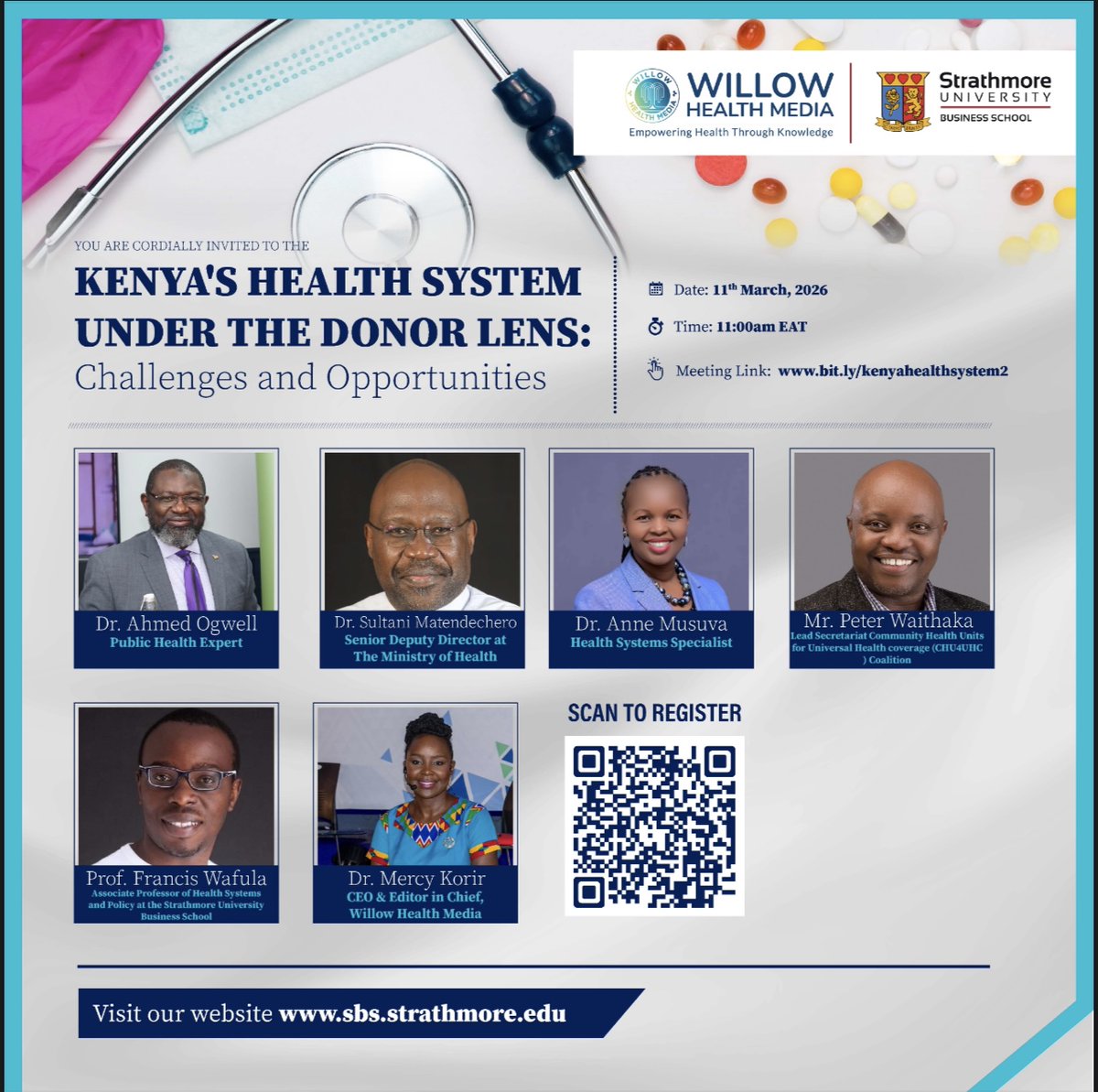
The webinar brought together voices from across Kenya’s health financing landscape. Dr Sultani Matendechero offered insights from government policy and programme coordination. Dr Anne Musuva-Njoroge, acting CEO of the Kenya Healthcare Federation, represented private sector innovation. Peter Waithaka contributed a development partner lens on health financing, while Prof Francis Wafula, Associate Professor of Health Systems and Policy at Strathmore University Business School and Chairperson of the Kenya Health Human Resources Advisory Council, anchored the conversation in evidence and systems thinking.
Together, they explored the misalignment between donor priorities and national health needs. Non-communicable diseases, mental health, and maternal and neonatal health have grown as burdens, even as donor attention has remained concentrated on infectious diseases. Fragmented aid, weak coordination mechanisms and accountability gaps have further reduced the impact of investments.
The collaboration between Willow Health Media and Strathmore University Business School was deliberate and purposeful. Willow, known for its rigorous health journalism and commitment to translating complex health policy into public understanding, identified the need for a structured, evidence-led dialogue that went beyond headlines. Strathmore University Business School, one of East Africa’s most respected academic institutions, brought the intellectual infrastructure, a credible platform for rigorous policy dialogue where evidence, practice and diverse institutional perspectives could meet.
Panel mapped opportunities in governance, in the potential of the social health insurance framework
“At Strathmore, we value creating spaces where important national questions can be examined seriously, openly, and from multiple perspectives,” said Christine Moraa, representing Strathmore University Business School at the opening of the webinar. “Health is one of the most important public issues in any nation.”
“These perspectives do not always engage each other often enough,” she noted, “yet strong policy debate depends on exactly this kind of exchange.”
The webinar was moderated by Dr Mercy Korir, CEO and Editor-In-Chief of Willow Health Media, who framed the conversation around three urgent priorities: donor dependency, domestic resource mobilisation and the long-term sustainability of Kenya’s health systems.
For Willow, the conversation aligned with its founding mission: to produce journalism and dialogue that influences decision-making
The panel mapped opportunities in governance reform, in the potential of the social health insurance framework and in the growing conviction among African institutions that health sovereignty is not an aspiration but a necessity.
For Willow, the conversation aligned with its founding mission: to produce journalism and dialogue that influences decision-making and strengthens public understanding of health systems. For Strathmore University Business School, it reflected a commitment to academic engagement that extends beyond lecture halls into the policy spaces where change is made.
The decisions Kenya makes in the months ahead on domestic financing, on governance and on how it rebuilds trust with both citizens and partners will shape its health system for a generation.